‘Imaginary law-and-order bogey manufactured for political convenience’: Madras HC slams DMK’s political agenda, upholds lighting lamp at Thiruparankundram Hill
The Madurai Bench of the Madras High Court upheld Justice GR Swaminathan’s judgment, which directed the lamp to be lit atop the ancient stone pillar over the iconic Thiruparankundram hill, one of the six abodes of Lord Murugan. The order was pronounced on 6th January by a division bench of Justice G Jayachandran and Justice KK Ramakrishnan. The court expressed strong disapproval towards the “mighty” Dravida Munnetra Kazhagam (DMK) government for its refusal to permit the ritual to be conducted on a designated day annually, claiming it would cause a “disturbance to public peace.” The bench referred to the assertion as “ridiculous and hard to believe” and berated, “Of course, it may happen only if such a disturbance is sponsored by the state itself. We pray no state should stoop to that level to achieve their political agenda,” in a major embarrassment for the government. Appellants fail to provide proof, Waqf Board lacks authority The judges noted that the appellants, which comprised Hazarat Sultan Sikandar Badusha Avuliya Dargah and the state authorities, had not presented compelling evidence that the “Agama Shastra” belonging to the Saivites prohibited the lighting of the lamp at the location, “which is not straight on top of the deity in the sanctum sanctorum.” They added, “Nor it is the case of the Devasthanam or the government that lighting deepam is not a custom prevailing in Thirupankundram Hill.” The court explained that the “stone pillar with a provision to light a lamp, in Tamil, is called Deepathoon.” It mentioned that the pillar is situated in the area of the hill that has been designated as Devasthanam property by a competent civil court, and the Waqf Board has no jurisdiction over this issue as of yet. It then shed light on a devious plea and its role in fostering doubt about the proposal for court-monitored mediation. “For the first time in the course of argument in the intra-court appeals, on behalf of the Waqf, a mischievous submission was made that the lamp pillar belongs to dharga. This plea, we would say, had deterred and added yet another reason for the other side to be sceptical about the offer made by the Waqf Board for court monitoring mediation,” the bench conveyed. It cited an older decision that allowed worshippers to choose another location for Deepam lighting on any other Devasthanam-owned hill, with a 15-meter buffer from the dharga property to protect the site. “The spirit of the direction is to ensure safety. Therefore, we clarify that the distance restriction suggested by the learned judge is not a sine qua non (essential condition) to fix the place of lighting the Deepam. The safety of the dharga property alone is sine qua non while fixing the alternate or additional place of lighting the Deepam lamp,” the court stressed. Significance of religious activities, relevance of lighting Deepam at the stone pillar The bench stated that the best spot to ignite Deepam is the stone pillar, which is situated on a distinct rock summit and beneath the peak where the dharga is situated. The judges also pointed out the purpose of the religious activities and conveyed that it is customary to ignite deepams at vantage spots during Karthikaideepam and other festivals, to ensure that the devotees in the foothills and adjacent areas can witness and worship. They then quoted Saint Thirumoolar, who noted that “the light is personification of Lord Shiva.” The court emphasised that there is no good reason for Devasthanam to disregard the wishes of its devotees when there is a tradition of burning lamps at elevated points that are accessible within the boundaries of its land. Moreover, such demands are not in conflict with public policy or morality. It reiterated a prior verdict to showcase that any activity on the hill, which the statute designates as a protected place, must stay within the acceptable bounds. The court reaffirmed that the hill is a protected area under the Ancient Monuments and Archaeological Sites and Remains (AMASR) Act and maintained that everyone must abide by the act, its regulations and the conclusion reached by Justice R. Vijakumar following a split judgment. DMK government’s fake concern and communal conduct The judges chastised the district administration for its alleged concern about the likelihood of an upset to public order and termed the same as nothing more than a fictitious ghost conjured up for their own convenience. They further stated that the administration incited suspicion and persistent enmity amongst two communities. “By allowing a few persons from Devasthanam to the pillar for lighting the lamp and keeping the devotees stay at the foothill and worship is not an unmanageable task. Projecting as if such a congregation will cause disturbance to peace, stampede, disharmony among the community, etc., is either an exposure of their incapacity to maintain law and order or a hesitation to bring harmony among the c
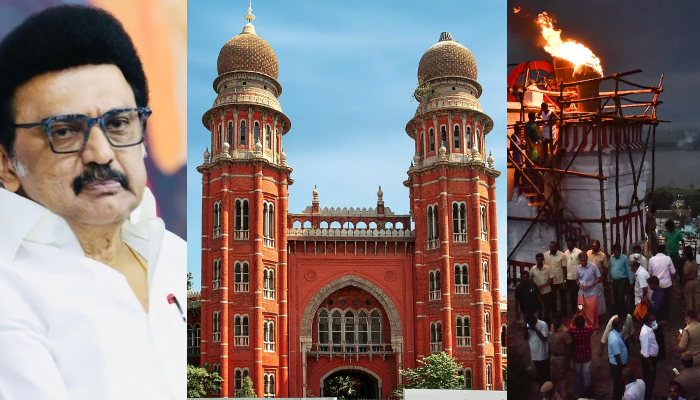

The Madurai Bench of the Madras High Court upheld Justice GR Swaminathan’s judgment, which directed the lamp to be lit atop the ancient stone pillar over the iconic Thiruparankundram hill, one of the six abodes of Lord Murugan. The order was pronounced on 6th January by a division bench of Justice G Jayachandran and Justice KK Ramakrishnan.
The court expressed strong disapproval towards the “mighty” Dravida Munnetra Kazhagam (DMK) government for its refusal to permit the ritual to be conducted on a designated day annually, claiming it would cause a “disturbance to public peace.” The bench referred to the assertion as “ridiculous and hard to believe” and berated, “Of course, it may happen only if such a disturbance is sponsored by the state itself. We pray no state should stoop to that level to achieve their political agenda,” in a major embarrassment for the government.
Appellants fail to provide proof, Waqf Board lacks authority
The judges noted that the appellants, which comprised Hazarat Sultan Sikandar Badusha Avuliya Dargah and the state authorities, had not presented compelling evidence that the “Agama Shastra” belonging to the Saivites prohibited the lighting of the lamp at the location, “which is not straight on top of the deity in the sanctum sanctorum.” They added, “Nor it is the case of the Devasthanam or the government that lighting deepam is not a custom prevailing in Thirupankundram Hill.”
The court explained that the “stone pillar with a provision to light a lamp, in Tamil, is called Deepathoon.” It mentioned that the pillar is situated in the area of the hill that has been designated as Devasthanam property by a competent civil court, and the Waqf Board has no jurisdiction over this issue as of yet.
It then shed light on a devious plea and its role in fostering doubt about the proposal for court-monitored mediation. “For the first time in the course of argument in the intra-court appeals, on behalf of the Waqf, a mischievous submission was made that the lamp pillar belongs to dharga. This plea, we would say, had deterred and added yet another reason for the other side to be sceptical about the offer made by the Waqf Board for court monitoring mediation,” the bench conveyed.
It cited an older decision that allowed worshippers to choose another location for Deepam lighting on any other Devasthanam-owned hill, with a 15-meter buffer from the dharga property to protect the site.
“The spirit of the direction is to ensure safety. Therefore, we clarify that the distance restriction suggested by the learned judge is not a sine qua non (essential condition) to fix the place of lighting the Deepam. The safety of the dharga property alone is sine qua non while fixing the alternate or additional place of lighting the Deepam lamp,” the court stressed.
Significance of religious activities, relevance of lighting Deepam at the stone pillar
The bench stated that the best spot to ignite Deepam is the stone pillar, which is situated on a distinct rock summit and beneath the peak where the dharga is situated. The judges also pointed out the purpose of the religious activities and conveyed that it is customary to ignite deepams at vantage spots during Karthikaideepam and other festivals, to ensure that the devotees in the foothills and adjacent areas can witness and worship.
They then quoted Saint Thirumoolar, who noted that “the light is personification of Lord Shiva.” The court emphasised that there is no good reason for Devasthanam to disregard the wishes of its devotees when there is a tradition of burning lamps at elevated points that are accessible within the boundaries of its land. Moreover, such demands are not in conflict with public policy or morality.
It reiterated a prior verdict to showcase that any activity on the hill, which the statute designates as a protected place, must stay within the acceptable bounds.
The court reaffirmed that the hill is a protected area under the Ancient Monuments and Archaeological Sites and Remains (AMASR) Act and maintained that everyone must abide by the act, its regulations and the conclusion reached by Justice R. Vijakumar following a split judgment.
DMK government’s fake concern and communal conduct
The judges chastised the district administration for its alleged concern about the likelihood of an upset to public order and termed the same as nothing more than a fictitious ghost conjured up for their own convenience. They further stated that the administration incited suspicion and persistent enmity amongst two communities.
“By allowing a few persons from Devasthanam to the pillar for lighting the lamp and keeping the devotees stay at the foothill and worship is not an unmanageable task. Projecting as if such a congregation will cause disturbance to peace, stampede, disharmony among the community, etc., is either an exposure of their incapacity to maintain law and order or a hesitation to bring harmony among the communities,” the bench charged.
It noted that the state, via the district administration, should have seized this opportunity to address the divide between the communities assisted by peaceful and serious negotiation. The court expressed that the peace talks throughout the years have simply served to increase suspicion because of a dearth of conviction.
Afterwards, it hoped that the execution of its directives, which can be appropriately adjusted whenever the celebration in relation to a respective faith occurs, would result in “only light and not any fight.”
The court upholds lighting lamp at Thiruparankundram Hill
The judges announced that the lamp at the Deepathoon needs to be lit by the Devastham. Archaeological Survey of India (ASI) will apply suitable and important conditions alongside the limitations and prohibitions in the AMASR Act to protect the hill’s monuments.
They outlined, “The Devasthanam, through their team, has to light the lamp in the Deepathoon on the event of Karthigaideepam festival falling in the Tamil month, Karthigai. No public shall be allowed to accompany the Devasthanam team.” The number of team members is going to be selected after consulting with the police and ASI, while the event will be coordinated and overseen by the district collector.
“The writ appeals are disposed of accordingly. Consequently, connected miscellaneous petitions are closed. There shall be no order as to costs,” the court concluded.
The legal battle for Hindu rights
The Madras High Court decided that the old stone pillar on Thiruparankundram hill is suitable for lighting the Karthigai Deepam lamp. However, there was opposition due to the pillar’s proximity to the Sikandar Badusha Dargah, and the lamp was usually lit at a different location close to the Uchipillaiyar temple.
Justice GR Swaminathan, however, rejected these arguments and argued that there would be no adverse impact on the rights of the Muslim community or the dargah from burning the lamp at the Deepathoon. Afterwards, a fight broke out between police and Hindu activists after a lamp was lit at the traditional Uchipillaiyar temple mandapam on 3rd November in defiance of the injunction.
Furthermore, the DMK also chose to oppose the order in court, under the guise of law and order issues. On the other hand, petitioner Rama Ravikumar attempted to scale the hill with Central Industrial Security Force (CISF) forces.
However, the state police, under the command of Madurai Commissioner J Loganathan, intervened and stopped them when the Madurai district collector issued prohibitory orders invoking public safety and the law-and-order situation. Hindu Munnani members, together with others, gathered in front of the temple to demand that the lamp be allowed to be lit in the place mandated by the court.
A few individuals also attempted to cross police barricades. A police officer was injured as a result of the jostling and altercation. According to a top Hindu Munnani activist, the temple administration had made “no arrangements whatsoever” to abide by the court’s edict.
The management of the temple had even challenged the former ruling, contending that the action could threaten communal harmony. However, the court responded with a firm instruction that the lamp must be lit by 6 pm or contempt proceedings will begin at 6:05 pm.
“I specifically mandated the jurisdictional police to ensure that the right of devotees to celebrate the event and offer worship at the petition-mentioned site is upheld. The order of this court was not only not complied with but brazenly defied,” slammed Justice Swaminathan after a contempt plea was filed owing to the major transgression.
Nevertheless, the Tamil Nadu government and the Madurai authorities later approached the court to contest the judgement where devotees informed the division bench of Justices G Jayachandran and KK Ramakrishnan that the Hindu Religious and Charitable Endowments Department (HR&CE Department) Commissioner of Tamil Nadu has “undisguised scorn and contempt” for Sanatan Dharma on 17th December.
Senior Advocate S Sriram, who was representing the Hindus, asserted that every time a peace meeting has been called, the temple has been forced to surrender or give up its rights, shutting down any chance of resolution with the help of mediation. He also discussed the illegal occupation of the Thiruparankundram hill, along with efforts to commit animal sacrifice there, rename it to Sikandar Hill and paint it green during an Islamic occasion. It was also mentioned that the state was unable to provide any documentation illustrating that the pillar is not a Deepathoon.
It is noteworthy that opposition leaders even walked out of the Parliament over the matter. Thol. Thirumavalavan, the founder-president of Viduthalai Chiruthaigal Katchi, even labelled Hindu devotees attempting to light a lamp at the Thiruparankundram hill as “terrorists” and demanded that Justice Swaminathan be removed from office. Meanwhile, Members of Parliament (MPs) from the I.N.D.I. Alliance filed a notice of impeachment against the judge for implementing a centuries-old custom and demanding adherence to court decisions.
Madras HC’s landmark precedent to curb state’s penchant for suppressing Hindu rights
The Madras High Court has set a landmark precedent for future cases, despite the efforts of the state machinery to shamelessly suppress Hindu rights and infringe upon their religious rights. The judgment noted that it is the responsibility of the state to maintain law and order, rather than to hinder Hindu devotees from carrying out their beliefs and practices under the pretence of communal harmony.
It has also denounced the perverse interpretation of communal harmony, which is only achieved by attacking the religious freedom of Hindus. Most importantly, the court has called out the malicious intentions of the state government, which aimed to restrict the rights of the Hindu community for the sake of appeasing Muslims.