Inside India’s final push against Naxalism: How roads and security ops are bringing Chhattisgarh’s Maoist strongholds into the mainstream
With the Central government’s deadline of 31st March, 2026, to make India Naxal-Free fast approaching, the final phase of India’s long battle against Naxalism is underway. Over the past two years, security forces have intensified operations across key strongholds, especially in Chhattisgarh, which has remained the epicentre of Maoist activity for decades. At the same time, an equally significant process has also been going on in the background, which is the rapid development of road and bridge infrastructure in some of the most remote areas of Chhattisgarh that was once the state with the highest number of Maoists. This process is not only about infrastructure development but also about establishing peace in those areas which were once dominated by the Maoists. Recent developments signal a major shift The recent developments have indicated that there is a major shift in the situation on the ground. The security forces have stepped up their operations in areas which were once dominated by the Maoists, whereas the infrastructure development projects, which were stalled for years, are now going on in full swing. Union Home Minister Amit Shah had earlier set the 31st March deadline for wiping out Naxalism. Since then, the Centre has been aggressively pursuing a two-pronged strategy, strong military action combined with development initiatives. This approach is now beginning to show results, with many previously inaccessible areas slowly opening up. Raipur, Chhattisgarh: Chief Minister Vishnu Deo Sai says, "Chhattisgarh will definitely be mentioned the most, because a large number of Naxalites were concentrated there, and due to the double-engine government, the willpower of the Prime Minister and the Home Minister, and the… pic.twitter.com/1Jpt7WMkhn— IANS (@ians_india) March 30, 2026 CM Vishnu Deo Sai says ‘Naxalism has ended’ Adding to the sense of momentum, Chhattisgarh Chief Minister Vishnu Deo Sai made a strong statement on 18th March, stating that Naxalism in the state is effectively over. “Naxalism has ended. Only a formal declaration awaits,” he said while speaking to reporters. He added, “It is indeed welcome that due to the strong leadership of our Prime Minister Narendra Modi and the Home Minister, and the courage of our security forces, the government’s commitment to eliminate Naxalism across the country by March 31, 2026, is being fulfilled…” Raipur, Chhattisgarh: CM Vishnu Deo Sai says, "It is indeed welcome that due to the strong leadership of our Prime Minister Narendra Modi and the Home Minister, and the courage of our security forces, the government’s commitment to eliminate Naxalism across the country by March… pic.twitter.com/9rBOXzGfaO— IANS (@ians_india) March 28, 2026 His remarks came during an interaction with 140 surrendered Maoists at the state Assembly. Many of them shared how their lives had changed after leaving the insurgency. According to Sai, some of them said they were now living “safe and dignified lives with their families,” and even celebrated festivals like Holi peacefully for the first time. BRO steps in: Roads and bridges in Maoist strongholds One of the biggest game-changers in this transformation has been the work done by the Border Roads Organisation (BRO). According to a report by The Indian Express, over the last 15 months, the BRO has built 20 Bailey bridges and completed 75 km of road construction in extremely difficult terrain across Maoist-affected districts like Bijapur and Sukma. In November 2024, the BRO was assigned the task of developing a 130-km road network in these districts, areas that had seen some of the worst Maoist violence. The project includes over 10 separate road works that had remained incomplete for years due to constant threats from Naxals. A BRO official highlighted the challenges, saying, “80% of the road projects were lying dormant for over half a decade on account of poor response from local contractors due to constant threat from Naxals.” In the past, Maoists frequently targeted road construction. Equipment was destroyed, contractors were killed, and even security personnel deployed for protection were attacked. As recently as last year, a contractor was killed in Bijapur’s Pamed area. The threat continues even today. Officials revealed that Maoists had planted a 50-kg improvised explosive device (IED) in Basaguda, which was later defused by the CRPF. Tough terrain, faster work Despite these risks, several key projects have been completed in record time. One such project is the Tadapala hill road in Bijapur district. Assigned to the BRO in January 2026, the 13-km road, with nearly 8 km passing through hilly terrain, was completed within just two months. Officials said the road holds strategic importance as it lies along a key route used by Maoists moving between Chhattisgarh and Telangana. The area’s dense forests and steep hills had long provided cover to insurgents. “Given
With the Central government’s deadline of 31st March, 2026, to make India Naxal-Free fast approaching, the final phase of India’s long battle against Naxalism is underway. Over the past two years, security forces have intensified operations across key strongholds, especially in Chhattisgarh, which has remained the epicentre of Maoist activity for decades.
At the same time, an equally significant process has also been going on in the background, which is the rapid development of road and bridge infrastructure in some of the most remote areas of Chhattisgarh that was once the state with the highest number of Maoists. This process is not only about infrastructure development but also about establishing peace in those areas which were once dominated by the Maoists.
Recent developments signal a major shift
The recent developments have indicated that there is a major shift in the situation on the ground. The security forces have stepped up their operations in areas which were once dominated by the Maoists, whereas the infrastructure development projects, which were stalled for years, are now going on in full swing.
Union Home Minister Amit Shah had earlier set the 31st March deadline for wiping out Naxalism. Since then, the Centre has been aggressively pursuing a two-pronged strategy, strong military action combined with development initiatives. This approach is now beginning to show results, with many previously inaccessible areas slowly opening up.
Raipur, Chhattisgarh: Chief Minister Vishnu Deo Sai says, "Chhattisgarh will definitely be mentioned the most, because a large number of Naxalites were concentrated there, and due to the double-engine government, the willpower of the Prime Minister and the Home Minister, and the… pic.twitter.com/1Jpt7WMkhn— IANS (@ians_india) March 30, 2026
CM Vishnu Deo Sai says ‘Naxalism has ended’
Adding to the sense of momentum, Chhattisgarh Chief Minister Vishnu Deo Sai made a strong statement on 18th March, stating that Naxalism in the state is effectively over.
“Naxalism has ended. Only a formal declaration awaits,” he said while speaking to reporters. He added, “It is indeed welcome that due to the strong leadership of our Prime Minister Narendra Modi and the Home Minister, and the courage of our security forces, the government’s commitment to eliminate Naxalism across the country by March 31, 2026, is being fulfilled…”
Raipur, Chhattisgarh: CM Vishnu Deo Sai says, "It is indeed welcome that due to the strong leadership of our Prime Minister Narendra Modi and the Home Minister, and the courage of our security forces, the government’s commitment to eliminate Naxalism across the country by March… pic.twitter.com/9rBOXzGfaO— IANS (@ians_india) March 28, 2026
His remarks came during an interaction with 140 surrendered Maoists at the state Assembly. Many of them shared how their lives had changed after leaving the insurgency. According to Sai, some of them said they were now living “safe and dignified lives with their families,” and even celebrated festivals like Holi peacefully for the first time.
BRO steps in: Roads and bridges in Maoist strongholds
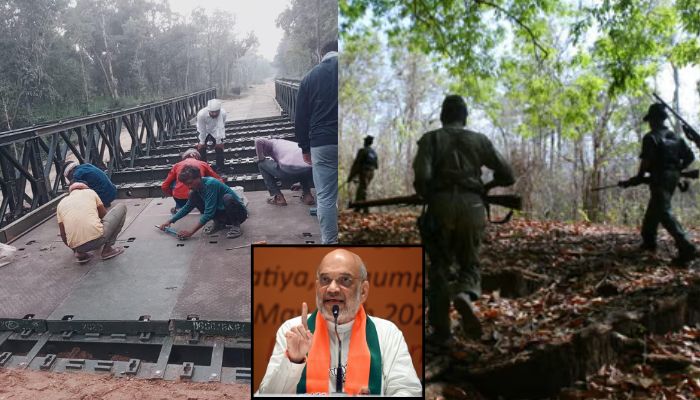
One of the biggest game-changers in this transformation has been the work done by the Border Roads Organisation (BRO). According to a report by The Indian Express, over the last 15 months, the BRO has built 20 Bailey bridges and completed 75 km of road construction in extremely difficult terrain across Maoist-affected districts like Bijapur and Sukma.
In November 2024, the BRO was assigned the task of developing a 130-km road network in these districts, areas that had seen some of the worst Maoist violence. The project includes over 10 separate road works that had remained incomplete for years due to constant threats from Naxals.
A BRO official highlighted the challenges, saying, “80% of the road projects were lying dormant for over half a decade on account of poor response from local contractors due to constant threat from Naxals.”
In the past, Maoists frequently targeted road construction. Equipment was destroyed, contractors were killed, and even security personnel deployed for protection were attacked. As recently as last year, a contractor was killed in Bijapur’s Pamed area.
The threat continues even today. Officials revealed that Maoists had planted a 50-kg improvised explosive device (IED) in Basaguda, which was later defused by the CRPF.
Tough terrain, faster work
Despite these risks, several key projects have been completed in record time. One such project is the Tadapala hill road in Bijapur district. Assigned to the BRO in January 2026, the 13-km road, with nearly 8 km passing through hilly terrain, was completed within just two months.
Officials said the road holds strategic importance as it lies along a key route used by Maoists moving between Chhattisgarh and Telangana. The area’s dense forests and steep hills had long provided cover to insurgents.
“Given the great difficulty level and the BRO’s expertise in hill road construction, it was the natural choice for the project,” an official said.
Construction here was extremely challenging, with landmines, IED threats, and hard rock formations. Yet, the BRO managed to complete the work well ahead of schedule. “Despite this, BRO personnel achieved connectivity to the Tadapala hilltop within two months,” the official added.
Another major achievement was the rerouting of a road connecting Kondapalli village in Bijapur to Puvarti in Sukma, the native village of slain Maoist leader Hidma. This reduced the distance from 38 km to just 9 km.
All-weather connectivity is changing lives
The construction of roads and Bailey bridges has improved connectivity in these regions. Over 20 such bridges have been installed in just eight months.
Explaining their importance, a BRO official said, “A Bailey bridge is a portable truss bridge developed by the British during World War II… it can be quickly assembled and moved.”
These bridges have ensured year-round connectivity, especially during the monsoon when many villages used to get cut off.
Officials say more than 25 villages in Bijapur and Sukma now have all-weather access. This has not only helped security forces but also improved daily life for residents.
Inspector General of Police (Bastar Range) P Sundarraj said, “These regions, which were once extremely remote and difficult to access due to dense forests and poor connectivity, are now gradually becoming more reachable for security forces. The improved road infrastructure has enabled faster movement of troops, better logistical support, and more effective coordination during anti-Naxal operations. As a result, security forces have been able to sustain pressure on Maoist groups, establish a stronger presence in previously inaccessible areas, and respond swiftly to operational requirements.”
Another key stretch, the 20-km road from Kondapalli to Dharmaram, is now operational, with buses already running. This route has reduced travel distance to Telangana’s Bhadrachalam from 270 km to 180 km.
Karegutta hills: Breaking the last stronghold
One of the most crucial developments has taken place in the Karegutta Hills region, considered one of the last Maoist strongholds near the Telangana border.
The BRO has completed around 70% of a key road project connecting the Tadapala hills in this area. The work involved cutting through hard rock for over a kilometre and conducting blasting operations for nearly 25 days.
This road has transformed logistics for security forces. Earlier, essential supplies had to be delivered by helicopters.
“The road project is almost complete, and CRPF troops no longer depend on Air Force helicopters,” an official said. Now, troops can move more easily, maintain a stronger presence, and carry out operations more effectively in the region.
Looking ahead, the BRO has lined up several more projects. Plans are in place to construct eight major bridges across districts like Narayanpur, Sukma, Kondagaon, and Kanker.
“These state-of-the-art modular bridges will be constructed in a short timeframe,” officials said, adding that proposals have already been sent to the Centre.
Additionally, over 10 detailed project reports (DPRs) have been prepared for new infrastructure projects in Maoist-affected regions.
Operation Kagar and the Modi govt’s push for a Naxal-free India
These developments are part of a larger national strategy. In January 2024, the Centre launched Operation Kagar to eliminate Naxalism across states like Chhattisgarh, Maharashtra, Odisha, Jharkhand, Madhya Pradesh, and Telangana.
As part of the operation, about 1 lakh para-military forces, including the Central Reserve Police Force (CRPF), its elite forces CoBRA (Commando Units of CRPF), District Reserve Guards (DRG), and state police forces, armed with modern technology, have been deployed in the areas affected by left-wing terrorism to completely root out the naxal terrorism from its last remaining strongholds.
The success of the centre’s anti-Naxal operation can be judged by the fact that, from 2015 to 2025, the number of Naxal-affected districts reduced from 106 to 18. Of these districts, 12 were considered the worst-affected by Naxalism. However, this number was further reduced to only 6 worst Naxal-affected districts, including Bijapur, Kanker, Narayanpur, and Sukma in Chhattisgarh, West Singhbhum in Jharkhand, and Gadhchiroli in Maharashtra.
On 19th February, Bihar authorities announced that the state is now “Naxal-free” after the surrender of prominent Maoist Suresh Koda, also known as Mustakim, who had a reward of Rs 3 lakh. He surrendered himself to the Special Task Force (STF) of the Munger district police a day ago. It is pertinent to note that the number of districts affected by left-wing extremists (LWE) has also decreased to seven, as per a recent analysis of the affected region.
In January this year, the Centre released a detailed 10-point plan to ensure that areas cleared of Left-Wing Extremism remain peaceful. The plan is meant for the post-Left-Wing Extremism phase and focuses on stabilising districts that have lived through years of violence. It aligns with the development-oriented part of the Cen.
A region in transition
The impact of the security operations and infrastructure development is now visible in the region. Areas which were previously totally inaccessible are slowly becoming part of the mainstream.
The increased connectivity is not only helping the security forces but is also bringing about positive changes in the region. With the development of roads, there is now easier access to schools, hospitals, markets, and government schemes.
Currently, the roads that are being constructed through the forests and hills of Bastar are not just connecting the places; they are also symbolising the transition from conflict to development.