No atta, No electricity, and yet Pakistan ranks higher than India in the 2026 World Happiness Report: Read how such international indexes are a farce
The World Happiness Report 2026 has been unveiled, identifying the Nordic countries as the happiest globally, with Finland, Iceland and Denmark securing the first three spots. The survey, which is released every year around the United Nations (UN) International Day of Happiness, evaluates over 140 nations, based on how people assess their own lives. Interestingly, Pakistan occupies the 109th spot while India is positioned at 118th. Notably, the Islamic Republic which has been grappling with a debilitating economy, characterised by long queues for depleting flour reserves that have led to violence, fatalities and injuries, a severe suppression of its alleged democracy with a former prime minister languishing in prison, relentless terror attacks from the Tehreek-e-Taliban Pakistan and Baloch rebels along with relentless border altercations with neighbours, is deemed happier than the fastest growing economy in the world. Their situation is increasingly dire as a result of the Middle East tensions. This is a country that has faced global humiliation after suffering repeated defeats at the hands of India, both on the battlefield and on the cricket fields. Hence, the ranking can only be considered valid if Pakistanis are detached from their grim reality, living in a fantasy world where everything is perfect or if the report itself is flawed. Of course, their blatant absurdity and impudence, where they win wars on social media and revel in these claims despite the contrasting truth, cannot be overlooked, but the reliability of the methodologies utilised in these surveys also brings forth significant doubts. The craft of impaired methodology According to WHR’s official website, the Cantril Ladder, a single life analysis question, serves as the basis for their happiness score, which is a culmination of five terms: well-being, subjective well-being, life evaluation and satisfaction, alongside affect in relation to a person’s feelings or emotional states. It said that the Gallup World Poll has been gathering the data since 2005, and independent specialists determine this. “The Gallup World Poll collects data throughout the year, taking into account religious observances, weather patterns, pandemics, war, and other local factors,” the publication highlighted. After the calculation procedure was outlined, it elaborated on the sample size, which should evoke special focus. “The number of people and countries surveyed varies year to year but, in general, more than 100,000 people in 140 countries and territories participate in the Gallup World Poll each year. In most countries, approximately 1,000 people are contacted by telephone or face-to-face each year,” it stated. The outcome derived from such a small group, particularly in countries like India, which has the largest population in the world, generate skepticism about its authenticity. How can it mirror the voice or reality of more than 1.4 billion citizens and does this not hold true for any other nation as well? Local opinion polls in India cover more people to establish the credibility of their findings. “To provide a more precise estimate of the average life evaluation in each country, we combine the responses from the last three years. For example, our 2025 rankings are based on combined data from 2022 to 2024. Using a sample size of at least 3,000 reduces random sampling error and allows us to keep countries in the rankings in years when no survey was conducted,” the website declared. However, the declarations fall short because of the limited number of approached individuals. Additionally, not everyone is interviewed face-to-face and answers are obtained over the phone, making it impossible to confirm the respondent’s identity, their comprehension of the inquiry, or the impact of their surroundings all of which play a key role in these exercises. More importantly, how can an opinion poll be a true indicator of factors that demand extensive calculations and details to measure happiness? WHR indicated that some countries excel more than others based on six factors, which consist of “having someone to count on, log GDP (Gross Domestic Product) per capita, healthy life expectancy, freedom to make life choices, generosity and freedom from corruption.” It goes without saying that India is miles ahead of Pakistan in these sectors, even when the intangible inquiries are disregarded. India is the 4th largest economy while Pakistan has relied on financial assistance from the International Monetary Fund, the United States and others for decades. Islamabad is ruled by its corrupt army, either directly or through a puppet government of politicians only keen to remain in power and fund personal bank accounts, while New Delhi is a thriving democracy. The two societies are essentially polar opposites. India leans towards conservatism, while its neighbour is deeply rooted in a strict Islamic ideology, dictating all decisions related
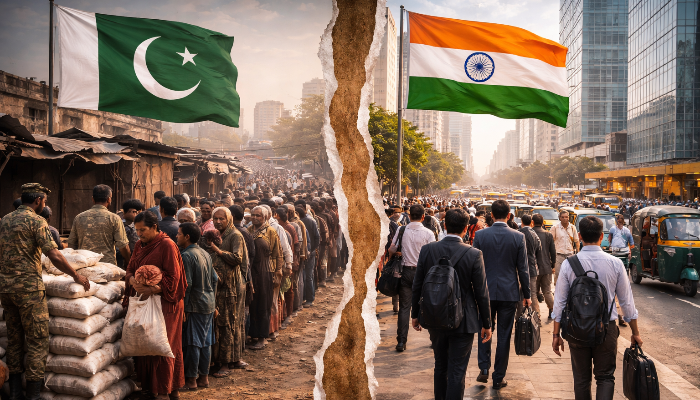
The World Happiness Report 2026 has been unveiled, identifying the Nordic countries as the happiest globally, with Finland, Iceland and Denmark securing the first three spots. The survey, which is released every year around the United Nations (UN) International Day of Happiness, evaluates over 140 nations, based on how people assess their own lives. Interestingly, Pakistan occupies the 109th spot while India is positioned at 118th.
Notably, the Islamic Republic which has been grappling with a debilitating economy, characterised by long queues for depleting flour reserves that have led to violence, fatalities and injuries, a severe suppression of its alleged democracy with a former prime minister languishing in prison, relentless terror attacks from the Tehreek-e-Taliban Pakistan and Baloch rebels along with relentless border altercations with neighbours, is deemed happier than the fastest growing economy in the world. Their situation is increasingly dire as a result of the Middle East tensions.
This is a country that has faced global humiliation after suffering repeated defeats at the hands of India, both on the battlefield and on the cricket fields. Hence, the ranking can only be considered valid if Pakistanis are detached from their grim reality, living in a fantasy world where everything is perfect or if the report itself is flawed.
Of course, their blatant absurdity and impudence, where they win wars on social media and revel in these claims despite the contrasting truth, cannot be overlooked, but the reliability of the methodologies utilised in these surveys also brings forth significant doubts.
The craft of impaired methodology
According to WHR’s official website, the Cantril Ladder, a single life analysis question, serves as the basis for their happiness score, which is a culmination of five terms: well-being, subjective well-being, life evaluation and satisfaction, alongside affect in relation to a person’s feelings or emotional states.
It said that the Gallup World Poll has been gathering the data since 2005, and independent specialists determine this. “The Gallup World Poll collects data throughout the year, taking into account religious observances, weather patterns, pandemics, war, and other local factors,” the publication highlighted.
After the calculation procedure was outlined, it elaborated on the sample size, which should evoke special focus. “The number of people and countries surveyed varies year to year but, in general, more than 100,000 people in 140 countries and territories participate in the Gallup World Poll each year. In most countries, approximately 1,000 people are contacted by telephone or face-to-face each year,” it stated.
The outcome derived from such a small group, particularly in countries like India, which has the largest population in the world, generate skepticism about its authenticity. How can it mirror the voice or reality of more than 1.4 billion citizens and does this not hold true for any other nation as well? Local opinion polls in India cover more people to establish the credibility of their findings.
“To provide a more precise estimate of the average life evaluation in each country, we combine the responses from the last three years. For example, our 2025 rankings are based on combined data from 2022 to 2024. Using a sample size of at least 3,000 reduces random sampling error and allows us to keep countries in the rankings in years when no survey was conducted,” the website declared.
However, the declarations fall short because of the limited number of approached individuals. Additionally, not everyone is interviewed face-to-face and answers are obtained over the phone, making it impossible to confirm the respondent’s identity, their comprehension of the inquiry, or the impact of their surroundings all of which play a key role in these exercises. More importantly, how can an opinion poll be a true indicator of factors that demand extensive calculations and details to measure happiness?
WHR indicated that some countries excel more than others based on six factors, which consist of “having someone to count on, log GDP (Gross Domestic Product) per capita, healthy life expectancy, freedom to make life choices, generosity and freedom from corruption.” It goes without saying that India is miles ahead of Pakistan in these sectors, even when the intangible inquiries are disregarded.
India is the 4th largest economy while Pakistan has relied on financial assistance from the International Monetary Fund, the United States and others for decades. Islamabad is ruled by its corrupt army, either directly or through a puppet government of politicians only keen to remain in power and fund personal bank accounts, while New Delhi is a thriving democracy.
The two societies are essentially polar opposites. India leans towards conservatism, while its neighbour is deeply rooted in a strict Islamic ideology, dictating all decisions related to life, which, if resisted, can lead to severe consequences. The liberty to make personal choices is primarily reserved for the upper class, similar to other resources in the country.
The figures of Pakistani citizens travelling to India for treatment of especially complicated diseases underscore the truth about the defective healthcare system in their country. They are obviously destined to have shorter lifespans than Indians in their doomed homeland. Thus, one might wonder: if Pakistan is lagging behind India in these important aspects, how can it be happier?
Why international indexes are a farce
The issue pertains not only to this instance but also to other international indices notorious for their bias against India. Although it is true that the country faces its own set of challenges that it must confront, these partial surveys have historically overlooked its achievements and improvements over the years, relegating it below some of the worst nations in the world.
The government outlined the same on 15th October 2022, when it dismissed the Global Hunger Report 2022, where India was named after Sri Lanka, Pakistan, Nepal and Bangladesh, charging that the latter had significant methodological shortcomings and an incorrect estimation of hunger.
“Misinformation seems to be the hallmark of the annually released Global Hunger Index. It is an erroneous measure of hunger and suffers from serious methodological issues. Three out of the four indicators used for the calculation of the index are related to the health of Children and cannot be representative of the entire population. The fourth and most important indicator estimate of the Proportion of Undernourished (PoU) population is based on an opinion poll conducted on a very small sample size of 3000,” it observed.
According to the statement, the centre’s efforts to guarantee food security for the populace, specifically during the Covid pandemic, have been purposefully disregarded by the report, which is likewise detached from facts.
“Taking a one-dimensional view, the report lowers India’s rank based on the estimate of the PoU population for India at 16.3%. The Food and Agriculture Organization (FAO) estimate is based on the Food Insecurity Experience Scale (FIES) Survey Module conducted through Gallop World Poll, which is an opinion poll based on 8 questions with a sample size of 3000 respondents,” it added.
Biased analysts and their dubious reports
American sociologist Salvatore Babones also explored the topic in a paper from last year where he examined how the personal favouritism of the “experts” plays a crucial role in these results.
He wrote, “Clear evidence of this can be seen in the evaluations of Indian democracy published by the Varieties of Democracy (V-Dem) Institute. The V-Dem ratings, first published in 2017, have rapidly become the standard reference point for evaluating the world’s democracies, completely eclipsing all other sources in analytical focus and the number of citations.”
“Although the V-Dem ratings rely on a highly sophisticated statistical methodology, they are ultimately based on expert evaluations. And there is strong circumstantial evidence to suggest that the experts who have been consulted by V-Dem have allowed their subjective preferences to shape evaluations that are meant to be objective,” Babones mentioned.
The institution is financed by the sinister George Soros and classified India as an “electoral autocracy,” lower than Nepal in its previous year’s review of democracies. Babones stated that Rashtriya Swayamsevak Sangh and Jamaat-e-Islami Hind were outlawed on the first day of the state of emergency imposed by late Indira Gandhi regime in 1975 until democratic elections were held in 1977. Thousands of their members and all leaders were also thrown behind bars.
“Yet throughout that period, the V-Dem historical database rates civil society repression in India at two points on a scale from 0 (severe) to 4 (none),” he pointed out, sharing the descriptor which alleged that “the government engages in minor legal harassment (detentions, short-term incarceration) to dissuade (civil society organisations) CSOs from acting or expressing themselves.”
The sociologist invoked the V-Dem codebook, which insists, “religiously inspired organisations (if they are engaged in civic or political activities” are part of the civil society outfits and the RSS and JIH and fit within this category. “Clearly and unambiguously, the correct V-Dem coding for India for 1976 should have been one (the government arrests, tries, and imprisons leaders of and participants in oppositional CSOs who have acted lawfully),” he conveyed.
Nevertheless, only one of its five coders provided this precise assessment. “The result is that democracy indices, like those published by V-Dem, inevitably incorporate moral judgments: after all, the judges are human and thus subjective beings,” he aptly concluded which is true for other such indexes as well.
Conclusion
The international indexes undoubtedly have no credibility and are primarily employed as a propaganda asset for preferred nations or governments. They disparage what they disagree with through bogus and misleading methods or outright denial, while bolstering what they support using similar tactics.
This has been particularly true for India since the Modi government took office in 2014. If it is performing exceptionally bad in all other indexes during his tenure, it may very well be among the unhappiest countries to sustain this trend. Who is bothered about trivialities like data and facts, after all?