Is India’s GDP overstated? As a study claims 20 years of ‘misestimation’, read why it is not that straightforward and all conclusive
India’s economic growth has been based on a simple claim for a long time that it is one of the World’s fastest-growing major economies. But in a recent research report, Arvind Subramanian, former chief economic advisor to India, challenges this story, saying that India’s growth may have been greatly exaggerated over the past 10 years. According to the paper, while official data shows steady growth of around 6% but, the reality may differ. Indicators such as credit growth, exports, and investment have slowed sharply in recent years, raising an uncomfortable question: if the economy is doing so well on paper, why does it not feel as strong in practice? The current argument centres on the conflict between official data and economic experience. The report has raised a basic question: are we accurately evaluating India’s economy, or do the numbers simply convey part of the story? What the Report claims According to the research paper titled “India’s 20 Years of GDP Misestimation: New Evidence”, it argues that India’s economic growth over the past 2 decades has been misestimated. According to official data, India grew at around 6% annually between 2011 and 2023, but the paper estimates that the actual growth may have been closer to 4–4.5%. Over time, these gaps increased, leading to the claim that India’s overall GDP could be overstated by roughly 20%-22% and consumption levels by an even higher margin. Basically, the argument centres on two main issues in the calculation of GDP. First, India has a large informal economy, including small businesses, daily wage workers, and unregistered enterprises, which is not directly measured. Instead, official data often uses trends from the formal sector (large companies) as a proxy. According to the paper, it became problematic after 2015, when events such as demonetisation, GST implementation, and the COVID-19 pandemic disproportionately affected the informal sector relative to the formal sector, yet the GDP calculations may not have captured this divergence. Second, the paper points to the use of the Wholesale Price Index (WPI) to adjust for inflation. Since commodity prices declined after 2011, WPI inflation remained relatively low, thereby making real GDP growth appear higher. In simple terms, the paper’s core claim is that if the informal economy were weaker than assumed and inflation were underestimated, then India’s reported growth rate may overstate the true pace of economic expansion. Where the argument falls short While the paper raises important questions, its conclusions are inconclusive and rely heavily on assumptions that are subject to contention. The analysis fundamentally substitutes one set of estimates for another, criticising official GDP calculations for their reliance on proxies, while formulating an alternative estimate based on its own proxies and constrained data. The assertion that GDP is exaggerated is primarily based on discrepancies between GDP and several macroeconomic indicators, including credit, exports, and electricity consumption. But these indicators don’t capture the whole economy, especially in a country like India, where services, digital activity, and structural changes have become more important. A slowdown in some indicators does not automatically imply that overall growth is mismeasured. Moreover, the paper does not adequately account for structural changes in the Indian economy after 2015. It mentions events like demonetisation, GST, and COVID as shocks to the economy, but forgets to mention the formalisation brought by GST, the growth of digital payments, and the shift towards services. According to the report, the main claim that GDP is overestimated by 22 per cent and that the level of real consumption is overestimated by about 31 per cent is also not based on direct measurement but on compounded differences arising from alternative assumptions over time, which introduces significant uncertainty. These limitations suggest that, while the paper highlights potential measurement weaknesses, it does not conclusively establish that India’s GDP growth has been systematically overstated. The counter-view: A debate, not a conclusion It is important to note that the claims that India’s GDP is overestimated have not gone unchallenged. Although similar arguments have been critically examined in the past. An earlier academic paper by economists Ashima Goyal and Abhishek Kumar titled “Indian Growth is Not Overestimated: Mr. Subramanian You Got it Wrong” disagrees with thi argument and points out the major flaws in the method flaws in the method used to question GDP estimates. Indicators such as exports, credit, and electricity consumption question official growth estimates . Their analysis found that these indicators were not reliable predictors of GDP even before 2011, suggesting that their divergence in later years may reflect limitations of the model rather than evidence of mismeasurement. The study f
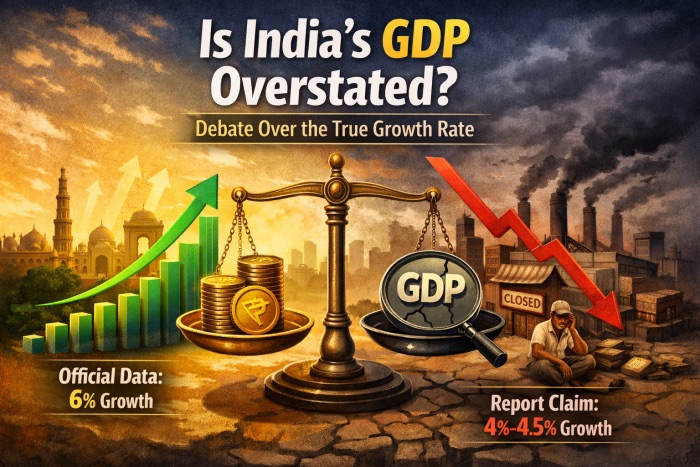
India’s economic growth has been based on a simple claim for a long time that it is one of the World’s fastest-growing major economies. But in a recent research report, Arvind Subramanian, former chief economic advisor to India, challenges this story, saying that India’s growth may have been greatly exaggerated over the past 10 years. According to the paper, while official data shows steady growth of around 6% but, the reality may differ. Indicators such as credit growth, exports, and investment have slowed sharply in recent years, raising an uncomfortable question: if the economy is doing so well on paper, why does it not feel as strong in practice?
The current argument centres on the conflict between official data and economic experience. The report has raised a basic question: are we accurately evaluating India’s economy, or do the numbers simply convey part of the story?
What the Report claims
According to the research paper titled “India’s 20 Years of GDP Misestimation: New Evidence”, it argues that India’s economic growth over the past 2 decades has been misestimated. According to official data, India grew at around 6% annually between 2011 and 2023, but the paper estimates that the actual growth may have been closer to 4–4.5%. Over time, these gaps increased, leading to the claim that India’s overall GDP could be overstated by roughly 20%-22% and consumption levels by an even higher margin. Basically, the argument centres on two main issues in the calculation of GDP. First, India has a large informal economy, including small businesses, daily wage workers, and unregistered enterprises, which is not directly measured. Instead, official data often uses trends from the formal sector (large companies) as a proxy.
According to the paper, it became problematic after 2015, when events such as demonetisation, GST implementation, and the COVID-19 pandemic disproportionately affected the informal sector relative to the formal sector, yet the GDP calculations may not have captured this divergence. Second, the paper points to the use of the Wholesale Price Index (WPI) to adjust for inflation. Since commodity prices declined after 2011, WPI inflation remained relatively low, thereby making real GDP growth appear higher. In simple terms, the paper’s core claim is that if the informal economy were weaker than assumed and inflation were underestimated, then India’s reported growth rate may overstate the true pace of economic expansion.
Where the argument falls short
While the paper raises important questions, its conclusions are inconclusive and rely heavily on assumptions that are subject to contention. The analysis fundamentally substitutes one set of estimates for another, criticising official GDP calculations for their reliance on proxies, while formulating an alternative estimate based on its own proxies and constrained data. The assertion that GDP is exaggerated is primarily based on discrepancies between GDP and several macroeconomic indicators, including credit, exports, and electricity consumption. But these indicators don’t capture the whole economy, especially in a country like India, where services, digital activity, and structural changes have become more important. A slowdown in some indicators does not automatically imply that overall growth is mismeasured. Moreover, the paper does not adequately account for structural changes in the Indian economy after 2015. It mentions events like demonetisation, GST, and COVID as shocks to the economy, but forgets to mention the formalisation brought by GST, the growth of digital payments, and the shift towards services. According to the report, the main claim that GDP is overestimated by 22 per cent and that the level of real consumption is overestimated by about 31 per cent is also not based on direct measurement but on compounded differences arising from alternative assumptions over time, which introduces significant uncertainty. These limitations suggest that, while the paper highlights potential measurement weaknesses, it does not conclusively establish that India’s GDP growth has been systematically overstated.
The counter-view: A debate, not a conclusion
It is important to note that the claims that India’s GDP is overestimated have not gone unchallenged. Although similar arguments have been critically examined in the past. An earlier academic paper by economists Ashima Goyal and Abhishek Kumar titled “Indian Growth is Not Overestimated: Mr. Subramanian You Got it Wrong” disagrees with thi argument and points out the major flaws in the method flaws in the method used to question GDP estimates. Indicators such as exports, credit, and electricity consumption question official growth estimates . Their analysis found that these indicators were not reliable predictors of GDP even before 2011, suggesting that their divergence in later years may reflect limitations of the model rather than evidence of mismeasurement.
The study further showed that when the same methodology is applied to other countries, it produces inconsistent and often implausible results, implying that many economies would simultaneously appear to overestimate or underestimate their growth. This raises concerns about the robustness of such approaches. In addition, the critique highlights issues such as omitted variables, structural differences across economies, and the limitations of using simplified econometric models to replicate a complex statistical exercise like GDP estimation. While this earlier work does not directly respond to the current paper, it underscores a broader point that debates over GDP measurement are not new, and such methodologies have faced substantive criticism before.
Understanding the limits of GDP measurement
At its core, GDP is not a directly observable number but an estimate constructed from multiple data sources, surveys, and statistical techniques. In a country like India, where a significant portion of economic activity occurs in the informal sector, measuring output with precision is inherently challenging. Statistical agencies rely on proxies, periodic revisions, and evolving datasets to improve accuracy over time. Importantly, this is not limited to India; no country measures GDP accurately. All estimates account for trade-offs between data availability and methodological choices, particularly in economies undergoing rapid structural change.
A balanced view
The issues raised in the paper deserve serious attention. It is hard to measure the informal sector, and the choice of inflation measure can change growth estimates. These are legitimate issues that warrant continued scrutiny and improvement in statistical methods. However, moving from these concerns to precise claims of large-scale overestimation requires stronger evidence than what is currently available. While the questions are valid, the certainty of the conclusions may be overstated. But to go from these worries to specific claims of large-scale overestimation, we need stronger proof than what we have right now. While the questions are valid, the certainty of the conclusions may be overstated.
Why this debate matters
The debate over GDP measurement is not merely academic; it has real-world consequences. Economic data shapes government policy, influences investment decisions, and affects how citizens perceive economic performance. If growth is overstated, it may lead to misaligned policy priorities. At the same time, excessive scepticism about official data can undermine institutional credibility and distort public understanding. In a rapidly evolving economy like India’s, ensuring that measurement tools keep pace with structural changes is critical for informed decision-making.
Conclusion
Ultimately, the controversy highlights a deeper issue: an economic measurement is as much about methodology as it is about numbers. The real question is not whether India’s GDP is entirely right or wrong, but whether the methods used to estimate it are keeping pace with a rapidly changing and increasingly complex economy.