Pakistan as the Muslim face of Gaza demilitarisation: How Washington and Jerusalem shift the cost and keep the control
The most recent reports on Gaza’s post-war peace plan follow a well-known pattern, Israel establishes the red lines, the United States builds the architecture, and an army with a majority of Muslims is supposed to provide the troops and withstand the criticism. Reuters has once again highlighted Pakistan in the past 24 hours as a nation that Washington is pressuring to provide troops to a proposed International Stabilisation Force (ISF) for Gaza. The broader plan is specifically focused on reconstruction and ‘demilitarisation,’ a euphemism for dismantling armed groups and permanently decommissioning weapons. At the same time, today’s reports highlight how fragile the ceasefire is and how the next phase, containing an international force and Hamas disarmament, is slipping. According to the Associated Press, the second phase of the ceasefire is meant to involve international peacekeepers and stabilisation, the establishment of new governance mechanisms, disarming Hamas, and additional Israeli troop withdrawals; however, the process is hindered by violence, allegations of violations, and political impasse. The what’s next dilemma is similarly framed by Reuters. Disarmament and international force are essential to the Trump plan, but they are still unresolved, with Hamas opposing disarmament in the absence of political guarantees. Pakistan’s potential involvement in that situation is more important as a geopolitical tool than as a peacekeeping contribution. The nuanced reality is that Pakistan runs the possibility of becoming both (1) the front line enforcer for tasks few Arab states want tied to their own flags and (2) the Muslim legitimacy shield for a coercive security design if it is drawn into Gaza under a framework supported by the United States. In contemporary conflict management, being used takes the form of responsibility flowing downward and control flowing upward. The headlines are about ‘stabilisation’, but the paperwork is about force The idea of ISF is marketed as a stabilising mechanism. However, Reuters’ coverage of the plan’s UN track is direct on the legal framework. According to a draft language that Reuters saw, an ISF would be permitted to employ all necessary measures a basic diplomatic code that permits force to fulfill its mandate. Demilitarisation is a primary goal, according to Reuters’ December planning report, but it acknowledges that the difficult question is how Hamas would be disarmed. This is the first method that powerful governments use on others. While the main architects attempt to keep their own soldiers out of the bomb radius, the mission is publicly presented as humanitarian stabilisation, but the legal and operational architecture keeps the possibility of violence at the center. Additionally, according to an Axios article that Reuters quoted, the Trump administration intended to name a two-star general from the United States to lead the ISF. If the reporting is correct, it shows the hierarchy, outsourced boots, but centralised command influence a setup that lets Washington shape results while allowing other nations to bear the political fallout on the ground. akistan is attractive as a tool, not as a peacemaker Pakistan is being discussed because it satisfies three criteria that mission designers frequently look for. First, the demand for optics: in a region with a majority of Muslims, Muslim troops can be promoted as culturally acceptable, which lessens the perception of Western occupation. Second, the need for capacity: Pakistan’s army is sizable and well-versed in institutional logistics and deployments. Third, the need for political management: Pakistan’s military establishment, which is largely responsible for making security-related decisions, has the authority to make important foreign decisions, even if they are contentious. The final point that Washington may negotiate with a small command circle rather than a wide democratic consensus is reflected in Reuters’ portrayal of Pakistan’s army leader as being under pressure. Given that Gaza is politically poisonous, high-risk, and time-sensitive, this is helpful to the plan’s designers. However, this is precisely where use becomes apparent. Israel offers the security doctrine and veto power; Washington offers structure and international cover, Pakistan offers Muslim legitimacy and manpower, and the troop contributor becomes the face of any coercion. Everyone wants Hamas disarmed, but nobody wants to be the one doing it According to Reuters’ December reporting, international troops could be deployed as early as January as part of a UN-authorised mission, but the disarmament issue remains unresolved. From the perspective of the ceasefire, AP reporting makes the same point, although disarming Hamas and sending in foreign peacekeepers are part of the second phase, the truce is crumbling, and both sides accuse one another of violating it. Assigning the most difficult work
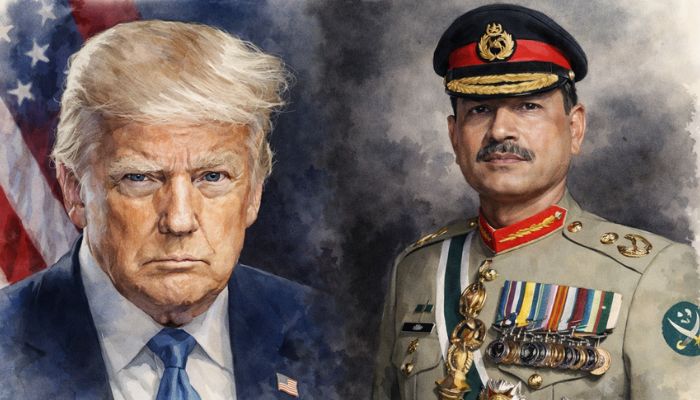

The most recent reports on Gaza’s post-war peace plan follow a well-known pattern, Israel establishes the red lines, the United States builds the architecture, and an army with a majority of Muslims is supposed to provide the troops and withstand the criticism. Reuters has once again highlighted Pakistan in the past 24 hours as a nation that Washington is pressuring to provide troops to a proposed International Stabilisation Force (ISF) for Gaza. The broader plan is specifically focused on reconstruction and ‘demilitarisation,’ a euphemism for dismantling armed groups and permanently decommissioning weapons.
At the same time, today’s reports highlight how fragile the ceasefire is and how the next phase, containing an international force and Hamas disarmament, is slipping. According to the Associated Press, the second phase of the ceasefire is meant to involve international peacekeepers and stabilisation, the establishment of new governance mechanisms, disarming Hamas, and additional Israeli troop withdrawals; however, the process is hindered by violence, allegations of violations, and political impasse. The what’s next dilemma is similarly framed by Reuters. Disarmament and international force are essential to the Trump plan, but they are still unresolved, with Hamas opposing disarmament in the absence of political guarantees.
Pakistan’s potential involvement in that situation is more important as a geopolitical tool than as a peacekeeping contribution. The nuanced reality is that Pakistan runs the possibility of becoming both (1) the front line enforcer for tasks few Arab states want tied to their own flags and (2) the Muslim legitimacy shield for a coercive security design if it is drawn into Gaza under a framework supported by the United States. In contemporary conflict management, being used takes the form of responsibility flowing downward and control flowing upward.
The headlines are about ‘stabilisation’, but the paperwork is about force
The idea of ISF is marketed as a stabilising mechanism. However, Reuters’ coverage of the plan’s UN track is direct on the legal framework. According to a draft language that Reuters saw, an ISF would be permitted to employ all necessary measures a basic diplomatic code that permits force to fulfill its mandate. Demilitarisation is a primary goal, according to Reuters’ December planning report, but it acknowledges that the difficult question is how Hamas would be disarmed.
This is the first method that powerful governments use on others. While the main architects attempt to keep their own soldiers out of the bomb radius, the mission is publicly presented as humanitarian stabilisation, but the legal and operational architecture keeps the possibility of violence at the center.
Additionally, according to an Axios article that Reuters quoted, the Trump administration intended to name a two-star general from the United States to lead the ISF. If the reporting is correct, it shows the hierarchy, outsourced boots, but centralised command influence a setup that lets Washington shape results while allowing other nations to bear the political fallout on the ground.
akistan is attractive as a tool, not as a peacemaker
Pakistan is being discussed because it satisfies three criteria that mission designers frequently look for.
First, the demand for optics: in a region with a majority of Muslims, Muslim troops can be promoted as culturally acceptable, which lessens the perception of Western occupation.
Second, the need for capacity: Pakistan’s army is sizable and well-versed in institutional logistics and deployments.
Third, the need for political management: Pakistan’s military establishment, which is largely responsible for making security-related decisions, has the authority to make important foreign decisions, even if they are contentious.
The final point that Washington may negotiate with a small command circle rather than a wide democratic consensus is reflected in Reuters’ portrayal of Pakistan’s army leader as being under pressure. Given that Gaza is politically poisonous, high-risk, and time-sensitive, this is helpful to the plan’s designers.
However, this is precisely where use becomes apparent. Israel offers the security doctrine and veto power; Washington offers structure and international cover, Pakistan offers Muslim legitimacy and manpower, and the troop contributor becomes the face of any coercion.
Everyone wants Hamas disarmed, but nobody wants to be the one doing it
According to Reuters’ December reporting, international troops could be deployed as early as January as part of a UN-authorised mission, but the disarmament issue remains unresolved. From the perspective of the ceasefire, AP reporting makes the same point, although disarming Hamas and sending in foreign peacekeepers are part of the second phase, the truce is crumbling, and both sides accuse one another of violating it.
Assigning the most difficult work to someone else creates a foreseeable temptation. In this case, Pakistan serves as a Muslim enforcer in two ways. The designers of the plan can assert that this isn’t Israel occupying Gaza, it’s an international Muslim backed force ensuring security, if Pakistani forces take on Hamas or demand disarmament. The same architects can back out if things don’t work out and can state we urged peace, local dynamics turned violent.
Strategic insulation is what that is. Pakistan may be positioned as a moral shield even while being pushed into coercive duties, which is why it is being floated despite its public pro-Palestinian stance.
Pakistan’s own public stance already exposes the trap
Ishaq Dar, Pakistan’s deputy prime minister and foreign minister, stated that his country was prepared to provide troops to a peace force in Gaza, but he specifically stated that disarming Hamas was not his country’s job and distinguished between peacekeeping and peace enforcement.
This is important because a mission cannot be both a force that openly opposes demilitarisation and a force that ensures demilitarisation.
Therefore, when the plan stalls, either the mandate will be modified in practice (making the mission symbolic) or Pakistan will face pressure to do more, first in private and then publicly. Pakistan becomes useful at the pressure point when it is requested to sign up for a benign label and then progressively given coercive duties after it is inside the apparatus.
Historical precedent: Pakistan in the theatre, Palestinians paying the price
When people bring up Pakistan in the Arab-Israeli conflict, they frequently mention Pakistani pilots who served as advisers/volunteers with Arab air forces. When Palestinian armed movements and Arab regimes clashed, stability took precedence, and the Palestinian presence was seen as the issue.
Black September in Jordan (1970), not the 1967 war, is the most obvious and well-documented instance of widespread Palestinian murder by Arab forces, in which military officers with ties to Pakistan are reportedly involved as trainers or advisers. Zia ul Haq is specifically mentioned in a CIA historical assessment that indicates Jordan’s army benefited from Pakistani expertise, which helped reorganise training and prepare for conflict. The number of casualties for Black September varies greatly between sources. Encyclopaedia Britannica describes the event as ‘brief but bloody,’ with estimates ranging from roughly 1,000 to 2,000 in some discussions, while other accounts claim much higher figures; the variation itself is part of the political history.
The same CIA study also documents covert communications between King Hussein and Israeli officials after 1967, including a description of Hussein’s intention to visit Israeli Prime Minister Golda Meir, demonstrating the coexistence of private backchannels and public posture in the same setting. Therefore, the historical warning is this: Muslim regimes have frequently turned their guns inward on Palestinians when stability becomes the top objective, and military networks connected to Pakistan have been implicated in enhancing such regimes’ capability for coercion. The demilitarisation phase in Gaza runs the risk of repeating this cycle.
There are two under-the-radar consequences of that history for the present: When forces presumably supporting the Palestinian cause fight Palestinians, external troop engagement in the name of security can quickly morph into internal repression. The Pakistani establishment has a history of being present in these kinds of situations as advisors and trainers close enough to be relevant but far enough to disavow primary responsibility.
Even though the language used on social media is historically unclear, regional power arrangements have frequently resulted in incidents where Palestinians were slain by Arab forces, sometimes with military involvement connected to Pakistan. Gaza’s demilitarisation phase runs the risk of recreating that dynamic.
Behind the curtain, Israel-Pakistan contacts: denials, loopholes, and selective engagement
According to Dawn, which refuted reports that the clause was eliminated, Pakistan does not formally recognise Israel and even keeps the passport phrase ‘valid for all countries except Israel.’ However, no recognition has never meant no contact.
Documented public contact: The foreign ministers of Israel and Pakistan met in Istanbul in 2005, a historic event that was simultaneously reported by several media outlets and recognised by Israel’s foreign ministry. Dawn has also reexamined this incident, stating that it resulted in more extensive diplomatic interactions during that time.
Claims of covert channels: According to certain investigations, there have traditionally been covert intelligence exchanges between Israeli and Pakistani services, particularly in the context of Cold War-era regional dynamics. These should be regarded as claims rather than gospel since they are disputed and difficult to establish conclusively in public sources.
Current rumors and denials: Pakistan’s information ministry has openly refuted any talks or understandings between the CIA, Mossad, and Pakistan regarding deployments to Gaza, declaring them false, in response to claims made by Indian media and online narratives.
More recently, after a picture went viral, Dawn reported that Pakistan’s Foreign Office claimed to have no information of a Pakistani official interacting with an Israeli tourist ministry official in London. Such a reaction is a classic indication of bureaucratic distance. It is neither an investigation nor a confirmation, but rather just enough ambiguity to limit domestic fallout.
What can we legitimately say about the behind-the-curtain reality?
- Although Pakistan’s stated stance is maximalist (no Israel), it has made high-level contacts when beneficial (2005).
- When allegations of covert coordination jeopardise internal legitimacy, particularly with regard to Palestine, Pakistan responds violently.
- Even if it were done indirectly through intermediaries, a Gaza force would need operational coordination with Israel (movement, airspace, information deconfliction), which would almost certainly lead to hypocrisy.
This is interpreted in India as typical Pakistani establishment behaviour to maintain a pro-Palestine public narrative, maintain pragmatic operational channels, and strategically exploit the divide between the two.
How the US and Israel use Pakistan in the Gaza plan predictably
Step 1: Create a UN wrapper that permits the use of force.
The U.S. draft resolution’s all necessary measures phrasing, as reported by Reuters, demonstrates how the plan seeks legal justification for coercion without referring to it as an occupation.
Step 2: Retain American influence while keeping American soldiers out
Washington avoids direct troop participation while maintaining enormous operational leverage, as demonstrated by the Reuters-cited Axios claim about a U.S. general possibly commanding the ISF.
Step 3: Call for demilitarisation, but leave the physical risk to others.
Demilitarisation is crucial, according to Reuters, which also notes that few nations enjoy sending soldiers to disarm Hamas.
Step 4: Find a Muslim face to both absorb and lessen criticism
Pakistan’s ability to present itself as a Muslim contributor and its internal power structure’s ability to make choices fast make it appealing. Another indication that Washington views Pakistan as a lever rather than a partner with equal agency is the way Reuters presents Pakistan’s predicament in terms of internal backlash vs U.S. pressure.
Step 5: The troop contributor is held accountable if the strategy fails.
The narrative shifts to Hamas refused, the stabilisation force failed, and local actors escalated if disarmament leads to conflict. The enforcer becomes the headline, but the architect stays architect.
By positioning them in the area between ideology and enforcement, where reputations perish, powerful regimes use mid-tier forces in this way.
India’s perspective
India maintains ties throughout the area and has consistently emphasised humanitarian aid, stability, and measured diplomacy in West Asia. However, India has also experienced firsthand the consequences of internationalising and legitimising Pakistan’s security system without holding it accountable.
Expanding its influence networks in West Asia, rebranding Pakistan’s military as a peace provider, and giving it a moral shield (we were there for Palestine), even if its operational engagement turns into coercion against Palestinians, are all possible outcomes of a Pakistan-led role in Gaza.
There is more to India’s deeper interest than just Gaza. It sets the pattern for Pakistan’s army to be acknowledged as a Muslim security contractor, obtaining new sources of financing, prestige, and strategic cover while its Indian subcontinent posture remains unchanged.
Conclusion: the quiet lesson of this entire episode
Pakistan may yet attempt to portray any involvement in Gaza as peacekeeping or moral solidarity. However, the present reporting already depicts a distinct reality, a demilitarised force with Israeli security expectations and a command structured by the United States, looking on Muslim troops to bear the visible load.
Pakistan won’t be in charge of the strategy if it takes on that role. In addition to being required to perform the most difficult tasks that the architects themselves are afraid to perform in public, it will be renting out its uniform to a structure over which it has little influence. History also indicates what happens when an external force imposes stability on Palestinian politics. Palestinians are frequently damaged by forces claiming to be assisting them, while the true creators of the structure remain at a remove.