NYT writes fantasy fiction on RSS , equates the organisation with some ultra-powerful ‘secret society’ that is running India: Read how the Leftist media’s habit of fearful Nazi-labels are detached from reality
On 26th December, the New York Times published an article titled “From the Shadows to Power: How the Hindu Right Reshaped India”. The aim of publishing this particular piece, authored by Mujib Mashal and Hari Kumar, is simple. It is not just a critical piece on the Rashtriya Swayamsevak Sangh (RSS) but a downright attempt to vilify the largest Hindu organisation working tirelessly for the betterment of society. The article constructs a work of ideological fiction that portrays the RSS as a shadowy, near-omnipotent “far-right” secret society, in other words, the “illuminati” of India. If the article, or, as a matter of fact, other such articles published by the NYT or other Left-liberal media houses, are to be believed, the RSS has “infiltrated” India’s institutions and is quietly dismantling the country’s secular republic. Source: NYT The issue is not that the NYT or any other media outlet criticises the RSS. It is well within their rights to question organisations that operate in India and influence the political landscape of the country. However, the issue is how it is being done. The loaded language, selective history, and insinuations that have replaced evidence, everything that these articles contain showcases a familiar Left-liberal narrative. It is a narrative that treats Hindu self-organisation itself as something inherently sinister, as if Hindus are the ones blowing themselves up, and the secular fabric of the country, while chanting religious slogans. ‘Far-right’ as a shortcut, not an explanation The article published by the NYT repeatedly brands the RSS as a “far-right Hindu nationalist group”. It is a term borrowed wholesale from Western political vocabulary and applied without contextual explanation. The concept of the far-right is completely different in India and in Western countries. In India, the RSS is neither a political party nor a clandestine militia. It is a volunteer-based cultural organisation that has existed openly for a century. Source: NYT Yet “far-right” is used as a conclusion, not an analytical category. Once the Western concept of the far-right is applied to an Indian organisation, it absolves the writer of the responsibility to engage with Indian social realities. Everything that follows, from mass mobilisation to ideological influence, is automatically framed as extremism. Nazi labels without saying ‘Nazi’ The New York Times article does not explicitly use the word “Nazi”, nor does it directly equate the RSS with Hitler or the Third Reich. That omission is deliberate. Instead, the article relies on implication and association, drawing repeatedly from fascist era imagery to guide readers towards a particular conclusion. It states that early RSS leaders “openly drew inspiration from the nationalist formula of Fascist parties in Europe during the 1930s and 1940s” and references MS Golwalkar’s writings in connection with Hitler’s treatment of Jews. These historical references are not explored as part of a balanced inquiry but are used to anchor the present day RSS to the moral weight of European fascism. Source: NYT The language employed throughout reinforces this framing. Terms such as “shadowy cabal”, “secret society”, “paramilitary discipline”, “supremacy”, and “infiltration of institutions” mirror the standard vocabulary Western media uses when describing authoritarian movements. By avoiding explicit labels while saturating the narrative with fascist tropes, the article creates moral suspicion without making a direct charge. This technique offers plausible deniability while still achieving its intended effect, framing Hindu social organisation itself as something inherently dangerous. From political organisation to imagined ‘secret society’ RSS leaders, even when they venture into politics, give public speeches. They do not hide their association with the RSS. Those who lead the RSS locally organise open conclaves and operate daily shakhas in neighbourhood parks. This is not a secret but a well-known aspect of the organisation. In fact, anyone can attend these shakhas, irrespective of their association with the organisation itself. Despite this clarity, the NYT insists on describing the organisation as “shadowy” and “secretive”. The authors never try to present a contradictory view or attempt to look at the organisation through an unbiased lens. The contrast between what the article presents and what the organisation really is never gets resolved throughout. Prime Minister Narendra Modi has never concealed his RSS background. He has always called himself a “worker” of the organisation. Senior ministers, chief ministers, MPs, judges, civil servants, and professionals have openly acknowledged their association with the Sangh. Despite this, the RSS is presented as a secret society, the “illuminati” of the Indian political and social landscape. This is not how secret societies operate. Members of secret societies are prohibit
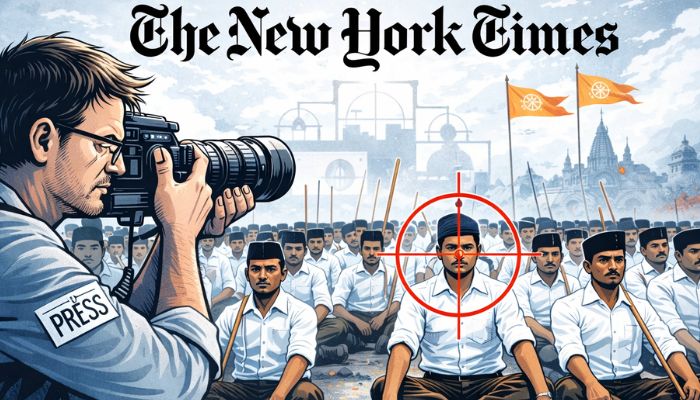

On 26th December, the New York Times published an article titled “From the Shadows to Power: How the Hindu Right Reshaped India”. The aim of publishing this particular piece, authored by Mujib Mashal and Hari Kumar, is simple. It is not just a critical piece on the Rashtriya Swayamsevak Sangh (RSS) but a downright attempt to vilify the largest Hindu organisation working tirelessly for the betterment of society.
The article constructs a work of ideological fiction that portrays the RSS as a shadowy, near-omnipotent “far-right” secret society, in other words, the “illuminati” of India. If the article, or, as a matter of fact, other such articles published by the NYT or other Left-liberal media houses, are to be believed, the RSS has “infiltrated” India’s institutions and is quietly dismantling the country’s secular republic.

The issue is not that the NYT or any other media outlet criticises the RSS. It is well within their rights to question organisations that operate in India and influence the political landscape of the country. However, the issue is how it is being done. The loaded language, selective history, and insinuations that have replaced evidence, everything that these articles contain showcases a familiar Left-liberal narrative. It is a narrative that treats Hindu self-organisation itself as something inherently sinister, as if Hindus are the ones blowing themselves up, and the secular fabric of the country, while chanting religious slogans.
‘Far-right’ as a shortcut, not an explanation
The article published by the NYT repeatedly brands the RSS as a “far-right Hindu nationalist group”. It is a term borrowed wholesale from Western political vocabulary and applied without contextual explanation. The concept of the far-right is completely different in India and in Western countries. In India, the RSS is neither a political party nor a clandestine militia. It is a volunteer-based cultural organisation that has existed openly for a century.

Yet “far-right” is used as a conclusion, not an analytical category. Once the Western concept of the far-right is applied to an Indian organisation, it absolves the writer of the responsibility to engage with Indian social realities. Everything that follows, from mass mobilisation to ideological influence, is automatically framed as extremism.
Nazi labels without saying ‘Nazi’
The New York Times article does not explicitly use the word “Nazi”, nor does it directly equate the RSS with Hitler or the Third Reich. That omission is deliberate. Instead, the article relies on implication and association, drawing repeatedly from fascist era imagery to guide readers towards a particular conclusion.
It states that early RSS leaders “openly drew inspiration from the nationalist formula of Fascist parties in Europe during the 1930s and 1940s” and references MS Golwalkar’s writings in connection with Hitler’s treatment of Jews. These historical references are not explored as part of a balanced inquiry but are used to anchor the present day RSS to the moral weight of European fascism.

The language employed throughout reinforces this framing. Terms such as “shadowy cabal”, “secret society”, “paramilitary discipline”, “supremacy”, and “infiltration of institutions” mirror the standard vocabulary Western media uses when describing authoritarian movements.
By avoiding explicit labels while saturating the narrative with fascist tropes, the article creates moral suspicion without making a direct charge. This technique offers plausible deniability while still achieving its intended effect, framing Hindu social organisation itself as something inherently dangerous.
From political organisation to imagined ‘secret society’
RSS leaders, even when they venture into politics, give public speeches. They do not hide their association with the RSS. Those who lead the RSS locally organise open conclaves and operate daily shakhas in neighbourhood parks. This is not a secret but a well-known aspect of the organisation. In fact, anyone can attend these shakhas, irrespective of their association with the organisation itself.
Despite this clarity, the NYT insists on describing the organisation as “shadowy” and “secretive”. The authors never try to present a contradictory view or attempt to look at the organisation through an unbiased lens. The contrast between what the article presents and what the organisation really is never gets resolved throughout.
Prime Minister Narendra Modi has never concealed his RSS background. He has always called himself a “worker” of the organisation. Senior ministers, chief ministers, MPs, judges, civil servants, and professionals have openly acknowledged their association with the Sangh.
Despite this, the RSS is presented as a secret society, the “illuminati” of the Indian political and social landscape. This is not how secret societies operate. Members of secret societies are prohibited from talking about their association. As it is said, “The first rule of Fight Club is: you do not talk about Fight Club”. In the same way, the foremost rule of being a member of a secretive society is that you do not talk about it, not like Prime Minister Narendra Modi, who openly attends RSS events.
The discomfort of the NYT appears to stem not from secrecy, but from the sheer scale of the organisation. The RSS is large, disciplined, decentralised, and culturally embedded. For a Western liberal worldview accustomed to NGO-driven activism and elite gatekeeping, an indigenous volunteer network that does not seek approval is unsettling.
‘Infiltration’ without evidence
One of the allegations made in the article is that the RSS has “infiltrated” institutions such as the judiciary, police, media, and academia. This is a serious allegation. However, it is made without any evidence. There is no documentary proof, no command structure, no directives, and no financial trail demonstrating such capture.
Instead, the authors present ideological proximity and organisational overlap as evidence of subversion. By that logic, Left-leaning academics who have dominated Indian universities for decades would also qualify as an “infiltration”. Pro-Naxal ideologues ruling academia for decades can be seen as Urban Naxals ruining the Indian education system from its roots. However, when such allegations, which are actually true, are raised, Left-liberal ideologues claim an attack on free speech.
The word “affiliate” is repeatedly used by the authors as a convenient device. Any act by any group vaguely aligned with Hindu causes is folded into the RSS universe without establishing organisational responsibility.
Recycling fascism and Gandhi without legal closure
As is customary in Western coverage of the RSS, the article revisits alleged fascist inspirations of early Sangh thinkers and again invokes Mahatma Gandhi’s assassination. Notably, Indian courts exonerated the RSS as an organisation decades ago. However, outlets like the NYT carefully stop short of that legal conclusion and ensure that the insinuation lingers in their narrative. It is convenient to claim that the RSS was behind Gandhi’s assassination without engaging with the judicial outcome, as it fits the narrative.
This is not historical inquiry. It is narrative maintenance. The RSS has been permanently framed as morally suspect, regardless of judicial findings, because absolution would disrupt the story.
Bulldozers without chronology
Then comes the Uttar Pradesh section. It also follows a familiar template. Since Chief Minister Yogi Adityanath, the firebrand monk who governs the most populous state in the country, took charge, Western media has tried to build a negative image around him.

The entire episode has been selectively constructed around the “I love Mohammed” poster controversy, which led to communal unrest in parts of the state. What the article omits is that the situation quickly escalated into public disorder, making it the chief minister’s responsibility to restore law and order and act against those who attempted to provoke communal violence.
At the same time, questions were raised in Western media over flower petals being showered on Kanwariyas, who were undertaking a peaceful religious pilgrimage across states. Police action in Uttar Pradesh has consistently followed incidents of law and order breakdown. In cases such as Gyanvapi and the Sambhal mosque, rioters attempted to create unrest along communal lines, and Chief Minister Yogi Adityanath’s decisive intervention prevented a local disturbance from turning into a wider conflagration.
Bulldozers, arrests, internet shutdowns, and police action are presented as religious repression without explaining the events that triggered the state response. When Yogi Adityanath took charge, the law-and-order situation was in the worst possible condition. Riots and communal tension were common. Gangsters dominated many areas. However, when Yogi Adityanath assumed office, he made it clear that law and order was his priority, and since 2017, much has changed in that regard. Even bulldozer action takes place only after it is evident that the building is illegal and linked to criminal activity.
Yet, in the article, law enforcement is stripped of chronology and converted into ideological persecution. Governance becomes authoritarianism by default, and popular support is dismissed as mob mentality.
When charity becomes fascist infrastructure
Western and Left-liberal media, including in India, has a habit of framing everything negatively if it is Hindu. In a recent article, The Caravan described schools, hostels, orphanages, old age homes, medical missions, yoga centres, and disaster relief initiatives associated with the RSS as “last-mile” instruments of ideological control. The NYT article in fact cites the Caravan article explicitly.
This framing exposes the deeper anxiety of the Left-liberals. The problem is not the work but the organisation itself. If the same work were done by an NGO linked to Soros or USAID, they would be pouring praise. At that point, criticism ceases to be political and becomes civilisational. Hindu civil society itself is rendered illegitimate.
What really unsettles Left liberal media
The background of the NYT article is filled with unspoken fear. The RSS has succeeded in building institutions that endure across generations without foreign funding, elite endorsement, or ideological conformity to Western liberalism, something no other organisation has managed in India.
The RSS produces cadres, not conferences. It relies on volunteers, not donors. It functions through decentralisation, not bureaucratic grants. The longevity and independence of the RSS are often interpreted as conspiracy because Western and Left-liberal media either do not understand this model or refuse to understand it due to ideological hostility towards Hindus.
Democracy acknowledged, but never respected
The NYT article repeatedly suggests that while Indians vote, the RSS “really” rules. Institutions function but are allegedly “co-opted”. Electoral victories are explained away as organisational manipulation. Such framing allows Western commentators to question Indian democracy without openly saying so.
When political outcomes do not align with their preferences, democracy itself is quietly delegitimised. Since Prime Minister Modi took charge of the Prime Minister’s Office in 2014, Western media has repeatedly suggested that Indian democracy is declining or that India has become an authoritarian state.
Fear masquerading as journalism
There is no doubt that the RSS is open to criticism. If someone believes the RSS has done something wrong, it is their right to question it. Its ideology, politics, and influence merit scrutiny. However, what the NYT has offered in its coverage is not scrutiny. It is a fear narrative constructed through loaded labels, historical shortcuts, and civilisational misunderstanding.
By portraying the RSS as an ultra-powerful secret society and recycling Nazi analogies, the NYT reveals less about India and more about the Left-liberal inability to accept the fact that the Hindu community can self-organise on its own terms.
The RSS has not emerged “from the shadows”. It has always been in plain sight. The real discomfort lies in the fact that it no longer seeks permission to exist.