The lynching of Dipu Chandra Das and how radical Islam in Bangladesh and Pakistan is posing security challenges for India
The images of Dipu Chandra Das’s inhumane torture in Bangladesh are heartbreaking. These images of his torture have sparked outrage across India, especially among Hindus. In 1971, India played its role in establishing the existence of Bangladesh separate from Pakistan and today in 2025, this country has finally followed the path of Pakistan. The situation now is such that religious fundamentalists and jihadis from Pakistan and Bangladesh have come together to oppose India. In Pakistan, democracy has never been able to stand up to the alliance of the military, religious fundamentalist and Jihadis. Together, these two neighbouring countries are posing serious religious-fanatic challenges to India. What is this India-Pakistan-Bangladesh conflict all about? To understand this, we need to understand the demography as well as the background of the partition and creation of these three countries. The worst nightmare of the establishment of Pakistan was that only half of the Muslims living on Indian side went to this new country created to realise the idea of a Muslim nation, while the rest remained in India. There were 7.44 crore Muslims in undivided India and at the time of India-Pakistan partition in 1947, 3.90 crore Muslims remained in Pakistan while 3.54 crore remained in India. The interesting thing is that after partition, out of 4.25 crore Muslims present in the Indian territory, only 72 lakh Muslims went to Pakistan, whereas 83 lakh Hindus and Sikhs came to India from Pakistan. According to a data, in 1947, the Hindu population in West Pakistan i.e. present Pakistan was 20 percent, whereas in East Pakistan i.e. present Bangladesh, the Hindu population was 28-30 percent. In 1947, the population of India was around 33-34 crore, of which about 9.8 percent were Muslims. Now according to the 1951 census, the population of India was 36 crore in which Hindus were 84.1 percent and Muslims were 9.8 percent. In 1951, the total population of Pakistan was 7.5 crore, of which West Pakistan had a population of 3.37 crore and East Pakistan (present-day Bangladesh) had a population of 4.2 crore. In this, apart from 98.4 percent Muslims in West Pakistan, there were a total of 2.9 percent non-Muslims in which 1.6 percent was Hindu population. Similarly, in East Pakistan (present Bangladesh), apart from 78 percent Muslims, there were 23.2 percent non-Muslims, in which 22 percent was Hindu population. If we look at the present population of India-Pakistan-Bangladesh then according to the data released by the Pakistan government in 2023, out of the total 24 crore population of the country, 23.12 crore i.e. 96.35 percent were Muslims. Apart from this, the Hindu population was 38 lakh i.e. 1.61 percent, Christian population was 26 lakh i.e. 1.37 percent, Sikh population was 15,998 and Parsis only 2348. According to the data released in 2022, the total population of Bangladesh was 16.5 crore, of which 15.03 crore i.e. 91 percent were Muslims. Apart from this, 1.31 crore i.e. 7.95 percent Hindus, 10 lakh i.e. 0.61 percent Buddhists, 4.95 lakh i.e. 0.30 percent Christians lived in Bangladesh. At the same time, according to the estimated figures of 2024, the population of India is 145 crore, in which Hindus are likely to be 115.71 crore i.e. 79.8 percent. Whereas Muslims are estimated to be 20.59 crore i.e. 14.2 percent, Christians 3.33 crore i.e. 2.3 percent, Sikhs 2.46 crore i.e. 1.7 percent, Buddhists 1.01 crore i.e. 0.7 percent, Jains 0.58 crore i.e. 0.4 percent and Parsis are estimated to be around 50 thousand. From the above data, the change in the Hindu and Muslim demography in India-Pakistan-Bangladesh from 1947 can be easily understood. In India, the Hindu population decreased from 84.1 percent to 79.8 percent, while the Muslim population increased from 9.8 percent to 14.2 percent. The Hindu population in Pakistan decreased from 20 percent to 1.61 percent, while the Hindu population in Bangladesh decreased from 28-30 percent to 7.95 percent. Interestingly, in West Pakistan (present-day Pakistan) the Hindu population declined from 9.8 per cent to 1.61 per cent between 1947 and 1951, and in East Pakistan (present-day Bangladesh) the Hindu population declined from 28-30 per cent to 22 per cent during the same period. Although Pakistan’s statistics have always been shrouded in suspicion, the released figures must be trusted. It is also important to know that at the time of the birth of Bangladesh in 1971, the total population of Bangladesh was approximately 7.10 crore, in which the estimated Hindu population was 1.7 crore i.e. approximately 20-22 percent. Religion has definitely been at the backdrop of the India-Pakistan-Bangladesh conflict because the main reason and basis for the partition of the nation has been religious. It is no less interesting that among these countries divided on the basis of religion, Pakistan and Bangladesh are declared Islamic countries whereas India was made secular. The wors
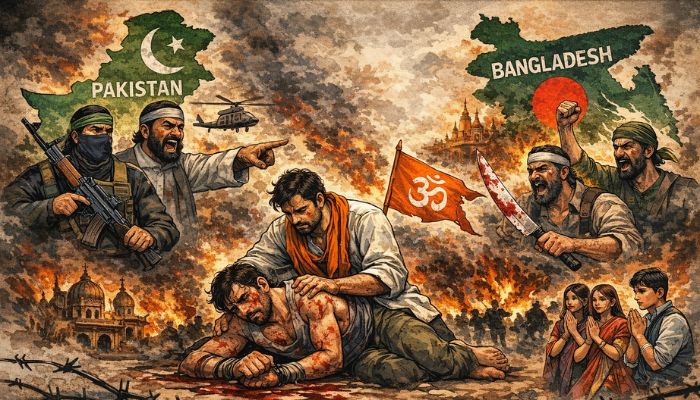

The images of Dipu Chandra Das’s inhumane torture in Bangladesh are heartbreaking. These images of his torture have sparked outrage across India, especially among Hindus. In 1971, India played its role in establishing the existence of Bangladesh separate from Pakistan and today in 2025, this country has finally followed the path of Pakistan. The situation now is such that religious fundamentalists and jihadis from Pakistan and Bangladesh have come together to oppose India. In Pakistan, democracy has never been able to stand up to the alliance of the military, religious fundamentalist and Jihadis. Together, these two neighbouring countries are posing serious religious-fanatic challenges to India.
What is this India-Pakistan-Bangladesh conflict all about? To understand this, we need to understand the demography as well as the background of the partition and creation of these three countries. The worst nightmare of the establishment of Pakistan was that only half of the Muslims living on Indian side went to this new country created to realise the idea of a Muslim nation, while the rest remained in India. There were 7.44 crore Muslims in undivided India and at the time of India-Pakistan partition in 1947, 3.90 crore Muslims remained in Pakistan while 3.54 crore remained in India. The interesting thing is that after partition, out of 4.25 crore Muslims present in the Indian territory, only 72 lakh Muslims went to Pakistan, whereas 83 lakh Hindus and Sikhs came to India from Pakistan. According to a data, in 1947, the Hindu population in West Pakistan i.e. present Pakistan was 20 percent, whereas in East Pakistan i.e. present Bangladesh, the Hindu population was 28-30 percent. In 1947, the population of India was around 33-34 crore, of which about 9.8 percent were Muslims.
Now according to the 1951 census, the population of India was 36 crore in which Hindus were 84.1 percent and Muslims were 9.8 percent. In 1951, the total population of Pakistan was 7.5 crore, of which West Pakistan had a population of 3.37 crore and East Pakistan (present-day Bangladesh) had a population of 4.2 crore. In this, apart from 98.4 percent Muslims in West Pakistan, there were a total of 2.9 percent non-Muslims in which 1.6 percent was Hindu population. Similarly, in East Pakistan (present Bangladesh), apart from 78 percent Muslims, there were 23.2 percent non-Muslims, in which 22 percent was Hindu population.
If we look at the present population of India-Pakistan-Bangladesh then according to the data released by the Pakistan government in 2023, out of the total 24 crore population of the country, 23.12 crore i.e. 96.35 percent were Muslims. Apart from this, the Hindu population was 38 lakh i.e. 1.61 percent, Christian population was 26 lakh i.e. 1.37 percent, Sikh population was 15,998 and Parsis only 2348.
According to the data released in 2022, the total population of Bangladesh was 16.5 crore, of which 15.03 crore i.e. 91 percent were Muslims. Apart from this, 1.31 crore i.e. 7.95 percent Hindus, 10 lakh i.e. 0.61 percent Buddhists, 4.95 lakh i.e. 0.30 percent Christians lived in Bangladesh. At the same time, according to the estimated figures of 2024, the population of India is 145 crore, in which Hindus are likely to be 115.71 crore i.e. 79.8 percent. Whereas Muslims are estimated to be 20.59 crore i.e. 14.2 percent, Christians 3.33 crore i.e. 2.3 percent, Sikhs 2.46 crore i.e. 1.7 percent, Buddhists 1.01 crore i.e. 0.7 percent, Jains 0.58 crore i.e. 0.4 percent and Parsis are estimated to be around 50 thousand.
From the above data, the change in the Hindu and Muslim demography in India-Pakistan-Bangladesh from 1947 can be easily understood. In India, the Hindu population decreased from 84.1 percent to 79.8 percent, while the Muslim population increased from 9.8 percent to 14.2 percent. The Hindu population in Pakistan decreased from 20 percent to 1.61 percent, while the Hindu population in Bangladesh decreased from 28-30 percent to 7.95 percent. Interestingly, in West Pakistan (present-day Pakistan) the Hindu population declined from 9.8 per cent to 1.61 per cent between 1947 and 1951, and in East Pakistan (present-day Bangladesh) the Hindu population declined from 28-30 per cent to 22 per cent during the same period.
Although Pakistan’s statistics have always been shrouded in suspicion, the released figures must be trusted. It is also important to know that at the time of the birth of Bangladesh in 1971, the total population of Bangladesh was approximately 7.10 crore, in which the estimated Hindu population was 1.7 crore i.e. approximately 20-22 percent.
Religion has definitely been at the backdrop of the India-Pakistan-Bangladesh conflict because the main reason and basis for the partition of the nation has been religious. It is no less interesting that among these countries divided on the basis of religion, Pakistan and Bangladesh are declared Islamic countries whereas India was made secular. The worst situation was that even after the creation of Pakistan on the basis of religious discrimination between Hindus and Muslims, more than 3.50 crore Muslims remained in India.
The question is that if Jinnah accepted the partition of India completely on religious grounds and created Pakistan, then why did Gandhi-Nehru not fully implement it in India? The reality is that despite the partition on religious grounds, both these leaders were busy preventing Muslims from going to Pakistan. India openly gave Muslims the option to stay in India, due to which a large number of Muslims stayed in India. Is it not less unfortunate that the country was divided on religious grounds but only 18 percent of the total Muslim population living in the Indian part shifted its base to Pakistan?
Not only this, after the partition, a large number of Muslims who returned to India disappointed with the bad conditions in Pakistan, were again granted Indian citizenship by the then Indian Government by taking a policy decision. Surprisingly, Gandhi- Nehru also gave open call to Muslims to return to Indian side. The biggest argument for the partition of India by imperialist Britain was that people of two different religious communities, Hindus and Muslims, could not live together. But leaders like Gandhi and Nehru not only got India divided, but also by thwarting the reasons for the partition, they added a permanent feeling of Muslim appeasement to the society and politics of India.
Over a period of time, the politics of so-called secularism, which has been successful for a long time in India under the leadership of Congress, has left no stone unturned in hollowing out the country socially, politically, economically and psychologically. It is obvious that Pakistan, which had a Muslim population of about 4 crore in 1947, has not been able to become democratic till date and in 1971, Bangladesh became Independent, with Muslim population of about 5.5 crore, failed to follow the path of democracy. Then it can easily be understood, the serious challenge of maintaining democracy in the society & politics of India with its Muslim population of about 21 crore.
In Pakistan and Bangladesh, Islamic religious fanaticism is synonymous with nationalism. But in the India from which these two countries originated after partition, there have been social and political attempts to cast doubt and question on the Sanatan Hindu religious consciousness since independence. All this has had such a bad psychological impact that even a common Sanatani Hindu, who feels proud in wearing the Maulana cap, has started avoiding applying the tilak and using religious symbols.
It should not be an exaggeration to say that the Shri Ram Janmabhoomi movement has played a major role in reviving the Sanatan Hindu religious consciousness in India. Due to the foundation of liberal soft democracy laid by Gandhi and Nehru in India, Muslim appeasement in Indian politics was given the name of secularism. But at the same time, those who expressed India’s cultural heritage, Sanatan Hindu religious consciousness and nationalist ideology were declared communal.
In recent times, the entire world including America, Britain, France, Italy, Japan and almost all the countries of Europe are falling prey to increasing Islamic fundamentalist and jihadi mentality. The grooming gangs in western countries are the lowest level of this mentality which is spreading its roots in a country like India in the form of burqa niqab, love jihad, land jihad, religious conversion and terrorism. Islam is expanding with a complete strategy and the apartment societies, streets, neighborhoods, villages, cities, states and countries are coming under its grip.
Due to approximately 1 crore Rohingya, Bangladeshi and other infiltrators in India, there has been a major change in the local demography in many states, which has affected society, politics and economy. Now, countless mini Pakistan and mini Bangladesh have been created within India itself, which are busy hollowing out the country by eating it away like termites. These elements present within India are getting strength from foreign forces as well as leftist, moderate, extremist, secular, anti- Sanatan Hindu and anti-national, anti- India forces.
At present, the blood of every nationalist and Sanatani Hindus of India is boiling over the incident in Bangladesh. The way Islamic fundamentalist tendencies are increasing in South Asia, especially in Pakistan and Bangladesh has shaken the global democratic forces. The massacre of Hindus in Bangladesh has exposed the global community including the United Nations, United Nations Human Rights, America, United Kingdom, which has remained silent like a mute spectator.
The time has come to not only be alert and aware of the Islamic religious fundamentalist and jihadi challenges present within India and the neighbourhood. There is a serious need to give befitting reply to the designs of anti-Hindu and anti-India forces present inside and outside the country with every possible strategy.
(Dr. Nikhil Anand is a BJP leader from Bihar and is currently the National General Secretary of the BJP OBC Morcha.)