Rahul Gandhi claims Delhi Police told him “Inko Hataiye”: Here’s how his baseless remarks indicate a wider regime change operation
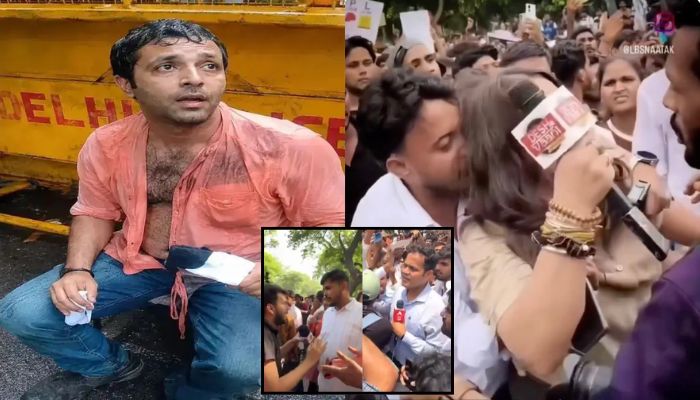
In a recent press conference, Lok Sabha MP and Leader of the Opposition Rahul Gandhi made controversial claims regarding Delhi Police personnel involved in detaining him during a protest near the Prime Minister’s high-security official residence. Gandhi claimed that while he was being forcibly removed from 7 Lok Kalyan Marg on Tuesday, 21st July, security officers privately urged him to overthrow the current administration. According to Gandhi, police officers whispered in his ear, “Inko Hataiye” (Please remove the current government). Expanding on his claims, Gandhi claimed specific interactions with officers during the confrontation. Gandhi claimed that one cop told him, “I am from Rajasthan, we’re just wearing uniform. The second one is saying, I am from Haryana, remove them. So that sentiment is there, and everybody knows the truth.” He asserted that while police officers are required to fulfil their official duties, many are dissatisfied with the current state of affairs. “Those people have to accept the order, so they are doing it. But even the police are not happy about what has happened. Sensitive police people feel that this is a crime that is being done to the future of our country. They can see their children in this…,” he further claimed. आज हर छात्र कह रहा है, पुलिसवाले कह रहे हैं, पूरा देश कह रहा है – मोदी सरकार को जाना पड़ेगा।विपक्ष के नेता के रूप में मेरी ज़िम्मेदारी हर भारतीय की आवाज़ बनना है – और उसके लिए हर कीमत छोटी है। pic.twitter.com/uSLu9Py3F5— Rahul Gandhi (@RahulGandhi) July 22, 2026 Addressing his involvement in the demonstration, Gandhi said he stands firmly with the country’s student movement. He brushed off the physical altercation with security personnel, noting that “a couple of punches” is a minor trade-off for standing up for students. The incident took place during an unannounced demonstration outside Prime Minister Narendra Modi’s residence. Joined by senior leaders, including Wayanad MP Priyanka Gandhi Vadra, Rajya Sabha Leader of Opposition Mallikarjun Kharge, KC Venugopal, and Pawan Khera, the group marched into the high-security zone. The sit-in was kept secret even from participating Congress members until the final moment. Opposition MPs were initially informed that they were gathering at Kharge’s residence, located about 500 metres from the PM’s residence, to celebrate his birthday. Reports indicate that this story was planned by Rahul Gandhi, Priyanka Gandhi Vadra, and KC Venugopal to avoid alerting government security agencies and the Special Protection Group (SPG). A deliberate attempt to foster mistrust Gandhi’s deliberate focus on police dissatisfaction is an effort to foster division within state institutions. By alleging that security personnel privately oppose the administration, Gandhi appeared to actively encourage disaffection among the armed forces and police against the elected government. Creating internal friction within state institutions is a recognised tactic in wider political strategy. Attempting to seed doubt regarding the loyalty of security personnel often serves as an early phase in destabilising an established government. By publicising statements that suggest officers oppose their leadership, political actors attempt to weaken official authority and lay the groundwork for broader systemic disruption. Historically, attempts to demoralise or turn security forces against an existing administration are a recognised mechanism in broader regime change operations. When state institutions lose internal cohesion, the stability of a nation’s political system can quickly deteriorate. A military coup (or coup d’état) is the illegal and sudden seizure of political power by a country’s armed forces, typically resulting in the overthrow of the existing civilian government. Rather than ascending to power through democratic elections or established constitutional mechanisms, the military utilises force, or the threat of force, to secure control of state governance. Such tactics have been documented in several regional contexts across South Asia. The case of Bangladesh: A blueprint of internal betrayal Recent geopolitical developments in neighbouring countries provide clear examples of how political instability and institutional mistrust can lead to regime change. Bangladesh offers a striking example of internal military dynamics triggering the fall of an administration. Political developments in Bangladesh were highlighted following revelations in a book published on 15th November 2025. Titled Inshallah Bangladesh: The Story of an Unfinished Revolution, authored by Deep Halder, Jaideep Mazumdar, and Sahidul Hasan Khokon, and published by Juggernaut, the text details how former Prime Minister Sheikh Hasina was removed from office. In the book, Hasina’s former Home Minister, Asaduzzaman Khan Kamal, made detailed claims regarding the collapse of her administration. Image via HINDU E SHOP During a conversation wi
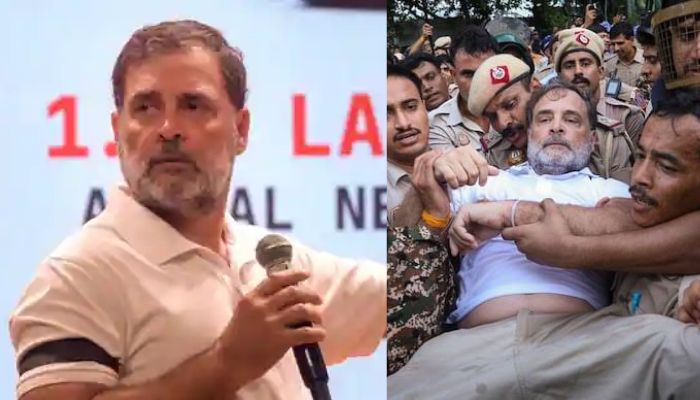
In a recent press conference, Lok Sabha MP and Leader of the Opposition Rahul Gandhi made controversial claims regarding Delhi Police personnel involved in detaining him during a protest near the Prime Minister’s high-security official residence. Gandhi claimed that while he was being forcibly removed from 7 Lok Kalyan Marg on Tuesday, 21st July, security officers privately urged him to overthrow the current administration. According to Gandhi, police officers whispered in his ear, “Inko Hataiye” (Please remove the current government).
Expanding on his claims, Gandhi claimed specific interactions with officers during the confrontation. Gandhi claimed that one cop told him, “I am from Rajasthan, we’re just wearing uniform. The second one is saying, I am from Haryana, remove them. So that sentiment is there, and everybody knows the truth.”
He asserted that while police officers are required to fulfil their official duties, many are dissatisfied with the current state of affairs. “Those people have to accept the order, so they are doing it. But even the police are not happy about what has happened. Sensitive police people feel that this is a crime that is being done to the future of our country. They can see their children in this…,” he further claimed.
आज हर छात्र कह रहा है, पुलिसवाले कह रहे हैं, पूरा देश कह रहा है – मोदी सरकार को जाना पड़ेगा।विपक्ष के नेता के रूप में मेरी ज़िम्मेदारी हर भारतीय की आवाज़ बनना है – और उसके लिए हर कीमत छोटी है। pic.twitter.com/uSLu9Py3F5— Rahul Gandhi (@RahulGandhi) July 22, 2026
Addressing his involvement in the demonstration, Gandhi said he stands firmly with the country’s student movement. He brushed off the physical altercation with security personnel, noting that “a couple of punches” is a minor trade-off for standing up for students.
The incident took place during an unannounced demonstration outside Prime Minister Narendra Modi’s residence. Joined by senior leaders, including Wayanad MP Priyanka Gandhi Vadra, Rajya Sabha Leader of Opposition Mallikarjun Kharge, KC Venugopal, and Pawan Khera, the group marched into the high-security zone. The sit-in was kept secret even from participating Congress members until the final moment. Opposition MPs were initially informed that they were gathering at Kharge’s residence, located about 500 metres from the PM’s residence, to celebrate his birthday. Reports indicate that this story was planned by Rahul Gandhi, Priyanka Gandhi Vadra, and KC Venugopal to avoid alerting government security agencies and the Special Protection Group (SPG).
A deliberate attempt to foster mistrust
Gandhi’s deliberate focus on police dissatisfaction is an effort to foster division within state institutions. By alleging that security personnel privately oppose the administration, Gandhi appeared to actively encourage disaffection among the armed forces and police against the elected government.
Creating internal friction within state institutions is a recognised tactic in wider political strategy. Attempting to seed doubt regarding the loyalty of security personnel often serves as an early phase in destabilising an established government. By publicising statements that suggest officers oppose their leadership, political actors attempt to weaken official authority and lay the groundwork for broader systemic disruption.
Historically, attempts to demoralise or turn security forces against an existing administration are a recognised mechanism in broader regime change operations. When state institutions lose internal cohesion, the stability of a nation’s political system can quickly deteriorate.
A military coup (or coup d’état) is the illegal and sudden seizure of political power by a country’s armed forces, typically resulting in the overthrow of the existing civilian government. Rather than ascending to power through democratic elections or established constitutional mechanisms, the military utilises force, or the threat of force, to secure control of state governance. Such tactics have been documented in several regional contexts across South Asia.
The case of Bangladesh: A blueprint of internal betrayal
Recent geopolitical developments in neighbouring countries provide clear examples of how political instability and institutional mistrust can lead to regime change. Bangladesh offers a striking example of internal military dynamics triggering the fall of an administration.
Political developments in Bangladesh were highlighted following revelations in a book published on 15th November 2025. Titled Inshallah Bangladesh: The Story of an Unfinished Revolution, authored by Deep Halder, Jaideep Mazumdar, and Sahidul Hasan Khokon, and published by Juggernaut, the text details how former Prime Minister Sheikh Hasina was removed from office. In the book, Hasina’s former Home Minister, Asaduzzaman Khan Kamal, made detailed claims regarding the collapse of her administration.
Image via HINDU E SHOP
During a conversation with the authors in Delhi, Khan Kamal characterised the transition of power as “a perfect CIA plot” that was orchestrated over an extended period. He revealed that Bangladesh’s Army Chief, General Waker-Uz-Zaman, played a key role in the operation. “We didn’t know that the CIA had Waker in its pocket,” Kamal stated, noting that intelligence bodies like the Directorate General of Forces Intelligence (DGFI) and the National Security Intelligence (NSI) failed to alert the Prime Minister.
Kamal outlined two primary motivations behind foreign interest in Bangladesh’s leadership. First, he claimed Washington was uncomfortable with multiple strong leaders holding power concurrently in South Asia, referencing Prime Minister Narendra Modi, China’s Xi Jinping, and Sheikh Hasina. Second, he pointed to the strategic importance of St Martin’s Island in the Bay of Bengal, situated near the Myanmar coastline. Before her departure, Hasina publicly claimed she faced pressure to cede access to St Martin’s Island in exchange for political support, a demand she rejected as an infringement on national sovereignty.
The authors also documented how domestic radical groups collaborated with external intelligence assets. Kamal noted that Pakistan’s Inter-Services Intelligence (ISI) coordinated with Jamaat-e-Islami Bangladesh to stir public agitation. Despite warnings regarding foreign-trained agitators targeting police forces, General Waker assured Hasina that the military would manage the situation without police intervention.
On the evening of 4th August 2024, during a high-level security meeting at Gonobhaban, Kamal proposed that police forces secure entry points into Dhaka. General Waker dismissed the proposal, claiming the public lacked trust in the police force and insisted that the army maintain control. Kamal remarked, “She trusted him that evening,” adding that by the morning of 5th August 2024, Hasina was forced to resign and depart the country under direct military pressure.
Lead author Deep Halder noted that these revelations significantly altered public perception regarding the fall of the Awami League government. Comparing Hasina’s sudden downfall to the mythological narrative of Abhimanyu in the Mahabharata, Kamal described how key political and military actors collaborated to bring about the end of her fifteen-year rule.
The Myanmar crisis: Constitutional coups and military rule
Myanmar presents another clear regional example where the armed forces directly intervened to dismantle a civilian government. On 1st February 2021, the Myanmar military (Tatmadaw) seized political power, overthrowing the democratically elected government and detaining key officials.
Myanmar’s political system has been shaped by military control since gaining independence in 1948, following an initial coup in 1962. Although a new constitution was introduced in 2008 to allow a transition toward civilian governance, the text guaranteed the military significant systemic influence. It reserved 25% of legislative seats for military appointees, granted control over three key security ministries, and established emergency provisions, often referred to by analysts as a built-in coup mechanism, allowing power to be transferred to the military during perceived national crises.
Strains between civilian leaders and the military escalated following the November 2020 parliamentary elections. Aung San Suu Kyi’s National League for Democracy (NLD) won a decisive majority, while the military-aligned Union Solidarity and Development Party (USDP) lost significant ground. This defeat eliminated Senior General Min Aung Hlaing’s prospects of securing the presidency through parliamentary election. Claiming widespread electoral irregularities, allegations rejected by domestic and international election observers, the military demanded a rerun of the vote and requested a postponement of Parliament’s opening session.
When the government proceeded with convening Parliament on 1st February 2021, the military executed a swift coup. President Win Myint, State Counsellor Aung San Suu Kyi, and numerous parliamentarians were detained. Vice President Myint Swe, a former military officer, assumed the acting presidency and invoked constitutional articles 417 and 418, declaring a state of emergency and transferring executive, legislative, and judicial power to Senior General Min Aung Hlaing.
The takeover prompted widespread civil unrest, public protests, and nationwide strike campaigns. In response, a shadow administration known as the National Unity Government was formed, alongside armed resistance groups. The military’s push to retain authority plunged Myanmar into prolonged civil conflict, leading to severe economic disruption and widespread instability across the region.
Historical precedents: The pre-emergency era in India
Attempts to influence the loyalty of police and armed forces are not entirely unprecedented in Indian political history. Similar rhetoric emerged during the turbulent period preceding the declaration of the National Emergency in 1975.
On 25th June 1975, opposition leader Jayaprakash Narayan (JP) delivered an address at Delhi’s Ramlila Maidan. During his 80-minute speech, JP called upon the police, armed forces, and civil servants to refuse to carry out orders from the government that they deemed “illegal and immoral.” JP framed his request as a form of non-violent civil disobedience intended to safeguard democratic principles against what he described as authoritarian tendencies under Prime Minister Indira Gandhi.
At the rally, JP also addressed Chief Justice of India A.N. Ray, asking him not to preside over Indira Gandhi’s appeal against an Allahabad High Court ruling that had invalidated her election. While clarifying that he was not directly questioning the Chief Justice’s personal integrity, JP argued that public confidence could be compromised because Ray had been appointed over three senior judges. Warning of democratic backsliding, JP remarked that India was neither Bangladesh nor Pakistan, where arbitrary governance would be accepted without challenge.
Following the rally, opposition parties organised a week-long satyagraha demanding the Prime Minister’s resignation, establishing the Lok Sangharsh Samiti (LSS) to coordinate nationwide protests. In response to the growing political pressure and appeals directed at the state’s administrative machinery, the Congress government led by Indira Gandhi declared a nationwide Emergency on the night of 25th June 1975, leading to the suspension of fundamental rights and the detention of political opposition figures.
The Media’s historical relationship with the “Coup” narrative
This tendency of media outlets and political actors to flirt with theories of military insubordination or coups is far from unprecedented. Notably, even during the Congress-led tenure, media narratives attempting to frame routine institutional movements as coup attempts faced intense pushback across political and ideological spectrums.
A prime example of this was journalist Shekhar Gupta’s infamous 2012 article on The Print, “Is Narendra Modi a sex symbol for village women?”, which insinuated an unauthorised military movement towards Delhi as a potential coup-like threat.
The report drew wide condemnation, not just from the government of the day, but even from fierce critics of the Congress party who rejected the conspiracy narrative as sensationalist fiction designed to garner readership and mockingly dubbed him “Coupta.” Pushing such reckless “coup theories” unnecessarily damages the reputation of the armed forces and destabilises public trust in democratic institutions. This historical pattern demonstrates that using the pretext of military or police dissatisfaction to construct regime-change narratives has long been seen as a harmful form of sensationalism rather than responsible political or journalistic conduct.
Similarly, Rahul Gandhi’s recent claims about police officers urging him to remove the government mirror this exact playbook, using insinuations of institutional disaffection to construct a dangerous narrative of instability.