The Guardian’s Hannah Ellis-Petersen suffers a meltdown after PM Modi receives the Seychelles highest honour: Read about the anti-India propagandist and her track record
On Friday, 3rd July, The Guardian published an article, written by Hannah Ellis Petersen, titled “‘Give him any award, and he’ll come running’: Narendra Modi racks up honours on overseas trips.” The anti-India British publication highlighted the Indian Prime Minister’s recent visit to Seychelles, where he was conferred with the archipelago’s highest honour. According to the article, as Narendra Modi touched down in Seychelles over the weekend, the nation swiftly bestowed the “Guardian of the Blue Horizon” award upon him. The report described Modi as “beaming” while accepting the trophy and certificate from Seychelles President Patrick Herminie. However, the publication quickly shifted its focus to critics who claimed the award was marred by several discrepancies. Screengrab of the report The core of The Guardian’s critique rested on alleged formatting errors and the timing of the award’s creation. The piece highlighted that the presentation certificate misspelt “republic” as “repubblic” and “Seychelles” as “Seycheeles.” However, the article itself wrote that, on Thursday, 2nd July, the Seychelles foreign ministry responded with a statement claiming that a “working draft” had accidentally been circulated and that an “authentic and duly approved” version had now been issued. “The Guardian of the Blue Horizon distinction is genuine,” added the foreign ministry. It further alleged that the distinction had been created a mere three days before Modi’s arrival, making him the sole recipient. To amplify the controversy, the article noted that when the certificate was run through verification software, it was flagged as AI-generated. The author argued that accolades have become a transactional expectation for Modi’s foreign trips, quoting biographer Nilanjan Mukhopadhyay, who claimed the global push for prizes is intended “to convey to supporters and potential converts that Modi is being honoured across the world because of his greatness.” A pattern of selective focus in Western Media This reporting aligns with a broader tendency observed in segments of the Western Media, which frequently adopt a highly critical stance toward India’s political leadership and domestic developments. Publications like The Guardian often dedicate significant editorial space to dissecting the optics of Indian governance, framing routine diplomatic exchanges or national policies through an adversarial lens. This intense scrutiny of Global South democracies stands in stark contrast to how these same outlets handle sensitive domestic crises within their own borders, often turning a blind eye to covering the major issues in their home countries. For instance, investigative reporting on deeply entrenched issues in the United Kingdom, such as the grooming gangs. An independent Rape Gang Inquiry Report has revealed that the Muslim rape gangs comprised 87% to 95% Pakistani Muslim men, who raped, exploited and groomed over 250,000 non-Muslim, mostly White girls. This perceived double standard leads to viewing such overseas coverage not as objective journalism, but as a habitual projection of anti-India sentiment designed to overshadow the country’s growing international stature. The reality behind Seychelles’ National Honours system Despite the narrative pushed by external critics, the creation of the ‘Guardian of the Blue Horizon’ distinction has nothing to do with Prime Minister Modi himself but is instead rooted in the internal political restructuring of Seychelles. The island nation enacted the National Awards Act in 2022 to establish a formal civilian honours system. Under that framework, the country introduced the Medal of the Republic, the Medal of Honour, and the Medal of Merit to recognise public service and environmental work. The first National Awards ceremony was eventually held in 2023 after the legislation came into force, recognising individuals from different walks of life for public service, environmental work, healthcare, culture, governance and acts of bravery. Among the recipients were President Wavel Ramkalawan, who received the Medal of the Republic under the provisions of the Act, former President Sir James Mancham, Central Bank Governor Caroline Abel, environmentalist Antonio Constance, singer Joe Samy and several others who had made significant contributions to Seychelles. At the time, President Ramkalawan had said the country had long recognised Seychellois honoured abroad but lacked a proper system to acknowledge its own citizens. The National Awards were therefore introduced to fill that gap and formally celebrate national achievements. However, following a recent change in government, President Patrick Herminie’s Cabinet approved the National Awards (Repeal) Bill, 2026, which abolished the previous framework while preserving the validity of past honours. The repeal effectively dissolved the old National Awards Committee, paving the way for a fresh honours system under the
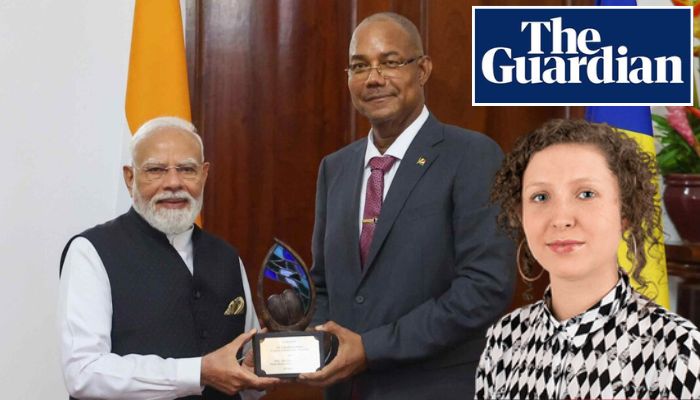
On Friday, 3rd July, The Guardian published an article, written by Hannah Ellis Petersen, titled “‘Give him any award, and he’ll come running’: Narendra Modi racks up honours on overseas trips.” The anti-India British publication highlighted the Indian Prime Minister’s recent visit to Seychelles, where he was conferred with the archipelago’s highest honour.
According to the article, as Narendra Modi touched down in Seychelles over the weekend, the nation swiftly bestowed the “Guardian of the Blue Horizon” award upon him. The report described Modi as “beaming” while accepting the trophy and certificate from Seychelles President Patrick Herminie. However, the publication quickly shifted its focus to critics who claimed the award was marred by several discrepancies.
Screengrab of the report
The core of The Guardian’s critique rested on alleged formatting errors and the timing of the award’s creation. The piece highlighted that the presentation certificate misspelt “republic” as “repubblic” and “Seychelles” as “Seycheeles.” However, the article itself wrote that, on Thursday, 2nd July, the Seychelles foreign ministry responded with a statement claiming that a “working draft” had accidentally been circulated and that an “authentic and duly approved” version had now been issued.
“The Guardian of the Blue Horizon distinction is genuine,” added the foreign ministry.
It further alleged that the distinction had been created a mere three days before Modi’s arrival, making him the sole recipient. To amplify the controversy, the article noted that when the certificate was run through verification software, it was flagged as AI-generated.
The author argued that accolades have become a transactional expectation for Modi’s foreign trips, quoting biographer Nilanjan Mukhopadhyay, who claimed the global push for prizes is intended “to convey to supporters and potential converts that Modi is being honoured across the world because of his greatness.”
A pattern of selective focus in Western Media
This reporting aligns with a broader tendency observed in segments of the Western Media, which frequently adopt a highly critical stance toward India’s political leadership and domestic developments. Publications like The Guardian often dedicate significant editorial space to dissecting the optics of Indian governance, framing routine diplomatic exchanges or national policies through an adversarial lens.
This intense scrutiny of Global South democracies stands in stark contrast to how these same outlets handle sensitive domestic crises within their own borders, often turning a blind eye to covering the major issues in their home countries. For instance, investigative reporting on deeply entrenched issues in the United Kingdom, such as the grooming gangs. An independent Rape Gang Inquiry Report has revealed that the Muslim rape gangs comprised 87% to 95% Pakistani Muslim men, who raped, exploited and groomed over 250,000 non-Muslim, mostly White girls. This perceived double standard leads to viewing such overseas coverage not as objective journalism, but as a habitual projection of anti-India sentiment designed to overshadow the country’s growing international stature.
The reality behind Seychelles’ National Honours system
Despite the narrative pushed by external critics, the creation of the ‘Guardian of the Blue Horizon’ distinction has nothing to do with Prime Minister Modi himself but is instead rooted in the internal political restructuring of Seychelles. The island nation enacted the National Awards Act in 2022 to establish a formal civilian honours system. Under that framework, the country introduced the Medal of the Republic, the Medal of Honour, and the Medal of Merit to recognise public service and environmental work. The first National Awards ceremony was eventually held in 2023 after the legislation came into force, recognising individuals from different walks of life for public service, environmental work, healthcare, culture, governance and acts of bravery.
Among the recipients were President Wavel Ramkalawan, who received the Medal of the Republic under the provisions of the Act, former President Sir James Mancham, Central Bank Governor Caroline Abel, environmentalist Antonio Constance, singer Joe Samy and several others who had made significant contributions to Seychelles.
At the time, President Ramkalawan had said the country had long recognised Seychellois honoured abroad but lacked a proper system to acknowledge its own citizens. The National Awards were therefore introduced to fill that gap and formally celebrate national achievements.
However, following a recent change in government, President Patrick Herminie’s Cabinet approved the National Awards (Repeal) Bill, 2026, which abolished the previous framework while preserving the validity of past honours. The repeal effectively dissolved the old National Awards Committee, paving the way for a fresh honours system under the current administration.
The available facts demonstrate that the ‘Guardian of the Blue Horizon’ distinction represents a fresh beginning for Seychelles’ renewed honours framework rather than a sudden invention designed to flatter a visiting leader. The Seychelles government clarified that the title formally recognises PM Modi’s global leadership in environmental conservation, climate resilience, and his support for Small Island Developing States (SIDS).
The Ministry of External Affairs (MEA) reiterated that the distinction honours India’s commitment to sustainable development and the blue economy. Upon receiving the award, PM Modi dedicated the recognition to global environmental cooperation, stating: “I humbly accept this honour and dedicate it to all those countries that are fighting the challenge of climate change and consider environmental protection their responsibility towards future generations. This is a pressing challenge which we have to overcome together.”
Grateful to the people and Government of Seychelles as well as President Herminie for conferring upon me the ‘Guardian of the Blue Horizon.’I humbly accept this honour and dedicate it to all those countries that are fighting the challenge of climate change and consider… pic.twitter.com/iI4c7BjnFq— Narendra Modi (@narendramodi) June 28, 2026
Who is Hannah Ellis-Petersen? Examining her anti-India track record
The author of the controversial report, Hannah Ellis-Petersen, serves as the South Asian correspondent for The Guardian and has built a consistent track record of highly contentious reporting on India.
Her presence at politically motivated domestic protests, such as a recent Jantar Mantar demonstration organised by the Cockroach Janta Party, raises questions about journalistic neutrality.
Her past coverage includes presenting the humanitarian Citizenship Amendment Act (CAA) as a manifestation of the “toxic masculinity of Modi’s Hindutva politics” and labelling the 2020 anti-Hindu Delhi riots as a balanced “clash between Hindus and Muslims,” which downplayed targeted violence.
Screengrab of the tweets by Hannah Ellis-Petersen
From characterising school uniform regulations in Karnataka as a sweeping “hijab ban” to framing the lawful reclamation of historical temple sites as “rewriting India’s history,” her portfolio frequently draws allegations of institutional bias. Furthermore, a fact-finding report by the Centre for Democracy, Pluralism and Human Rights (CDPHR) on the 2022 Leicester unrest explicitly cited The Guardian for institutional bias and for relying on misinformation rather than verified police accounts.
Screengrab of the tweets by Hannah Ellis-Petersen
Hannah Ellis-Petersen also wrote several provocative pieces for The Guardian, where she tried to guilt-trip Hindus for the Ram Janmabhoomi verdict and the Pran Pratistha of the Ram Mandir. She also tried to dilute the significance of the events by referencing the disputed structure that once stood atop the grand Hindu temple.
The propaganda of Hannah Ellis-Petersen is not limited to shaming the Hindu community or downplaying atrocities committed against them by Islamists. She has authored articles, wherein she dehumanised Hindus participating in Kumbh Mela as ‘Covid superspreaders’ despite no evidence to back her claims.
Ellis-Petersen’s recent journalistic output continues to favour controversial political figures over objective legal analysis. On June 30th, she published a sympathetic profile of Umar Khalid, the prime accused in the larger conspiracy case related to the 2020 Delhi riots. Titled “‘Humanity is a privilege’: Umar Khalid on his six years in an Indian jail without trial,” the piece largely bypassed the specific legal prosecution and evidentiary framework of the case.
Instead, it painted Khalid as a left-wing rights campaigner and a victim of a government crackdown, using literary references to Dostoevsky and Bhagat Singh to build an emotional narrative. This consistent pattern of choosing sentimentality over legal and historical facts reinforces the view that reports concerning India’s leadership are heavily influenced by preexisting editorial agendas.
Conclusion
The controversy surrounding PM Modi’s award in Seychelles highlights the deep disconnect between localised administrative transitions and international media narratives. While opposition groups and Western correspondents framed the “Guardian of the Blue Horizon” award as a rushed, synthetic honour designed for political vanity, an examination of Seychelles’ legislative history reveals a nation undergoing a comprehensive overhaul of its domestic honours system.
By focusing entirely on typographical errors and relying on polarising commentators, publications like The Guardian often miss the substantive diplomatic and environmental partnerships driving India’s foreign policy. Ultimately, these reports tend to reveal more about the entrenched biases of the correspondents writing them than the actual geopolitical realities on the ground.