The Wire targets the Indian Army, claims armed forces are undergoing Hinduisation and Hindisation: Author Ali Ahmed concocts 2H to vent out his inner Hindi-Hindu Hate
The Islamo-leftist ideological circles have always antagonised overtly or in subtle ways. From villainising the army for its anti-terrorist operations and heavy presence in Kashmir historically to mindlessly alleging pro-Hindu politicisation, Islamo-leftists have consistently targeted the Indian Armed Forces for not fully adhering to their idea of ‘secularism’. In a fresh such rant, leftist propaganda outlet The Wire platformed a ‘strategic analyst’, Ali Ahmed, who ‘warned’ the Indian Army over its supposed “newfound love for Hindi and Hindutva”. The Wire claims that the Indian Army is undergoing Hindisation and Hinduisation driven by Hindutva: Ali Ahmed concocts 2H to vent out his inner 2H—Hindu hate Published on 24th June, the article titled, “Indian Army’s New Found Love for Hindi and Hindutva Has Serious Consequences”, framed the use of Hindi language by the Indian Army in its communications and institutions, as a “sign of political control over the military.” Author Ali Ahmed claimed that the supposed self-imposition of Hindi in the Indian Army is happening alongside the complementary Hinduisation agenda. Amusingly, Ali Ahmed cited an op-ed written by Lieutenant General Harcharanjit Singh Panag (retired), who claimed that the Indian Armed Forces enjoy extraordinary public trust because “they have historically remained secular, apolitical and professionally detached from political contestation.” While the professionalism, detachment from political contestation of the Indian Armed Forces, has been appreciated by the Indian people, it is not ‘secular’ in the sense Islamo-leftists describe secularism. For this Hinduphobic lot, the peak of secularism is when non-Hindu, particularly Islamic, beliefs, traditions, or symbolism are inserted in a public institution or government policy. Insertion of Hindu religiosity in any form into defence or political entities is declared as outright death of secularism and democracy, crushing of ‘minorities’ and all that jazz. Not to forget, HS Panag is the same ex-army official who, back in 2019, endorsed a coup against the government of India if Prime Minister Narendra Modi was elected to power again. Panag’s disdain for Modi and Hindutva, especially in the context of the Indian Army’s functioning, has found expression online on many occasions. Back in September 2021, he posted a video of the Army Band playing Hindu Aarti music during the Beating Retreat ceremony with a sarcastic and misleading title insinuating that the Modi government is imposing Hindu religious traditions in Army events, even as the Arti tradition was way older. Coming back to the “2H in Indian Army” propaganda by Ali Ahmed. The first H, Hindi, has not been recently imposed by or ordered to be aggressively incorporated into the Indian Army’s official communications, parlance, in academies and memorials. Hindi in Devanagari script is the official language of the Indian Union under Article 343 of the Constitution, although the continued use of English is also authorised for all official purposes. Hindi was introduced in the Armed Forces as the medium of instruction or for official purposes right after India achieved independence from British Colonial rule. From 1951, the Indian government, not led by a Hindutva-subscribing party, mandated Hindi in the Devanagari script across the services. In fact, officers had to pass Hindi tests and ranks learned the Devanagari script. From March 1951 onwards, the Army Education Corps Centre and School started special courses to teach Hindi to all Corps personnel and unit instructors. Back in 1952, an expert committee comprising officers from the he Indian Army, Navy, and Air Force, and noted educationists was formed as part of the decision to introduce Hindi as the official language. The embrace of Hindi, the language spoken and written by a large section of Indians, in a linguistically diverse India, was a part of deliberate Indianisation and national integration to shake off British colonial influence, where English dominated. The Modi government has indeed taken several measures to shed colonial-era traditions and symbolism in the Armed Forces; however, the so-called Hindisation of the Indian Army is not a new, Hindutva-driven policy shift, as Ali Ahmed and The Wire portray it as. Hindi is used as a working language in most units for communication, training, and cohesion among soldiers, who hail from diverse linguistic backgrounds. This does not mean that the Indian Army hates languages other than Hindi or bans communication in regional languages altogether. The Hindi language is a link language, essentially a unifier. The policy of using Hindi as a unifying language predates the current Modi-led ruling dispensation by decades. The use of Hindi has not only simplified the functioning of the armed forces but also strengthened unity. Some obvious questions arise here: Why do Islamo-leftists oppose the use of Hindi i
The Islamo-leftist ideological circles have always antagonised overtly or in subtle ways. From villainising the army for its anti-terrorist operations and heavy presence in Kashmir historically to mindlessly alleging pro-Hindu politicisation, Islamo-leftists have consistently targeted the Indian Armed Forces for not fully adhering to their idea of ‘secularism’. In a fresh such rant, leftist propaganda outlet The Wire platformed a ‘strategic analyst’, Ali Ahmed, who ‘warned’ the Indian Army over its supposed “newfound love for Hindi and Hindutva”.
The Wire claims that the Indian Army is undergoing Hindisation and Hinduisation driven by Hindutva: Ali Ahmed concocts 2H to vent out his inner 2H—Hindu hate
Published on 24th June, the article titled, “Indian Army’s New Found Love for Hindi and Hindutva Has Serious Consequences”, framed the use of Hindi language by the Indian Army in its communications and institutions, as a “sign of political control over the military.”
Author Ali Ahmed claimed that the supposed self-imposition of Hindi in the Indian Army is happening alongside the complementary Hinduisation agenda.
Amusingly, Ali Ahmed cited an op-ed written by Lieutenant General Harcharanjit Singh Panag (retired), who claimed that the Indian Armed Forces enjoy extraordinary public trust because “they have historically remained secular, apolitical and professionally detached from political contestation.”
While the professionalism, detachment from political contestation of the Indian Armed Forces, has been appreciated by the Indian people, it is not ‘secular’ in the sense Islamo-leftists describe secularism. For this Hinduphobic lot, the peak of secularism is when non-Hindu, particularly Islamic, beliefs, traditions, or symbolism are inserted in a public institution or government policy. Insertion of Hindu religiosity in any form into defence or political entities is declared as outright death of secularism and democracy, crushing of ‘minorities’ and all that jazz.
Not to forget, HS Panag is the same ex-army official who, back in 2019, endorsed a coup against the government of India if Prime Minister Narendra Modi was elected to power again.
Panag’s disdain for Modi and Hindutva, especially in the context of the Indian Army’s functioning, has found expression online on many occasions. Back in September 2021, he posted a video of the Army Band playing Hindu Aarti music during the Beating Retreat ceremony with a sarcastic and misleading title insinuating that the Modi government is imposing Hindu religious traditions in Army events, even as the Arti tradition was way older.
Coming back to the “2H in Indian Army” propaganda by Ali Ahmed. The first H, Hindi, has not been recently imposed by or ordered to be aggressively incorporated into the Indian Army’s official communications, parlance, in academies and memorials. Hindi in Devanagari script is the official language of the Indian Union under Article 343 of the Constitution, although the continued use of English is also authorised for all official purposes.
Hindi was introduced in the Armed Forces as the medium of instruction or for official purposes right after India achieved independence from British Colonial rule. From 1951, the Indian government, not led by a Hindutva-subscribing party, mandated Hindi in the Devanagari script across the services. In fact, officers had to pass Hindi tests and ranks learned the Devanagari script.
From March 1951 onwards, the Army Education Corps Centre and School started special courses to teach Hindi to all Corps personnel and unit instructors.
Back in 1952, an expert committee comprising officers from the he Indian Army, Navy, and Air Force, and noted educationists was formed as part of the decision to introduce Hindi as the official language.
The embrace of Hindi, the language spoken and written by a large section of Indians, in a linguistically diverse India, was a part of deliberate Indianisation and national integration to shake off British colonial influence, where English dominated.
The Modi government has indeed taken several measures to shed colonial-era traditions and symbolism in the Armed Forces; however, the so-called Hindisation of the Indian Army is not a new, Hindutva-driven policy shift, as Ali Ahmed and The Wire portray it as.
Hindi is used as a working language in most units for communication, training, and cohesion among soldiers, who hail from diverse linguistic backgrounds. This does not mean that the Indian Army hates languages other than Hindi or bans communication in regional languages altogether. The Hindi language is a link language, essentially a unifier.
The policy of using Hindi as a unifying language predates the current Modi-led ruling dispensation by decades. The use of Hindi has not only simplified the functioning of the armed forces but also strengthened unity.
Some obvious questions arise here: Why do Islamo-leftists oppose the use of Hindi in the Indian Armed Forces? What is wrong with Hindisation, even if it is assumed to be a coordinated campaign? Is Hindi not an Indian language? Don’t around 43% of Indians speak Hindi?
The answers to these questions about one “H” are to be found in the other “H”. The Wire claimed that Hindisation is rooted in Hinduisation, which is the agenda of Hindutva.
This essentially means that the Islamo-leftists view Hindi as a Hindu language, and thus, its use in the armed forces becomes Hinduisation. Hindi is undeniably rooted in the Sanskrit language; Sanskrit is associated with Hinduism, even though not all Hindus, be it in ancient times or modern, spoke Hindi or Sanskrit and still remained Hindus.
Ali Ahmed here played a tried and tested tactic of communalising language to sow divisions. This “Hindi is a Hindu language, Urdu is a Muslim language” tactic finds its roots in the 19th-20th century Hindi-Urdu controversy.
In the 19th century, the Muslim elite in the North-Western Provinces, especially Sir Syed Ahmed Khan, the one who coined the two-nation theory that resulted in the bloodied partition of India on Islamic lines, began opposing Hindi/Devanagari in courts and administration, pushing for Urdu with the Perso-Arabic script (Nastaliq), arguing that Urdu was linked to Muslim identity and the medieval era Muslim rule. The use of Hindi in the Devanagari script in official work was portrayed as a “Hindu” push.
In response, Hindus promoted Hindi in Devanagari with Sanskritised vocabulary as an indigenous and accessible language for the majority community. The Muslim assertion of linguistic superiority added to communal divisions.
The trouble began in 1837, when the British replaced Persian with Urdu written in Nastaliq script as the official vernacular language for courts and lower administration in northern India. Since the existing Muslim-educated elite was familiar with Urdu, the change in language policy suited them.
However, the Hindu-educated elite and growing middle class obviously felt disadvantaged due to little to no familiarity with Urdu in Nastaliq script. While the British policy suited the Muslims of the United Province, even though they were in a lesser population than Hindus, the Hindu community in Varanasi and soon in the entire region rose in resistance. They demanded the replacement of Nastaliq with Devanagari.
By 1867, Syed Ahmed Khan began believing in and propagating the idea that Hindus and Muslims cannot co-exist peacefully and that Muslims need a Muslim-exclusive country.
Although later in 1900, the British colonial government issued an order granting symbolic equal status to both Hindi (Devanagari script) and Urdu (Perso-Arabic script), the issue was never just about languages.
Muslims weaponised Urdu to assert their religious dominance and retain an edge in the administration, while Hindus sought recognition for the language they could read and write. Even MK Gandhi’s secular blend of Hindi and Urdu, which he called Hindustani, could not satiate the conflicting sides.
Before partition, the Muslim leadership communalised languages to advance the two-nation theory. After partition, the Islamic Republic of Pakistan adopted Urdu as their national language as a marker of Muslim identity, even as Punjabi should logically have been its national language, while India adopted Hindi as its official language.
Hindi has its roots in Sanskrit, and in the 19th century, it emerged as a Hindu response to the Muslim erection of Urdu as a part of Muslim identity; however, Hindi is not a Hindu language or an exclusively Hindu language.
North India houses a significant Muslim population, among them, the educated ones can largely speak, read and write in Hindi alongside Urdu, without any imposition. Thus, there is no way Hindi is a Hindu-exclusive language, and its adoption in any institution, be it any state department or the Indian armed forces, does not amount to ‘Hinduisation’.
The Wire also has a problem with the Army Chief Upendra Dwivedi visiting temples.
“The temple visits of General Dwivedi show a conscious lending of an epauleted shoulder to the national reset. It is moot whether this was for personal gains, now that he departs into the sunset. Precedent set, his successor cannot but be expected to conform,” Ali Ahmed wrote.
“However, what if brass hats are instead driven by a sense of their mandate, handed to them tacitly by the regime? What if the military leadership believes that the way to go for the military is to keep step with the pronounced and unmistakable turn in the social and political spheres?” he added.
It is amusing how the same Islamo-leftist lot does not invoke violation of secularism or Islamisation when the army officers perform Namaz in Kashmir as a part of social outreach. Quite conveniently, namaz offering becomes everything about peace and harmony, but the army chief’s visit to Jagannath Temple becomes Hinduisation of Armed Forces, pivot to majoritarianism, and whatnot.
If there was actually a Hindutva-based Hinduisation of armed forces going on, Ali Ahmed, a Muslim, would have been consigned to prison for casting aspersions on the integrity of the sitting army chief and attacking his right to practice his religion and visit a temple.
Unsurprisingly, The Wire article proceeded to attack the Rashtriya Swayamsevak Sangh (RSS), falsely claiming that RSS considers itself synonymous with Hinduism. Ali Ahmed invoked ‘unity in diversity’ to claim that the RSS is pushing for “unity sans diversity”.
Lamenting the BJP’s electoral successes, Ali Ahmed cried, “The military has pragmatically cast the weight of its authority and respect it commands on the side of the majoritarian enterprise. In the secular era, in which democratic alternation between parties was feasible, the military was secular and apolitical. Now, the multifarious idea of India that accompanied the concept of being secular is potentially redundant. With a single party set to dominate even the regional political space, the idea of being apolitical, too, is irrelevant. In an era of one nation, one party, one election, to belabour these two would amount to landing offside the political masters.”
Audaciously, Ali Ahmed has also questioned the Indian military’s apolitical stance and professionalism due to his sheer hatred for the supposedly pro-Hindu ruling dispensation.
The whole point of the word salad Ali Ahmed served in his article is that the Indian Armed Forces, are through its top officials visiting temples, imaginary new found love for Hindi, and ‘embrace’ of Hindutva-driven Hinduisation, is discarding its secular character.
India is unique country, where its modern nation-state character is secular, that too solely because the majority community is Hindu, the country’s consciousness is rooted in Hindu Sanatan Dharma. Hinduism can and should never be separated from the political or military establishment of the country. Indian Armed Forces do not ask about the religion of Indians before defending from foreign attacks and enemies, even though the enemies are almost always Muslims and the victims are largely Hindus.
Secularism is not discarding Dharma; secularism is not letting one’s religious belief hinder their official duty. The Indian Army uses Urdu and local Kashmiri for public outreach. Does that mean our armed forces are getting Islamised under the so-called Hindu hardliner Modi?
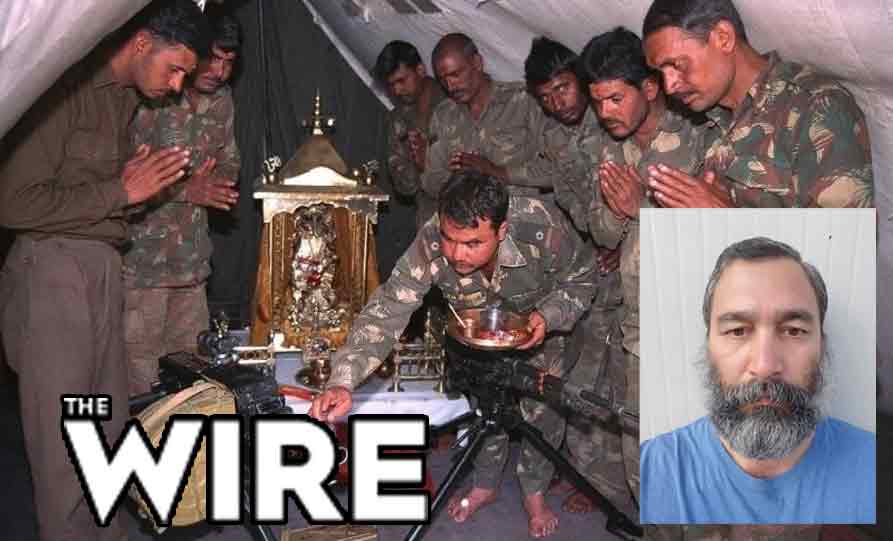
Indian Army Regiments have longstanding war cries and mottos invoking Hindu deities and Sikh Gurus. And no, these are ‘Hinduisation agenda’ impositions under the Hindutva-driven government.
There are numerous examples of war cries where the Indian soldiers invoke their respect for the Gods to boost their morale. Some of the examples include:
Rajputana Rifles – Raja Ramchandra Ki Jai
Rajput Regiment – Bol Bajrang Bali Ki Jai
Dogra Regiment – Jawala Mata Ki jai
Sikh Regiment – Jo Bole So Nihal, Sat Shri Akal
Garwal Rifles – Badri Vishal Lal Ki Jai
Kumaon Regiment – Kalika Mata Ki Jai
Jammu and Kashmir Rifles – Durga Mata Ki Jai
It won’t be surprising if, in the near future, Ali Ahmed or The Wire raises questions over why there are no war cries in the Army Regiments after Allah.
There are several examples where Hindu traditions are being followed by the soldiers religiously. One of the best examples that one may recall is the story of Tanot Mata Mandir in Rajasthan, which has been maintained by the Border Security Force (BSF) since 1965.
As per the story, the temple that is located on the Indo-Pak border was untouched by the heavy shelling done by Pakistan during the 1965 and 1971 wars. The shells that fell in the premises of the temple failed. Those shells are still placed on display in the temple’s premises. Our soldiers still perform Aarti there.
The Sikh Regiment celebrates Baisakhi. Sikh soldiers partake in celebrations, carrying the Guru Granth Sahib Ji on their heads as a mark of respect, and do paath. Indian Army bands also play ‘Abide By Me’, which is a traditional Christian hymn.
The Indian Army also recruits religious scholars or teachers from every religion to provide spiritual guidance to the soldiers whenever needed. These scholars include Pandits, Maulvis, Granthis, Monks, Priests and more. None of these practices has been banned by the Modi government nor the military leadership, which Ali Ahmed claims has “pragmatically cast the weight of its authority and respect it commands on the side of the majoritarian enterprise”, has abandoned these practices to accommodate the supposed Hindutva agenda.
What Ali Ahmed described as ‘politicisation’ of armed forces is actually an increased cooperation and bonhomie between the military leadership and the political leadership of India. And this shift is driven not by a quest for any material gains, but rather by the sheer difference in approach of the BJP-led government from the cowardly Congress-led UPA government that did nothing even after Pakistani terrorists killed dozens of Indians in the Mumbai 26/11 attacks.
Like it or not, a nationalist government will naturally better understand the aspirations of the military and fulfil them efficiently, and will have both will better tuning. This is not politicisation; this is how professional armed forces and elected government operate in a healthy and functional democracy.
However, those who attach religious labels to languages and decry unapologetic expression of the army chief’s Hindu religiosity to malign the image of the Indian Army cannot fathom that India is shunning the liberal-favourite ‘secularism’ wherein Hindu religiosity is suppressed, and expression of other faiths is accepted as secular, peace, harmony, and the idea of India.