Viral posts of alleged Chinese incursion 60 km inside Indian territory in Arunachal Pradesh debunked: Is there a pattern to such recycled claims?
A dramatic claim that Chinese troops had advanced nearly 60 kilometres inside Indian territory in Arunachal Pradesh spread rapidly across social media on Monday night, triggering widespread concern and debate. The posts, shared across Instagram, X, Facebook and other platforms, alleged that the People’s Liberation Army (PLA) had entered Indian territory, established new military camps and occupied a significant stretch of land. Several versions of the claim carried “breaking news” graphics, while others used videos of marching troops and military activity to suggest that a fresh Chinese incursion was underway. Many of these posts garnered hundreds of thousands, and in some cases millions, of views within hours. However, the claim has now been officially debunked. The claims The posts alleged that Chinese troops had crossed approximately 60 kilometres into the Taksing sector of Upper Subansiri district in Arunachal Pradesh. According to the viral narrative, the PLA had established camps inside Indian territory and India had either failed to respond or was suppressing information about the incident. The claim was presented as an ongoing development, with many users urging others to share the videos before they were allegedly “deleted” or “censored.” Is it true that China has occupied several kilometers of land in Arunachal Pradesh?If it's true, then why are our fourth pillar (the media) and the government silent about it?And if it's false, then why doesn't the government come and officially deny these claims? pic.twitter.com/arbOdyGiWk— SARCASTIC (@S0rcastic) July 6, 2026 PIB fact-checks and calls the claims fake The Press Information Bureau’s Fact Check unit examined the viral posts and categorically labelled the claim as fake. According to PIB Fact Check, the videos being circulated do not show any recent Chinese incursion into Arunachal Pradesh. Instead, the visuals are either unrelated military footage or videos that have previously circulated online under entirely different contexts.The fact-check noted that the videos had been misrepresented to create the impression of a fresh Chinese advance into Indian territory. Fake News Alert!Several social media accounts are circulating videos falsely claiming that the Chinese Army has entered 60 km inside India. #PIBFactCheck: This claim is #Fake. The videos being circulated are unrelated and not from the India-China border. … pic.twitter.com/ZuQAvamplC— PIB Fact Check (@PIBFactCheck) July 7, 2026 Indian Army had already rejected similar claims Even before the latest fact-check, the Indian Army had dismissed reports alleging Chinese encroachment and the construction of PLA camps inside Arunachal Pradesh. Responding to similar claims regarding the Taksing sector, the Army stated that reports of Chinese encroachment and establishment of military camps were “incorrect and without any basis.” With both the Indian Army and PIB Fact Check rejecting the claim, there is currently no official evidence to support the allegation that the PLA has advanced 60 kilometres into Indian territory. Familiar pattern of recycled videos The latest incident follows a pattern seen repeatedly during periods of heightened public interest in India-China relations. Old military footage, unrelated videos of troop movements, satellite images or clips from other countries are often repackaged with new captions claiming a fresh Chinese incursion into Indian territory. The visuals may appear convincing in isolation, but they frequently lack any verifiable connection to the location or event described in the accompanying posts. In several instances, accounts designed to resemble news organisations or official sources have amplified such content, allowing it to spread rapidly before fact-checks catch up. Why such claims gain traction? Border issues involving China evoke strong public emotions in India, making them particularly susceptible to misinformation. A sensational claim suggesting that India has lost territory is likely to generate engagement, outrage and rapid sharing, often long before official agencies have an opportunity to respond. According to the experts on information warfare, it have long noted that false or misleading narratives surrounding sensitive geopolitical issues can spread quickly online, especially when accompanied by dramatic visuals. The timing The circulation of these videos has also attracted attention because it coincides with Prime Minister Narendra Modi’s high-profile visit to Indonesia, where India and Indonesia are deepening their strategic partnership in the Indo-Pacific. During the visit, the two countries announced a series of significant defence and strategic initiatives, including agreements on the export of BrahMos cruise missiles, Astra air-to-air missiles, cooperation on critical minerals, and the joint development of Sabang Port, located near the strategically vital Strait of Malacca.
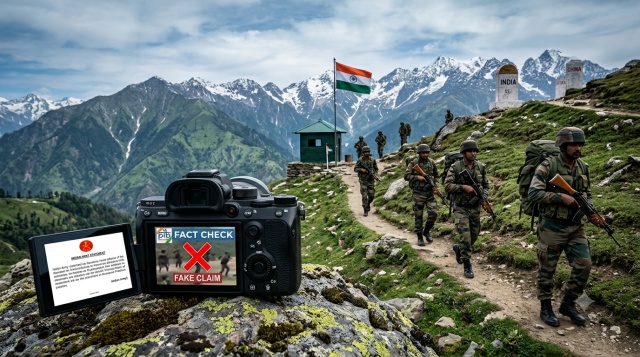
A dramatic claim that Chinese troops had advanced nearly 60 kilometres inside Indian territory in Arunachal Pradesh spread rapidly across social media on Monday night, triggering widespread concern and debate. The posts, shared across Instagram, X, Facebook and other platforms, alleged that the People’s Liberation Army (PLA) had entered Indian territory, established new military camps and occupied a significant stretch of land.
Several versions of the claim carried “breaking news” graphics, while others used videos of marching troops and military activity to suggest that a fresh Chinese incursion was underway. Many of these posts garnered hundreds of thousands, and in some cases millions, of views within hours. However, the claim has now been officially debunked.
The claims
The posts alleged that Chinese troops had crossed approximately 60 kilometres into the Taksing sector of Upper Subansiri district in Arunachal Pradesh. According to the viral narrative, the PLA had established camps inside Indian territory and India had either failed to respond or was suppressing information about the incident.
The claim was presented as an ongoing development, with many users urging others to share the videos before they were allegedly “deleted” or “censored.”
Is it true that China has occupied several kilometers of land in Arunachal Pradesh?If it's true, then why are our fourth pillar (the media) and the government silent about it?And if it's false, then why doesn't the government come and officially deny these claims? pic.twitter.com/arbOdyGiWk— SARCASTIC (@S0rcastic) July 6, 2026
PIB fact-checks and calls the claims fake
The Press Information Bureau’s Fact Check unit examined the viral posts and categorically labelled the claim as fake. According to PIB Fact Check, the videos being circulated do not show any recent Chinese incursion into Arunachal Pradesh. Instead, the visuals are either unrelated military footage or videos that have previously circulated online under entirely different contexts.The fact-check noted that the videos had been misrepresented to create the impression of a fresh Chinese advance into Indian territory.
Fake News Alert!Several social media accounts are circulating videos falsely claiming that the Chinese Army has entered 60 km inside India. #PIBFactCheck: This claim is #Fake. The videos being circulated are unrelated and not from the India-China border. … pic.twitter.com/ZuQAvamplC— PIB Fact Check (@PIBFactCheck) July 7, 2026
Indian Army had already rejected similar claims
Even before the latest fact-check, the Indian Army had dismissed reports alleging Chinese encroachment and the construction of PLA camps inside Arunachal Pradesh.
Responding to similar claims regarding the Taksing sector, the Army stated that reports of Chinese encroachment and establishment of military camps were “incorrect and without any basis.”
With both the Indian Army and PIB Fact Check rejecting the claim, there is currently no official evidence to support the allegation that the PLA has advanced 60 kilometres into Indian territory.
Familiar pattern of recycled videos
The latest incident follows a pattern seen repeatedly during periods of heightened public interest in India-China relations. Old military footage, unrelated videos of troop movements, satellite images or clips from other countries are often repackaged with new captions claiming a fresh Chinese incursion into Indian territory. The visuals may appear convincing in isolation, but they frequently lack any verifiable connection to the location or event described in the accompanying posts.
In several instances, accounts designed to resemble news organisations or official sources have amplified such content, allowing it to spread rapidly before fact-checks catch up.
Why such claims gain traction?
Border issues involving China evoke strong public emotions in India, making them particularly susceptible to misinformation. A sensational claim suggesting that India has lost territory is likely to generate engagement, outrage and rapid sharing, often long before official agencies have an opportunity to respond. According to the experts on information warfare, it have long noted that false or misleading narratives surrounding sensitive geopolitical issues can spread quickly online, especially when accompanied by dramatic visuals.
The timing
The circulation of these videos has also attracted attention because it coincides with Prime Minister Narendra Modi’s high-profile visit to Indonesia, where India and Indonesia are deepening their strategic partnership in the Indo-Pacific. During the visit, the two countries announced a series of significant defence and strategic initiatives, including agreements on the export of BrahMos cruise missiles, Astra air-to-air missiles, cooperation on critical minerals, and the joint development of Sabang Port, located near the strategically vital Strait of Malacca.
The Sabang Port project holds particular strategic importance because of its proximity to the Strait of Malacca, one of the world’s busiest maritime chokepoints through which a substantial share of global trade and energy supplies passes. For India, greater access to Sabang complements its Act East policy and strengthens its maritime presence close to a sea lane that is also crucial for China’s trade and energy imports.
While there is no evidence linking the viral “60 km incursion” videos to Prime Minister Modi’s Indonesia visit or the agreements announced during it, similar misinformation campaigns and exaggerated border claims have surfaced online during previous periods when India has expanded strategic cooperation with Indo-Pacific partners such as Japan and Indonesia.
Border-related narratives tend to gain traction during such diplomatic engagements because they evoke strong public emotions and can divert attention from developments that strengthen India’s regional partnerships. Whether this is merely coincidence or part of a broader information warfare pattern cannot be established in the absence of concrete evidence. Nevertheless, the timing once again highlights how unverified claims surrounding the India-China border can spread rapidly during sensitive geopolitical moments, underscoring the need to rely on official statements and verified information rather than viral social media posts.
Conclusion
The viral claim that Chinese troops advanced 60 kilometres into the Taksing sector of Arunachal Pradesh has been fact-checked as fake by PIB. The videos circulating online do not depict a recent Chinese incursion, and the Indian Army has also rejected allegations of Chinese encroachment in the area.
As with many viral claims involving sensitive national security issues, dramatic visuals and alarming captions should not be treated as evidence on their own. Official statements, verified reporting and authenticated imagery remain the most reliable sources for assessing developments along the India-China border.