Who are Gujarat’s Agariyas? The salt workers of Kutch now set to benefit from ‘School on Wheels’
Every day, salt becomes a part of our meals without us giving it much thought. A pinch of salt goes into vegetables, dal, chapatis, and almost every dish cooked at home. But very few people stop to think about where this salt comes from and who works behind it. Far away from cities and towns, in the vast white deserts of Gujarat’s Rann of Kutch, thousands of families spend months producing the salt that reaches homes across India. These families belong to the Agariya community, a group that has been making salt for generations under some of the toughest conditions imaginable. Now, this community is once again in the spotlight. This time, the focus is not on salt production but on the education of their children. The Gujarat government has announced a new initiative called ‘School on Wheels’, under which 28 retired buses are being converted into mobile classrooms. These moving schools are expected to benefit children of Agariya families living in the desert regions of Kutch and North Gujarat-Saurashtra. At first glance, it may look like a simple education scheme. But behind it lies a larger story about salt production, life in the desert, and the efforts being made to ensure that children from remote communities do not miss out on education. Who are the Agariyas? The Agariya community is mainly found in the Great Rann of Kutch and the Little Rann of Kutch in Gujarat. For generations, they have been involved in salt farming and are among the people responsible for producing a large share of India’s salt. Every year, after the monsoon season ends and the desert begins to dry, thousands of Agariya families leave their villages and move deep into the desert. They stay there for several months to begin the salt-making season. Life in these areas is very different from life in a village or city. There are no regular markets, no large settlements, and very few facilities. All around them lies an endless stretch of white land covered with salt. Despite these conditions, Agariya families continue this work year after year because it is not just their livelihood it is a way of life that has been passed down through generations. The difficult process of making salt Salt production in the Rann of Kutch is a long and demanding process. After reaching the desert, Agariya families prepare special salt fields known as agars. They then drill into the ground to extract saline water lying beneath the surface. This water is pumped into the prepared fields where it is left to evaporate under the sun. The process sounds simple, but it requires constant attention. The water level must be monitored carefully. Changes in temperature and weather can affect salt formation. The families spend months watching over the fields until salt crystals begin to appear. During this period, temperatures often rise above 45 degrees Celsius. Workers spend long hours under the scorching sun. Continuous exposure to salty water can damage the skin of their hands and feet. Yet they continue their work because salt farming is the foundation of their lives and livelihoods. The hidden story behind every packet of salt India is one of the world’s largest salt-producing countries, and Gujarat contributes the biggest share to the country’s total salt output. When people buy a packet of salt from a shop, they rarely think about the journey behind it. But every grain of salt has passed through months of hard work by families living in the desert. The contribution of the Agariya community goes far beyond economics. These families have learned how to survive and work in conditions where many people would find it difficult to stay even for a few days. They face extreme heat, water shortages, health challenges, and isolation from the outside world. Yet they continue to produce the salt that reaches kitchens across the country. For this reason, many people see them not only as salt producers but also as a community known for its resilience, hard work, and ability to adapt to difficult environments. Life in the desert is not easy To understand the Agariya community, it is important to understand what daily life in the desert looks like. Their day usually begins before sunrise. As the morning progresses, temperatures rise quickly. By afternoon, the heat becomes so intense that standing outside for long periods can be difficult. Locally, such harsh sunlight is sometimes described as a “black sun” because of its intensity. The surroundings offer little relief. There are no trees for shade, very few settlements, and often limited access to drinking water. Health services are not easily available, and children have few opportunities for recreation or social activities. Still, Agariya families have spent generations living in these conditions. What appears impossible to many has become a part of everyday life for them. How ‘Meetha Khara’ brought national attention to the community For a l
Every day, salt becomes a part of our meals without us giving it much thought. A pinch of salt goes into vegetables, dal, chapatis, and almost every dish cooked at home. But very few people stop to think about where this salt comes from and who works behind it.
Far away from cities and towns, in the vast white deserts of Gujarat’s Rann of Kutch, thousands of families spend months producing the salt that reaches homes across India. These families belong to the Agariya community, a group that has been making salt for generations under some of the toughest conditions imaginable.
Now, this community is once again in the spotlight. This time, the focus is not on salt production but on the education of their children.
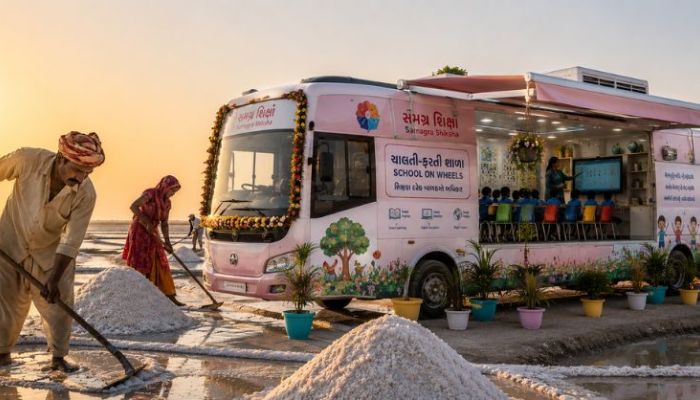
The Gujarat government has announced a new initiative called ‘School on Wheels’, under which 28 retired buses are being converted into mobile classrooms. These moving schools are expected to benefit children of Agariya families living in the desert regions of Kutch and North Gujarat-Saurashtra.
At first glance, it may look like a simple education scheme. But behind it lies a larger story about salt production, life in the desert, and the efforts being made to ensure that children from remote communities do not miss out on education.
Who are the Agariyas?
The Agariya community is mainly found in the Great Rann of Kutch and the Little Rann of Kutch in Gujarat. For generations, they have been involved in salt farming and are among the people responsible for producing a large share of India’s salt.
Every year, after the monsoon season ends and the desert begins to dry, thousands of Agariya families leave their villages and move deep into the desert. They stay there for several months to begin the salt-making season.
Life in these areas is very different from life in a village or city. There are no regular markets, no large settlements, and very few facilities. All around them lies an endless stretch of white land covered with salt.
Despite these conditions, Agariya families continue this work year after year because it is not just their livelihood it is a way of life that has been passed down through generations.
The difficult process of making salt
Salt production in the Rann of Kutch is a long and demanding process.
After reaching the desert, Agariya families prepare special salt fields known as agars. They then drill into the ground to extract saline water lying beneath the surface. This water is pumped into the prepared fields where it is left to evaporate under the sun.
The process sounds simple, but it requires constant attention. The water level must be monitored carefully. Changes in temperature and weather can affect salt formation. The families spend months watching over the fields until salt crystals begin to appear.
During this period, temperatures often rise above 45 degrees Celsius. Workers spend long hours under the scorching sun. Continuous exposure to salty water can damage the skin of their hands and feet. Yet they continue their work because salt farming is the foundation of their lives and livelihoods.
The hidden story behind every packet of salt
India is one of the world’s largest salt-producing countries, and Gujarat contributes the biggest share to the country’s total salt output.
When people buy a packet of salt from a shop, they rarely think about the journey behind it. But every grain of salt has passed through months of hard work by families living in the desert.
The contribution of the Agariya community goes far beyond economics. These families have learned how to survive and work in conditions where many people would find it difficult to stay even for a few days.
They face extreme heat, water shortages, health challenges, and isolation from the outside world. Yet they continue to produce the salt that reaches kitchens across the country.
For this reason, many people see them not only as salt producers but also as a community known for its resilience, hard work, and ability to adapt to difficult environments.
Life in the desert is not easy
To understand the Agariya community, it is important to understand what daily life in the desert looks like.
Their day usually begins before sunrise. As the morning progresses, temperatures rise quickly. By afternoon, the heat becomes so intense that standing outside for long periods can be difficult.
Locally, such harsh sunlight is sometimes described as a “black sun” because of its intensity.
The surroundings offer little relief. There are no trees for shade, very few settlements, and often limited access to drinking water. Health services are not easily available, and children have few opportunities for recreation or social activities.
Still, Agariya families have spent generations living in these conditions. What appears impossible to many has become a part of everyday life for them.
How ‘Meetha Khara’ brought national attention to the community
For a long time, the lives of the Agariyas remained largely unknown outside Gujarat.
That changed when folk singer Aditya Gadhvi’s song ‘Meetha Khara‘, released through Coke Studio Bharat, introduced millions of people to the community.
The song was more than just music. It highlighted the lives, struggles, and hard work of the people who spend months in the salt deserts producing one of the country’s most important everyday commodities.
After the song gained popularity, many people learned for the first time about the Agariya community and their contribution to India’s salt production.
Today, the community is once again making headlines. But this time, the conversation is centred around education and the future of its children.
The biggest challenge to education
While salt production remains the main occupation of the Agariyas, one of the biggest challenges faced by the community has been ensuring education for their children.
When families move to the desert after the monsoon, they do not leave their children behind. Entire families relocate together for several months. As a result, many children spend a significant part of the year away from their regular schools.
For a child living in a city or village, attending school may be routine. But for children growing up in the remote salt deserts, access to education becomes much more complicated.
The problem is not simply about the availability of schools. The larger issue is distance and lifestyle. Since families live and work in isolated areas for long periods, regular schooling becomes difficult.
Many children struggle to continue their studies without interruption. Teachers also face challenges in reaching students regularly in such remote locations. For years, finding a practical solution to this issue remained difficult.
When children cannot reach school
Education officials gradually realised that asking children to travel long distances to school was not enough.
The challenge was unique because the problem was linked directly to the community’s way of life. Families had to remain in the desert for work, and children naturally stayed with them. This meant that conventional schooling methods could not fully address the issue.
The question was simple but important: if children could not easily reach schools, could schools be brought to the children? That idea eventually led to the concept of ‘School on Wheels’.
Gujarat’s school on wheels initiative
Under the School Entrance Festival, the Gujarat government has decided to convert 28 retired buses into mobile classrooms. These buses are being designed as fully functional learning spaces that can reach children living in remote desert regions.
રણના અંતરિયાળ વિસ્તારોનું બાળક પણ ભણશે,શિક્ષણ અને કેળવણી સાથે આગળ વધશે ! આજે શાળા પ્રવેશોત્સવ નિમિત્તે અગરિયા સમુદાયના બાળકોના ઉજ્જવળ ભવિષ્ય માટે માનનીય મુખ્યમંત્રી શ્રી @Bhupendrapbjp જીના માર્ગદર્શનમાં ‘સ્કૂલ ઓન વ્હીલ્સ’ – રણશાળા પહેલ અંતર્ગત ૨૮ વિશેષ સુસજ્જ બસોનું લીલી… pic.twitter.com/PlEMLXgToh— Harsh Sanghavi (@sanghaviharsh) June 23, 2026
The buses are expected to include educational resources, study materials, digital learning facilities, smart TVs, and a child-friendly environment that supports learning.
However, the initiative is not limited to infrastructure alone. Teachers will also be associated with the programme because meaningful education depends not only on classrooms but also on interaction between students and teachers.
રાજ્યભરમાં 'શાળા પ્રવેશોત્સવ'નો પ્રારંભ થયો છે ત્યારે નાયબ મુખ્યમંત્રી શ્રી હર્ષભાઈ સંઘવીના વરદ્હસ્તે ગાંધીનગરના પથિકાશ્રમ એસ.ટી. ડેપો ખાતેથી 28 રણશાળા બસનું લોકાર્પણ કરાયું…અગરિયા સમુદાયના બાળકોના શિક્ષણ માટે ગુજરાત સરકારની અનોખી પહેલ સમાન ‘સ્કૂલ ઓન વ્હીલ્સ’ રણશાળા… pic.twitter.com/KFuyuP6Jse— Gujarat Information (@InfoGujarat) June 23, 2026
The idea behind the project is straightforward. Instead of expecting children to leave their families and travel long distances for education, the education system will travel to them.
In many ways, this marks a shift in thinking. Rather than forcing communities to adapt to traditional systems, the system itself is adapting to the realities of the community.
A new future for children growing up in salt pans
The Rann of Kutch is one of India’s most unique landscapes. But while geography shapes people’s lives, it does not limit their dreams. A child growing up in the desert can dream of becoming a doctor, teacher, engineer, government officer, entrepreneur, or anything else.
The challenge has always been ensuring that these dreams are supported by access to education. For years, many Agariya children faced interruptions in their learning because of the seasonal migration of their families.
Initiatives such as School on Wheels aim to change that reality. By taking education directly to children, the programme seeks to ensure that their future is not determined by their location.
Education has the power to transform not just individual lives but entire communities. When one generation gains better access to learning, new opportunities open up for the next.
Recognising the community behind India’s salt
Discussions about the Agariyas often focus on the hardships they face. While those challenges are real, their contribution is equally important.
The salt used by millions of Indians does not appear automatically on store shelves. It is produced through months of labour by thousands of families working in difficult conditions.
The long days spent under the sun, the constant exposure to salinity, and the months spent in remote desert areas are all part of the story behind every packet of salt.
The Agariya community has mastered the art of living and working in one of the country’s most challenging environments. Through their efforts, they continue to play a vital role in India’s salt industry.
In that context, initiatives like School on Wheels represent more than just an educational programme. They can also be seen as recognition of a community whose contribution often goes unnoticed.
A few months ago, ‘Meetha Khara’ helped introduce the country to the lives of the Agariyas. Today, School on Wheels is adding a new chapter to that story.
The children growing up among the salt pans of the Rann of Kutch may no longer have to choose between their family’s livelihood and their education. Just as their parents help bring flavour to meals across the country, access to education can now help bring new opportunities and possibilities to their future. And perhaps that is the most important outcome of all.