With Indus Water Treaty paused, India proceeds with multiple hydropower projects: Read how Modi govt is putting a stop to Pakistan taking unfair share of India’s rivers
Indus Waters Treaty, the lopsided water-sharing agreement signed between India and Pakistan, was essentially a documentary embodiment of the one-way ‘Aman ki Asha’, until the Modi government decided to put both the ‘treaty’ and the ‘Asha’ in abeyance, because ‘Aman’ was never there in from Pakistan’s side. On 5th January 2026, Union Power Minister Manohar Lal Khattar inspected multiple hydropower projects along the Chenab River. Union Minister @mlkhattar concluded his two-day visit to J&K todayToday, the Minister inspected all three projects of CVPP, namely Pakal Dul (1000 MW), Kiru (624 MW), and Kwar (540 MW), and held a review meeting with the project heads and contractors. The CMD, NHPC, briefed the… pic.twitter.com/lY0LpczctT— PIB India (@PIB_India) January 5, 2026 On the first day of his two-day visit, Minister Khattar visited the Salal Power Station in the Reasi district. The Power Minister directed the officials of the National Hydroelectric Power Corporation (NHPC) to expedite silt removal from the reservoir to enhance storage capacity and optimise water utilisation. Image via PIB Later, Manohar Lal Khattar proceeded to the Kishtwar district, where he laid the foundation for dam concreting works at the 850 Mega Watt Ratle Hydropower Project. The minister instructed the team to maintain high-quality and safety standards, ensuring the timely completion of the project. On the second day, the minister reviewed the progress at three projects under the Chenab Valley Power Projects (CVPP). These included the 624 MW Kiru, the 1000 MW Pakal Dul, and the 540 MW Kwar hydroelectric projects. Minister Khattar met the relevant officials and directed them to ensure commissioning of the Pakal Dul by December 2026, and the Kiru hydel project by March 2028. Taking to X, Minister Khattar wrote, “An inspection and review of the progress of the Kiru (624 MW) and Kwar (540 MW) hydroelectric projects located in Kishtwar was conducted. Necessary directives were issued to the officials and engineers to ensure the completion of work in these two important projects in accordance with high quality, safety standards, and the stipulated timeline. These projects will not only establish a new benchmark in the production of green and renewable energy in Jammu and Kashmir but will also strengthen regional development and infrastructure, thereby creating direct and indirect employment opportunities for the local people.” किश्तवाड़ स्थित कीरू(624MW) तथा क्वार (540 MW) जल विद्युत परियोजनाओं की प्रगति का अवलोकन एवं निरीक्षण किया। इन दो महत्वपूर्ण प्रोजेक्ट में उच्च गुणवत्ता, सुरक्षा मानकों तथा निर्धारित समय-सीमा के अनुरूप कार्य पूर्ण करने हेतु अधिकारियों एवं अभियंताओं को आवश्यक दिशा निर्देश दिए गए।… pic.twitter.com/yuoZ6LTG6A— Manohar Lal (@mlkhattar) January 5, 2026 Amidst the suspension of the Indus Waters Treaty, India is accelerating hydropower development in the upper Chenab basin to boost energy security, utilise water resources, and deprive Pakistan of the unfair reception of India’s waters. Indus Waters Treaty and India’s efforts at maximising its share of water before and after the treaty’s suspension Signed on 19th September 1960 in Karachi, the Indus Water Treaty between India and Pakistan was brokered by the World Bank. This water-sharing agreement governs the use of the Indus River system by India and Pakistan. Signed by Prime Minister Jawaharlal Nehru and Pakistan Field Marshal Ayyub Khan, this treaty allocated the waters of six rivers originating in the Himalayas, broadly divided into two categories: the eastern rivers and the western rivers. The eastern rivers Ravi (origin in Himachal Pradesh), Beas (flows through Himachal Pradesh and Punjab), and Sutlej (originates in Tibet, flows through India into Pakistan) were allocated to India, while Indus, Chenab and Jhelum were allocated to Pakistan. Under the now-suspended IWT, India controlled around 20 per cent of the total water flow, which translated into 33 million acre-feet or 41 billion cubic meters annually, and Pakistan received 80 per cent, which is approximately 135 million acre-feet or 99 billion cubic meters. This agreement allowed limited non-consumptive uses of the western rivers, such as hydropower generation; however, it restricted blocking or dramatically altering water flow into Pakistan. India, however, utilises the waters of eastern rivers for hydropower, irrigation and other purposes. Meanwhile, Indus, Jhelum and Chenab are essential for Pakistan’s hydropower, irrigation and other needs, with Indus being Pakistan’s lifeline. While the signing of the IWT was touted as a historic step towards mutual cooperation and peace, this treaty was not essentially balanced; in fact, it actually benefited Pakistan more due to the higher water flow in its assigned rivers, the western rivers. Pakistan, living up to its reputation of a backstabber, attacked India just five years after the IWT’s signing, although the betrayal culm
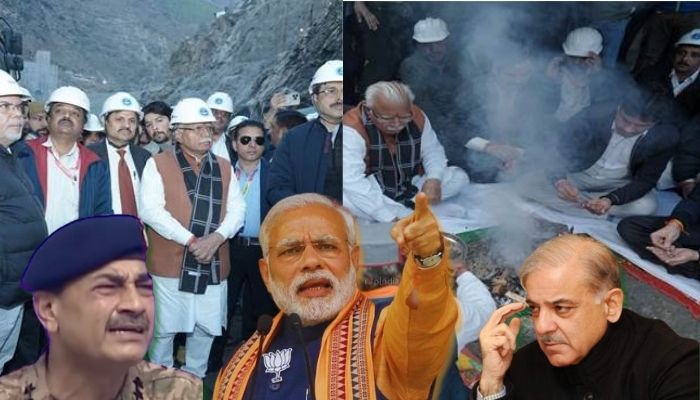

Indus Waters Treaty, the lopsided water-sharing agreement signed between India and Pakistan, was essentially a documentary embodiment of the one-way ‘Aman ki Asha’, until the Modi government decided to put both the ‘treaty’ and the ‘Asha’ in abeyance, because ‘Aman’ was never there in from Pakistan’s side. On 5th January 2026, Union Power Minister Manohar Lal Khattar inspected multiple hydropower projects along the Chenab River.
Union Minister @mlkhattar concluded his two-day visit to J&K today
— PIB India (@PIB_India) January 5, 2026
Today, the Minister inspected all three projects of CVPP, namely Pakal Dul (1000 MW), Kiru (624 MW), and Kwar (540 MW), and held a review meeting with the project heads and contractors. The CMD, NHPC, briefed the… pic.twitter.com/lY0LpczctT
On the first day of his two-day visit, Minister Khattar visited the Salal Power Station in the Reasi district. The Power Minister directed the officials of the National Hydroelectric Power Corporation (NHPC) to expedite silt removal from the reservoir to enhance storage capacity and optimise water utilisation.

Later, Manohar Lal Khattar proceeded to the Kishtwar district, where he laid the foundation for dam concreting works at the 850 Mega Watt Ratle Hydropower Project. The minister instructed the team to maintain high-quality and safety standards, ensuring the timely completion of the project.
On the second day, the minister reviewed the progress at three projects under the Chenab Valley Power Projects (CVPP). These included the 624 MW Kiru, the 1000 MW Pakal Dul, and the 540 MW Kwar hydroelectric projects. Minister Khattar met the relevant officials and directed them to ensure commissioning of the Pakal Dul by December 2026, and the Kiru hydel project by March 2028.
Taking to X, Minister Khattar wrote, “An inspection and review of the progress of the Kiru (624 MW) and Kwar (540 MW) hydroelectric projects located in Kishtwar was conducted. Necessary directives were issued to the officials and engineers to ensure the completion of work in these two important projects in accordance with high quality, safety standards, and the stipulated timeline. These projects will not only establish a new benchmark in the production of green and renewable energy in Jammu and Kashmir but will also strengthen regional development and infrastructure, thereby creating direct and indirect employment opportunities for the local people.”
किश्तवाड़ स्थित कीरू(624MW) तथा क्वार (540 MW) जल विद्युत परियोजनाओं की प्रगति का अवलोकन एवं निरीक्षण किया। इन दो महत्वपूर्ण प्रोजेक्ट में उच्च गुणवत्ता, सुरक्षा मानकों तथा निर्धारित समय-सीमा के अनुरूप कार्य पूर्ण करने हेतु अधिकारियों एवं अभियंताओं को आवश्यक दिशा निर्देश दिए गए।… pic.twitter.com/yuoZ6LTG6A
— Manohar Lal (@mlkhattar) January 5, 2026
Amidst the suspension of the Indus Waters Treaty, India is accelerating hydropower development in the upper Chenab basin to boost energy security, utilise water resources, and deprive Pakistan of the unfair reception of India’s waters.
Indus Waters Treaty and India’s efforts at maximising its share of water before and after the treaty’s suspension
Signed on 19th September 1960 in Karachi, the Indus Water Treaty between India and Pakistan was brokered by the World Bank. This water-sharing agreement governs the use of the Indus River system by India and Pakistan. Signed by Prime Minister Jawaharlal Nehru and Pakistan Field Marshal Ayyub Khan, this treaty allocated the waters of six rivers originating in the Himalayas, broadly divided into two categories: the eastern rivers and the western rivers. The eastern rivers Ravi (origin in Himachal Pradesh), Beas (flows through Himachal Pradesh and Punjab), and Sutlej (originates in Tibet, flows through India into Pakistan) were allocated to India, while Indus, Chenab and Jhelum were allocated to Pakistan.
Under the now-suspended IWT, India controlled around 20 per cent of the total water flow, which translated into 33 million acre-feet or 41 billion cubic meters annually, and Pakistan received 80 per cent, which is approximately 135 million acre-feet or 99 billion cubic meters. This agreement allowed limited non-consumptive uses of the western rivers, such as hydropower generation; however, it restricted blocking or dramatically altering water flow into Pakistan.
India, however, utilises the waters of eastern rivers for hydropower, irrigation and other purposes. Meanwhile, Indus, Jhelum and Chenab are essential for Pakistan’s hydropower, irrigation and other needs, with Indus being Pakistan’s lifeline.
While the signing of the IWT was touted as a historic step towards mutual cooperation and peace, this treaty was not essentially balanced; in fact, it actually benefited Pakistan more due to the higher water flow in its assigned rivers, the western rivers. Pakistan, living up to its reputation of a backstabber, attacked India just five years after the IWT’s signing, although the betrayal culminated in Pakistan’s defeat.
OpIndia reported earlier how then Prime Minister Jawaharlal Nehru signed the controversial Indus Water Treaty with Pakistan without the Indian parliament’s approval or even prior discussion.
Pakistan has repeatedly cited the IWT to assert its claim over the waters of the Indus River system. After enduring numerous Pakistan-sponsored Islamic terror attacks and betrayals since 1960, especially after the April 2025 Pahalgam attack, India decided to cut off the fragile thread of Aman ki Asha it was holding on to, and suspended the Indus Water Treaty and carried out Operation Sindoor.
Pakistani politicians and their rogue madarsa-bred jihadist military leadership continue to threaten to stop India’s breath if the IWT is not restored. Pakistan even knocked on the doors of the International Court of Arbitration to force India into resuming the treaty. However, the Modi government remains undeterred even in the face of nuclear attack threats and continues to bolster India’s hydel infrastructure.
Kishanganga hydel project
Over the years, India has progressively worked to utilise its full allocation under the Indus Water Treaty, particularly after the 2016 Uri Attack. India has, in recent years, increasingly focused on bolstering infrastructure to capture water from the eastern rivers and the limited use of western rivers.
In this direction, PM Modi inaugurated the Kishanganga project on the western river of Jhelum in Jammu and Kashmir in May 2018. Over 300 megawatts of electricity might be generated, and at least 30,000 hectares of land can be irrigated using the approximately 0.65 million acre-feet (MAF) of water that the Kishanganga project stores from the Ujh river. PM Modi’s bold move came despite Pakistan’s protests. The Kishanganga hydropower plant, which is situated on the Indus tributaries, started construction in 2007.
Ratle Hydropower Project
The Ratle hydel project is a joint venture between the NHPC and Jammu and Kashmir State Power Development Corporation, with NHPC having a 51% stake and JKSPDC having a 49% stake. Executed through the Ratle Hydroelectric Power Corporation Limited, the project is an 850 MW run-of-the-river scheme on the Chenab River in Kishtwar. It features a 133m tall gravity dam in addition to an underground powerhouse with four 205 MW Francis turbine units. The project is expected to generate around 3,137 million units (GWh) of electricity annually.
Back in 2017, Pakistan had raised a dispute over the project’s pondage and spillway features, potentially affecting the river flow. While Pakistan claimed that the project design violated the Indus Waters Treaty, India maintained that the project’s design and all features comply with the run-of-the-river rules.
While the construction process was gradual initially due to various challenges, with the project being around 25 to 26% complete, after the suspension of the IWT in 2025, the construction work has been accelerated.
Shahpurkandi Barrage
India had long allowed its share of water flow into Pakistan unused, due to a lack of storage infrastructure. However, with the completion of the Shahpurkandi Barrage in 2024, this flow was halted, and around 1,150 cusecs of water were diverted to Jammu and Kashmir and Punjab for irrigation. With this, India not only maximised the usage of an allocated eastern river for domestic use but also reduced water reaching Pakistan.

Earlier, India built storage facilities including the Bhakra Dam on the Sutlej, the Pong and Pandoh Dam on the Beas, and the Thein (Ranjitsagar) on the Ravi as part of a number of water management projects. India is now able to use almost all (95%) of the water from the eastern rivers because of these efforts and other projects like the Indira Gandhi Nahar Project and the Beas-Sutlej link.
Work to boost reservoir holding capacity at Salal and Baglihar hydel projects
Days after the Pahalgam Islamic terror attack last year, India started work to boost reservoir holding capacity at two hydroelectric projects in Salal and Baglihar. No work has been carried out on these projects since 1987 and 2008/09, respectively, when they were first built. The Indus Water Treaty had prohibited any expansion work on these projects. With the Indus Waters Treaty held suspended, India no longer heeds Pakistan’s ‘concerns’. India is now proceeding with building infrastructure to harness the Indus River, as per its requirements.
Revival of the Ujh multipurpose project
The Modi government is reviving the impending Ujh multi-purpose project in Jammu and Kashmir’s Kathua. The Ujh is a tributary of the Ravi. This project will be used for hydropower, irrigation and drinking purposes. A second Ravi-Beas link below Ujh, which was earlier planned to halt excess Ravi water from entering Pakistan, will now be part of the larger canal project. This would involve a barrage and a tunnel to transfer water to the Beas basin.

Feasibility study for Indus water transfer plan
In June 2025, India chalked out an inter-basin water transfer plan for full utilisation of its share of Indus River waters. A feasibility study is being undertaken for a 113-km canal for diverting surplus flows from Jammu & Kashmir to Punjab, Haryana, and Rajasthan. This canal will link the Chenab River with the Ravi-Beas-Sutlej system.
Under this project, India will optimise its share of water as per IWT by ensuring better use of both eastern (Ravi, Beas, Sutlej) and western (Indus, Jhelum, Chenab) rivers, reducing excess flows into Pakistan.
The proposed canal project will involve connecting the 13 existing canal structures across Jammu and Kashmir, Punjab, Haryana, and Rajasthan, ultimately flowing water into the Indira Gandhi canal system. With effective redirection of surplus waters of the Indus River, India will be able to better cater to domestic requirements and help Punjab, Rajasthan, and Haryana achieve balanced regional water availability even in the face of climate variability and changing rainfall patterns.
Ranbir Canal length doubling
In order to facilitate the 113-km-long canal for redirecting surplus flows from Jammu and Kashmir to Punjab, Haryana, and Rajasthan, the central government is set to double the length of the Ranbir canal from 60 km to 120 km to draw water from the Chenab. Based on feasibility assessments, the Centre will work towards fully utilising the Pratap canal.

These programs supplement current short-term interventions like the Chenab’s Salal hydro projects and the desilting of Baglihar reservoirs.
Acceleration of key storage-based projects post IWT suspension
Following the suspension of the Indus Waters Treaty in 2025, India has expedited the development of infrastructure in the upper Chenab basin, taking a bold shift toward storage-based projects that were restricted under the IWT.
In a major policy shift, the Modi government has fast-tracked around seven stalled projects, including the 1,856 MW Sawalkote Project on the Chenab. This project was stalled for years. In October 2025, it received the much-needed environmental clearance and a renewed budget of Rs 31,380 crore. The project holds strategic significance as it is located across Ramban, Reasi and Udhampur districts. Once operational, the project will generate around 7,534 million units of electricity annually.

Similarly, the 390 MW Dulhasti run-of-the-river project, which has its stage I operational since 2007, had the construction of its second stage stalling. In December 2025, the Centre’s Ministry of Environment gave clearance to the 260-megawatt Dulhasti Stage-II hydel project on the Chenab River in Jammu and Kashmir’s Kishtwar district.
Under Dulhasti Stage-II, water from the Stage-I power station will be diverted through a separate tunnel to form a horseshoe-shaped pondage for Stage-II. In addition, the project includes a surge shaft, a pressure shaft, and an underground powerhouse housing two 130 MW units.
There were many factors that caused delays in commencing construction or accelerating progress of these projects, including IWT-mandated information-sharing, design restrictions, and the exploitation of dispute resolution mechanisms by Pakistan to put hurdles. Pakistan would often claim that even the run-of-the-river projects could allow India to control water flows during low seasons, significantly affecting Pakistan’s water requirements.
Back in 2023-24, India issued notices to modify the Indus Waters Treaty, citing Pakistan’s intransigence in resolving disputes pertaining to the Ratle and Kishanganga HEPs. India also highlighted factors like demographic changes, environmental needs and climate impacts, etc. The diplomatic efforts continued until Pakistan’s bloodied misadventure in Pahalgam warranted a decisive measure.
Notably, the Indus waters system accounts for around 25% of Pakistan’s GDP and sustains crops such as wheat, rice, sugarcane, and cotton. What further exacerbates the situation for Pakistan is its ongoing water crisis. India’s hostile neighbours’ per capita availability is also steadily dropping.
The significance of “Sindhu” for Pakistan can be understood from the fact that Pakistan relies on the Indus basin for around 75% of its renewable water, irrigating about 80-90% of farmland, supporting 90% of agricultural crops, and generating around 20-30% of electricity through hydropower.
Under the prevailing circumstances, if India closes off or drastically decreases flows from the Indus, Jhelum, and Chenab, the consequences could prove disastrous for Pakistan, as their agricultural production could decline, putting food security for millions of Pakistanis at risk in the coming years.
Overall, India’s hydropower capacity in the Indus basin was confined to about 33 projects in planning or construction, generating only around 20-30% of potential output due to IWT-mandated storage caps. After relegating the Indus Waters Treaty to the veritable dustbin, India is working on unlocking its full potential to harness its share of Indus system waters.