Echoes of Manu: How ancient law shapes modern indian jurisprudence
Manusmriti has a complex role in Indian legal thought. In contrast to the Constitution, statutes, and legally binding precedent, it is not a source of enforceable law for constitutional courts. However, because Indian courts frequently discuss the nation’s social history, the development of personal laws, and the moral language that society uses to interpret justice, it still appears in judicial speech. Because of this, Manusmriti is occasionally cited not to “apply” its regulations but rather to highlight more traditional normative concepts, contrast tradition with contemporary constitutional obligations, or uphold moral standards, particularly in situations pertaining to social reform, women’s dignity, and family relationships. In two parts, we look at this limited but recurrent “relevance.” Dr. B. R. Ambedkar’s interaction with Manusmriti is briefly discussed in the first section. Although Ambedkar is renowned for criticising Manusmriti as a representation of caste oppression and graded inequality, his continued involvement with it also shows why historical texts and constitutional authority must be kept distinct in constitutional democracies. The second section focuses on published Supreme Court and High Court rulings where justices have cited Manusmriti, replicating the verses as they appear in the rulings and outlining the rationale for the quotations. The main contention is that Manusmriti serves only as an illustrative or rhetorical reference in Indian adjudication, with the decision’s binding authority deriving from established legislation and constitutional principles. Any study that wishes to demonstrate how “Manu” is still ingrained in Indian legal imagination even in the constitutional era must take into account the fact that Ambedkar’s interaction with Manusmriti was far more complex than the widely held stereotype of an indiscriminate rejection of the entire text. Although he used the dramatic act of burning a copy of the Manusmriti at Mahad in 1927 as a political protest against caste and gender oppression, his sophisticated legal and constitutional work frequently makes a distinction between the text’s objectionable parts and its provisions that could be interpreted as supporting equality and women’s rights, which he occasionally purposefully invoked. Thus, although rejecting birth-based hierarchy as unconstitutional, the same legal culture that Ambedkar transformed through the Constitution continued to regard Manusmriti and the larger Dharmashastra tradition as historical roots of Hindu law. Ambedkar’s protest: targeted, not textualist Ambedkar publicly burned a copy of the Manusmriti in Mahad in 1927 as a moral and political protest against the religious justification for caste inequality and untouchability. Instead of framing the event now known as Manusmriti Dahan Diwas as a philological judgment on every line of the book, Ambedkar specifically framed it as a strike against those particular laws in the text that denied Dalits access to water, temples, education, and dignity. Ambedkar’s response to critics who mocked the act by claiming that Manusmriti was already “outdated” was telling if the text was socially dead, its supporters should not be disturbed by its symbolic burning. This indicates that his target was not a thorough theological exegesis of the entire work, but rather the still-living caste ideology that was drawn from specific passages of Manu. Ambedkar’s doctrinal critique: specific provisions Ambedkar’s criticism of Manusmriti in his later academic and political works regularly focuses on specific doctrinal clusters, the systematic subjugation of women, the immutability of varna by birth, and caste-specific punishments. For instance, he objects to verses that forbid interdining and intermarriage, place women under lifelong male supervision, and impose mutilatory punishments on Shudras who hear or recite the Veda. He interprets these passages as the canonical justification for untouchability and patriarchy. However, contemporary analyses of his writings reveal that Ambedkar did not downplay the text’s historical complexity and was well aware that legal tradition frequently reinterpreted or softened harsh provisions. This further suggests that Ambedkar’s disagreement was with the oppressive strands that were accepted as normative rather than with all of Manu’s ideas or norms. Ambedkar citing Manu in reform debates The Hindu Code Bill discussions provide the most convincing proof that Ambedkar did not view Manusmriti as a monolithic enemy, since he occasionally cited Manu to support progressive reforms, particularly those pertaining to women’s inheritance. According to archival reconstructions of those discussions, Ambedkar used these readings strategically to convince conservative members that his ideas were not completely out of step with the Shastric tradition by pointing out that Manu could be interpreted to recognize certain proprietary rig
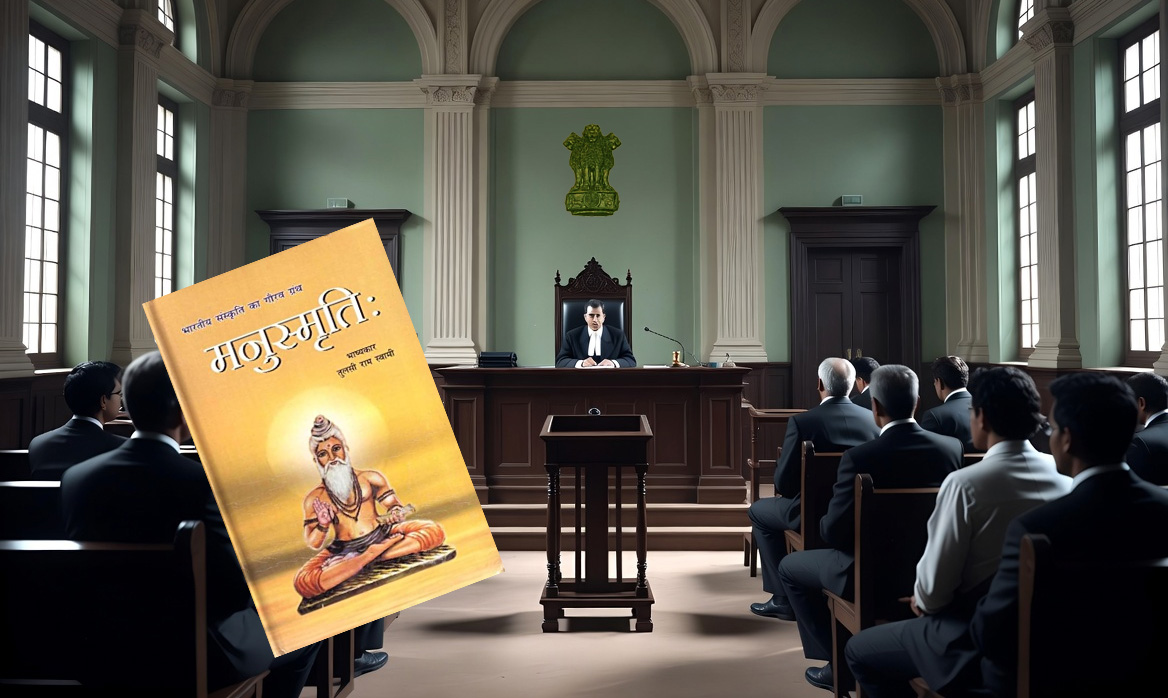

Manusmriti has a complex role in Indian legal thought. In contrast to the Constitution, statutes, and legally binding precedent, it is not a source of enforceable law for constitutional courts. However, because Indian courts frequently discuss the nation’s social history, the development of personal laws, and the moral language that society uses to interpret justice, it still appears in judicial speech. Because of this, Manusmriti is occasionally cited not to “apply” its regulations but rather to highlight more traditional normative concepts, contrast tradition with contemporary constitutional obligations, or uphold moral standards, particularly in situations pertaining to social reform, women’s dignity, and family relationships.
In two parts, we look at this limited but recurrent “relevance.” Dr. B. R. Ambedkar’s interaction with Manusmriti is briefly discussed in the first section. Although Ambedkar is renowned for criticising Manusmriti as a representation of caste oppression and graded inequality, his continued involvement with it also shows why historical texts and constitutional authority must be kept distinct in constitutional democracies. The second section focuses on published Supreme Court and High Court rulings where justices have cited Manusmriti, replicating the verses as they appear in the rulings and outlining the rationale for the quotations. The main contention is that Manusmriti serves only as an illustrative or rhetorical reference in Indian adjudication, with the decision’s binding authority deriving from established legislation and constitutional principles.
Any study that wishes to demonstrate how “Manu” is still ingrained in Indian legal imagination even in the constitutional era must take into account the fact that Ambedkar’s interaction with Manusmriti was far more complex than the widely held stereotype of an indiscriminate rejection of the entire text. Although he used the dramatic act of burning a copy of the Manusmriti at Mahad in 1927 as a political protest against caste and gender oppression, his sophisticated legal and constitutional work frequently makes a distinction between the text’s objectionable parts and its provisions that could be interpreted as supporting equality and women’s rights, which he occasionally purposefully invoked. Thus, although rejecting birth-based hierarchy as unconstitutional, the same legal culture that Ambedkar transformed through the Constitution continued to regard Manusmriti and the larger Dharmashastra tradition as historical roots of Hindu law.
Ambedkar’s protest: targeted, not textualist
Ambedkar publicly burned a copy of the Manusmriti in Mahad in 1927 as a moral and political protest against the religious justification for caste inequality and untouchability. Instead of framing the event now known as Manusmriti Dahan Diwas as a philological judgment on every line of the book, Ambedkar specifically framed it as a strike against those particular laws in the text that denied Dalits access to water, temples, education, and dignity. Ambedkar’s response to critics who mocked the act by claiming that Manusmriti was already “outdated” was telling if the text was socially dead, its supporters should not be disturbed by its symbolic burning. This indicates that his target was not a thorough theological exegesis of the entire work, but rather the still-living caste ideology that was drawn from specific passages of Manu.
Ambedkar’s doctrinal critique: specific provisions
Ambedkar’s criticism of Manusmriti in his later academic and political works regularly focuses on specific doctrinal clusters, the systematic subjugation of women, the immutability of varna by birth, and caste-specific punishments. For instance, he objects to verses that forbid interdining and intermarriage, place women under lifelong male supervision, and impose mutilatory punishments on Shudras who hear or recite the Veda. He interprets these passages as the canonical justification for untouchability and patriarchy. However, contemporary analyses of his writings reveal that Ambedkar did not downplay the text’s historical complexity and was well aware that legal tradition frequently reinterpreted or softened harsh provisions. This further suggests that Ambedkar’s disagreement was with the oppressive strands that were accepted as normative rather than with all of Manu’s ideas or norms.
Ambedkar citing Manu in reform debates
The Hindu Code Bill discussions provide the most convincing proof that Ambedkar did not view Manusmriti as a monolithic enemy, since he occasionally cited Manu to support progressive reforms, particularly those pertaining to women’s inheritance. According to archival reconstructions of those discussions, Ambedkar used these readings strategically to convince conservative members that his ideas were not completely out of step with the Shastric tradition by pointing out that Manu could be interpreted to recognize certain proprietary rights of women. If one assumes that Ambedkar’s position was an unqualified denunciation of the entire text, then this legislative strategy that criticizes oppressive verses while invoking more egalitarian strands makes little sense. Rather, it represents a jurist engaging critically with an inherited source of Hindu law, drawing arguments for equality from within while demolishing its casteist core.
Manu within Hindu Law tradition
Manusmriti was a foundational Dharmashastra for pre-modern and colonial jurists, but it was never the only or final word. Later commentators such as Vijnaneshwara (Mitakshara) and Jimutavahana (Dayabhaga) mediated it, adopting and modifying Manu’s rules on subjects like inheritance and joint families. According to contemporary doctrinal accounts, the Dharmashastra corpus, which includes Manu, Yajnavalkya, and others, is the ultimate source of both major schools of Hindu law, Mitakshara, which spread throughout most of India, and Dayabhaga in Bengal. This means that Manu’s categories, concepts, and terminology were carried over into the classical law that colonial courts subsequently treated as “Hindu personal law.” Therefore, even before to independence, Indian courts applied a juristically filtered Manu rooted in commentarial traditions that adapted his rules to local and temporal settings rather than applying “Manusmriti” in its entirety.
Manu’s juristic legacy in codified Hindu Law
Even though the codified Hindu law statutes of the 1950s and later on guardianship, succession, marriage, and minority were specifically written to overturn numerous injustices that can be linked to the Manusmriti and later Dharmashastras, they nevertheless maintain a number of legal categories and presumptions influenced by this tradition. Despite being redefined and trimmed by legislation and case law, concepts like coparcenary, joint family property, sapinda relationships, and ritual proximity are historically rooted in Manu-centered Dharmashastra discourse, and courts continue to interpret them using classical commentaries that heavily reference Manusmriti.
As the Law Minister spearheading these reforms, Ambedkar recognised this continuity. By enacting legislation to change Hindu law, he made sure that the aspects of Manu that went against constitutional equality were eliminated while the structural ideas that allowed for the maintenance of orderly family, property, and duty relationships within a democratic, secular framework could be preserved.
How Indian courts have actually used Manusmriti
Manusmriti is not a legally binding source in contemporary Indian law; instead, courts base their decisions on the Constitution, statutes, and precedents. However, courts may use ancient writings, such as Manusmriti, as cultural ethical examples to highlight principles like equality, decency, and women’s protection. The court is employing a well-known passage as a moral reminder when enforcing constitutional or statutory duties (dowry law, women’s safety, victim compensation, PCPNDT enforcement, etc.) in the majority of recorded “Manusmriti citations,” rather than “applying” Manusmriti as law.
Supreme Court using Manusmriti
Up to 2019, the Supreme Court has directly quoted or cited Manusmriti in seven published judgments, frequently in Hindu personal law, interpretive theory, or rights-related matters, according to survey study based on SCC Online and Indiankanoon. Vimla Bai v. Hiralal Gupta is one early example found by this research, in which the Court addressed the idea of “bandhava” (kinsman) in Hindu inheritance and mentioned Manusmriti as one of the classical dharmashastric sources influencing Mitakshara doctrine, even though the judgment does not include lengthy Sanskrit passages. Later, in Vijay Narayan Thatte v. State of Maharashtra, the Court again relied more on the conceptual framework than on duplicating specific verses, citing Mimamsa interpretation principles and mentioning Manusmriti as part of the shastric foundation.
The Supreme Court’s 2025 ruling, which maintained a father’s conviction for raping his minor daughter under the POCSO Act and cited Manusmriti to bolster its condemnation of incestuous sexual abuse, is the most notable contemporary example. In order to support their claim that granting bail would violate the constitutional promise of justice to every child, the Bench of Justices Aravind Kumar and Sandeep Mehta cited a verse that highlights the honor and importance of women in the home and society. They noted that this sentiment now aligns with the “constitutional vision” of non-negotiable dignity for women and children. In scholarly writing, you can describe this as “a verse from Manusmriti extolling the protection and honor owed to women in the family,” reference the case and the report, and then explain how the Court transformed a cultural cliché into a constitutional principle that upholds women’s rights without having to quote the original verse.
The position of personal law and dharmashastra sources following the Constitution is another significant area of Supreme Court doctrine that indirectly supports Manu’s legal significance. The Court emphasized in Sri Krishna Singh v. Mathura Ahir (AIR 1980 SC 707) that judges must apply “recognised and authoritative sources,” such as Smritis and commentaries, in matters of Hindu personal law unless they are modified by statute or custom. This keeps Manusmriti within the recognised canon of sources, even if the judgment does not quote any specific shloka. This method is essential to your research argument because it demonstrates how the highest court views Manu and other Smritis as part of the legal lineage that continues to influence uncodified portions of Hindu law, always subject to statutory override and constitutional review.
High Court using Manusmriti
When it comes to maintenance responsibilities in Hindu joint families, High Courts have been more inclined than the Supreme Court to replicate or at least closely paraphrase certain phrases from the Manusmriti. The Delhi High Court used a verse from Chapter 9 (often cited as 9.108) that establishes the karta of a Mitakshara joint family’s obligation to support all dependent members, including wives and children, as historical support for the contemporary legal duty of family maintenance in two Narang v. Narang rulings, according to the “Manusmriti and the Judiciary” study.
The 2024 Jharkhand High Court ruling on a maintenance dispute, in which Justice Subhash Chand cited Manusmriti to determine a wife’s entitlement to support, is a more recent and contentious example. According to media reports and summaries, the court framed the ideal Hindu view of women’s role in the home by citing a well known passage that is frequently paraphrased as follows: “where the women of a family are miserable, that family is soon destroyed and the family flourishes where the women are content.” The court then denied the specific wife maintenance based on the facts.
Manusmriti verses have also been used by High Courts to influence the law of spousal and post-marital obligations in various situations. In a case mentioned in the same survey (Das v. Das), the Chhattisgarh High Court read a traditional dharmashastric duty into contemporary matrimonial law by citing an uncited Manu verse regarding a husband’s ongoing duty to his wife. The court held that even in cases where a husband receives a decree for the restoration of conjugal rights, he is still obligated to pay maintenance if she does not return. Manu’s legal categories and moral rhetoric have been selectively re-used by courts to fill statutory gaps and to justify duties consistent with modern understandings of family justice. This type of reasoning where an ostensibly patriarchal text is used to protect a financially vulnerable wife fits the larger thesis.
Court’s treating Manusmriti as ‘holy book’ or ‘scripture’
In addition to direct verse-level quotes, certain High Court rulings have publicly referred to Manusmriti as a “holy book” or “our scriptures,” which is pertinent to the judiciary’s current normative positioning of Manu. The Bench referred to the Manusmriti as a “holy book” while refusing to quash a FIR against a political spokesperson accused of tearing it on live television, according to coverage of an Allahabad High Court case in 2025. This phrase subtly elevates the text’s symbolic status even though the order is basically about criminal procedure and freedom of religion.
Similar to this, women’s organizations and activists criticized Delhi High Court judge Justice Prathiba M. Singh for praising Manusmriti for giving women in Indian scriptures a “respectable position” in an extrajudicial speech at a FICCI event. They pointed out the conflict between this praise and the Constitution’s commitment to equality.
Conclusion
Dr. B.R. Ambedkar’s engagement with the Manusmriti is an example of a selective and principled critique, he acknowledged the text’s wider juristic complexity and possibility for reformist readings while focusing on the sections that solidified gender oppression and caste systems. In the Hindu Code Bill debates, he deliberately invoked egalitarian strands like women’s proprietary rights to advance legislative equality, exhibiting a jurist’s discernment rather than outright rejection. His symbolic burning at Mahad in 1927 protested specific verses sanctioning untouchability and unequal punishments. His constitutional vision is in line with this balanced approach, keep the flexible frameworks for a democratic system while eliminating the oppressive. Manusmriti verses on family maintenance (such as Chapter 9 duties of the karta), women’s household honor, and moral condemnation of incest are cited by Supreme Court and High Court benches to support statutory rights under POCSO or CrPC without endorsing the text’s discriminatory core. This selectivity is echoed in contemporary judicial practice.
After being scrutinized through the Mitakshara and Dayabhaga schools and selectively confirmed after codification, Manusmriti’s persistent presence in Indian adjudication highlights its deeply embedded significance within the Dharmashastra tradition that informs Hindu personal law. Courts use Manu as illustrative moral rhetoric or historical genealogy, always subservient to constitutional supremacy and equality under Articles 14–15, from Sri Krishna Singh v. Mathura Ahir, which affirms Smritis as authoritative sources, to recent Jharkhand and Delhi High Court invocations of verses on spousal duties and women’s “respectable position.” Manu’s evolution from prescriptive code to contested cultural reference is revealed by this critiqued yet operationalized integration, which embodies Ambedkar’s legacy: a legal system that respects indigenous heritage while subjecting it to egalitarian scrutiny, ensuring Manu survives not as sovereign law but as a pruned ancestor in India’s judicial DNA.