Highest voter turnout marks assembly elections in Assam, Kerala, Puducherry, Tamil Nadu and West Bengal: The possible reasons for the unprecedented numbers and who stands to benefit from it
The election season has captivated India, as the legislative assemblies of Assam, Kerala, Puducherry, Tamil Nadu and West Bengal, along with the bye-polls for 8 assembly constituencies in Goa, Gujarat, Karnataka, Maharashtra, Nagaland and Tripura, are taking place in April, with the outcome scheduled for the 4th of May (Monday). This election, like all others, is accompanied by its share of controversies, debates, allegations and protests. However, it is also distinguished by another significant factor that has drawn attention, which is the unprecedented voter turnout, specifically in Tamil Nadu and West Bengal. The Election Commission of India also lauded the two states for “the highest-ever poll participation since Independence” and “saluted every voter” for the same. It was referred to as a landmark moment in India’s democratic progress. General Elections to Legislative Assemblies and bye-elections 2026#TamilNadu (84.69%) and #WestBengal (Phase-I) (91.78%) record highest-ever poll participation since IndependenceRead more : https://t.co/VTBMzHvamP pic.twitter.com/jYGAbAvgRu— Election Commission of India (@ECISVEEP) April 23, 2026 Notably, the development took place after the critical Special Intensive Revision (SIR) exercise, which sought to prioritise authentic voters and eliminate illegitimate names, including deceased, migrated or fabricated entries, from the list to fortify the democratic process. A record voter turnout: A steady element from West Bengal to Puducherry On 23rd April (Thursday), voting in Tamil Nadu and West Bengal started at 7:00 am with improved voter facilitation and extensive surveillance. Tamil Nadu had an excellent overall voter engagement of 84.69% until 5:00 pm. This exceeded its previous peak of 78.29%, which was attained at the assembly elections in 2011. The gender-wise engagement is even more impressive. The participation was higher among women (85.76%) as compared to men (83.57%). This was in line with the state’s trend of growing female voter turnout and demonstrated a considerable spike over prior elections. Voter turnout in the state has historically wavered from the early decades following independence. Moderate attendance was observed throughout the 1950s and 1960s. However, there was a surge starting in the late 20th century. Nonetheless, the 2026 numbers reflected a substantial boost that put the state at its highest level of democratic involvement ever. On the other hand, West Bengal’s Phase-I polling registered an exceedingly exceptional turnout of 91.78% by 5:00 pm, surpassing its previous breakthrough of 84.72%, which was reached in 2011. Females again took the lead at 92.69% as male voters stood at 90.92%. This pointed to a widespread trend of high female voter turnout. West Bengal already displayed staggering voting figures, counted frequently among the greatest in the nation. However, the magnitude of this turnout is especially noteworthy. The state gradually rose to overtake 80% in the 1980s and 1990s from levels in the mid-50% range in the early post-Independence years. This was constantly maintained in the following polls. Thus, Phase-I turnout illustrated both continuity and a sharp boost in voter mobilisation and fervour. The concluding Phase-II is going to be held on 29th April (Wednesday) and considering the precedent, it is also expected to establish new benchmarks. The voter turnout for the assembly elections in Assam, Kerala and the Union Territory of Puducherry similarly registered outstanding statistics on 9th April. Assam scored 85.38% turnout while Puducherry was at 89.83%, delivering the highest numbers. The best poll participation rates touched by Assam and Puducherry in the past were 84.67% and 86.19%, respectively, in the 2016 and 2011 assembly elections. Image via Election Commission According to the Election Commission, 78.03% cast their votes in Kerala as compared to 77.35% in 2016 and 74.06% in 2021 during the COVID-19 pandemic. This represented the third-highest voter turnout in the state’s history. The three regions also boosted the greatest female voter turnout with 85.96% in Assam, 80.86% in Kerala and 91.33% in Puducherry. What brought about the unparalleled totals The stunning boom can be attributed to several reasons, ranging from the enthusiasm of the populace to be a part of the democratic process, the monumental SIR initiative designed to cleanse the electoral rolls across the country, alongside fear and intimidation from the politicians and even an attempt to defend their illegal presence in India. A phenomenon recently came to light in which multiple videos with women discussing the abrupt absence of house helps in Gurgaon and Delhi-National Capital Region (NCR) were posted online. OpIndia spoke with the latter, and the first clear pattern was that the majority were from West Bengal. In fact, the unique accent of some suggested that they were likely Bengalis from Bangladesh
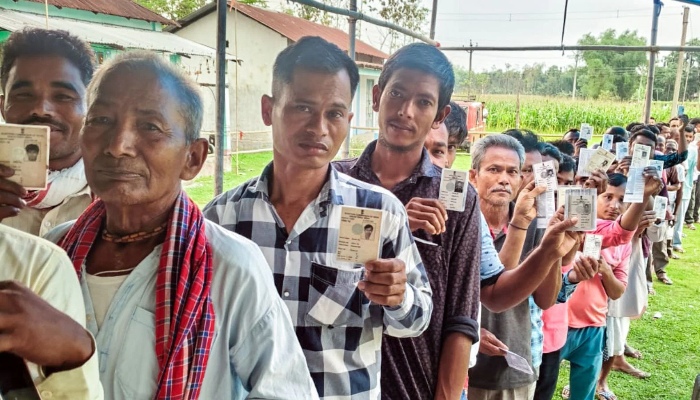
The election season has captivated India, as the legislative assemblies of Assam, Kerala, Puducherry, Tamil Nadu and West Bengal, along with the bye-polls for 8 assembly constituencies in Goa, Gujarat, Karnataka, Maharashtra, Nagaland and Tripura, are taking place in April, with the outcome scheduled for the 4th of May (Monday).
This election, like all others, is accompanied by its share of controversies, debates, allegations and protests. However, it is also distinguished by another significant factor that has drawn attention, which is the unprecedented voter turnout, specifically in Tamil Nadu and West Bengal. The Election Commission of India also lauded the two states for “the highest-ever poll participation since Independence” and “saluted every voter” for the same. It was referred to as a landmark moment in India’s democratic progress.
General Elections to Legislative Assemblies and bye-elections 2026#TamilNadu (84.69%) and #WestBengal (Phase-I) (91.78%) record highest-ever poll participation since IndependenceRead more : https://t.co/VTBMzHvamP pic.twitter.com/jYGAbAvgRu— Election Commission of India (@ECISVEEP) April 23, 2026
Notably, the development took place after the critical Special Intensive Revision (SIR) exercise, which sought to prioritise authentic voters and eliminate illegitimate names, including deceased, migrated or fabricated entries, from the list to fortify the democratic process.
A record voter turnout: A steady element from West Bengal to Puducherry
On 23rd April (Thursday), voting in Tamil Nadu and West Bengal started at 7:00 am with improved voter facilitation and extensive surveillance. Tamil Nadu had an excellent overall voter engagement of 84.69% until 5:00 pm. This exceeded its previous peak of 78.29%, which was attained at the assembly elections in 2011.
The gender-wise engagement is even more impressive. The participation was higher among women (85.76%) as compared to men (83.57%). This was in line with the state’s trend of growing female voter turnout and demonstrated a considerable spike over prior elections.
Voter turnout in the state has historically wavered from the early decades following independence. Moderate attendance was observed throughout the 1950s and 1960s. However, there was a surge starting in the late 20th century. Nonetheless, the 2026 numbers reflected a substantial boost that put the state at its highest level of democratic involvement ever.
On the other hand, West Bengal’s Phase-I polling registered an exceedingly exceptional turnout of 91.78% by 5:00 pm, surpassing its previous breakthrough of 84.72%, which was reached in 2011. Females again took the lead at 92.69% as male voters stood at 90.92%. This pointed to a widespread trend of high female voter turnout.
West Bengal already displayed staggering voting figures, counted frequently among the greatest in the nation. However, the magnitude of this turnout is especially noteworthy. The state gradually rose to overtake 80% in the 1980s and 1990s from levels in the mid-50% range in the early post-Independence years. This was constantly maintained in the following polls.
Thus, Phase-I turnout illustrated both continuity and a sharp boost in voter mobilisation and fervour. The concluding Phase-II is going to be held on 29th April (Wednesday) and considering the precedent, it is also expected to establish new benchmarks.
The voter turnout for the assembly elections in Assam, Kerala and the Union Territory of Puducherry similarly registered outstanding statistics on 9th April. Assam scored 85.38% turnout while Puducherry was at 89.83%, delivering the highest numbers. The best poll participation rates touched by Assam and Puducherry in the past were 84.67% and 86.19%, respectively, in the 2016 and 2011 assembly elections.
Image via Election Commission
According to the Election Commission, 78.03% cast their votes in Kerala as compared to 77.35% in 2016 and 74.06% in 2021 during the COVID-19 pandemic. This represented the third-highest voter turnout in the state’s history. The three regions also boosted the greatest female voter turnout with 85.96% in Assam, 80.86% in Kerala and 91.33% in Puducherry.
What brought about the unparalleled totals
The stunning boom can be attributed to several reasons, ranging from the enthusiasm of the populace to be a part of the democratic process, the monumental SIR initiative designed to cleanse the electoral rolls across the country, alongside fear and intimidation from the politicians and even an attempt to defend their illegal presence in India.
A phenomenon recently came to light in which multiple videos with women discussing the abrupt absence of house helps in Gurgaon and Delhi-National Capital Region (NCR) were posted online. OpIndia spoke with the latter, and the first clear pattern was that the majority were from West Bengal. In fact, the unique accent of some suggested that they were likely Bengalis from Bangladesh. The second clear trend was that Bengali Muslims made up the vast bulk of these maids escaping Gurgaon.
Moreover, it was revealed that they were receiving calls from local All India Trinamool Congress (AITC or TMC) party leaders who were pushing them to show up for the ongoing polls. A woman quoted her area’s TMC worker who stated, “Voting this time is important, even if you can’t vote next time. You have to come.”
They were blackmailed that their land would be occupied and their homes destroyed if the party is not elected to power. The TMC representatives even threatened that they would be transported to the Bangladesh border and either shot or pushed into the country if Bharatiya Janata Party (BJP) assumed control of the state.
“I don’t know why they are so desperate this time. They are scaring us and forcing us to return. They are saying if they win, they will not let the National Register of Citizens (NRC) happen. If the BJP comes to power, NRC will take place and we will all be killed,” a woman voiced. OpIndia also interviewed several Hindu domestic workers who were also departing, albeit in smaller numbers.
They highlighted, “This is our last chance to save Bengal. See how the Muslims are going in thousands to vote for TMC. We have to go too. If they come back, we will never be able to go back. Do you know what they did to us in Sandeshkhali? Do you know how they treat us. Bengal will become Bangladesh, that is what they want. This is why these Muslims are going to vote.”
A Short Note on Bengal Voter TurnoutThe massive voter turnout in the first phase of voting in West Bengal Assembly election, about 92.5% compared to 82.5% earlier, means the BJP has swept this phase.Let us understand this: TMC’s core vote, Muslims, was already voting at peak…— Kanchan Gupta (@KanchanGupta) April 23, 2026
The evident desperation of the TMC, which might have sensed a brewing wave against their corrupt and anti-Hindu government, likely contributed to the hike in voter turnout. However, there is a different side of this story that contends that Muslims were already voting en masse for the TMC and the growth is categorically ascribed to Hindus backing the saffron party. There was no serious jump in polling percentages after 5:30 pm, leading up to the final turnout statistics as opposed to 2024 and 2021.
Indians fly home to vote
Indian voters from abroad and other states rushed to their native regions to utilise their Constitutional right in an exemplary manner. Tamils from Singapore, Malaysia and the Gulf states headed to the central region of Tamil Nadu, which includes Tiruchy, Thanjavur, Tiruvarur, Nagapattinam, Pudukottai, Ariyalur and Peramblur. Flights from Kuala Lumpur had been fully booked for the last few days.
The Gulf, Singapore, Malaysia, Sri Lanka, Dubai, Sharjah, Kuwait, Abu Dhabi and Muscat employ lakhs of Tamils. There are roughly 12 daily flights to these locations from airlines like Air India Express, Scoot Air, Indigo Air and Sri Lankan Air. Many non-resident Indian families also landed from other countries such as Australia and the United Kingdom.
A video of an Indigo Flight captain asking passengers journeying from Singapore to Tiruchirappalli how many were going to vote went viral because nearly all of them raised their hands.
Record number of NRIs flew in from the UK, Scotland, Singapore and beyond.. just to cast their vote!Domestic airfares into Tamilnadu surged sharply on polling day, nearly tripling, as travel demand spikedOn a Singapore–Trichy IndiGo flight, the pilot dropped the usual… pic.twitter.com/RTxacARVdb— Nabila Jamal (@nabilajamal_) April 23, 2026
On 21st (Tuesday) and 22nd (Wednesday) April more than 13 lakh people used public transport from Chennai to their hometowns in various regions of Tamil Nadu and other states to cast their votes. 97 trains with a combined daily capacity of almost 3.65 lakh individuals left Chennai Central and 85 from Chennai Egmore and Tambaram during this time. 7 lakh passengers reportedly took the train from Chennai in these two days. The railways also ran an unreserved special train from Chennai to Madurai to meet the demand.
ஜனநாயக கடமையாற்ற சொந்த ஊருக்கு கிளம்பிய மக்கள்; கிளாம்பாக்கம் பேருந்து நிலையத்தில் படையெடுத்த கூட்டம்#Kilambakkam | #TNElection | #Election2026 | #ElectionWithPT pic.twitter.com/R35mXq6RyX— PttvOnlinenews (@PttvNewsX) April 21, 2026
Chennai, which has a sizable population from other districts, underwent a massive outflow as professionals, workers and students readied themselves to head back to their homes. Transport services in key cities like Tiruchirappalli, Madurai, Coimbatore, Salem and Tirunelveli also saw an uptick to assist the voter movement. However, the fares also rose steeply as people were required to spend double and even triple the usual amount.
SIR ensured a clean and effective voting process
SIR, which represents a monumental action by the Election Commission to eliminate the irregularities tied to the voter list and secure the democratic rights of the eligible citizens, has extensively added to the remarkable achievement.
“Though we have experienced that the turnout is usually less in assembly polls, this polling percentage reflects the deletion of false and dead voters through SIR and also the improvement that has been brought in the electoral list through technology. Especially in Bengal the bogus voters have been removed through the impartial implementation of an honest process, who were not even Indian citizens. This will influence the citizens to raise their voice. The value of their votes will be reflected in the polls this time,” union minister Piyush Goyal pointed out, emphasising the role of the pivotal program.
More importantly, there is a history of high voter participation pertaining to SIR. Voter turnout in the 2025 assembly elections was much higher than in earlier elections following the exercise in Bihar and climbed from 57.29% in 2020 and 56.91% in 2015 to 67.13% in 2025. This resulted from the Election Commission’s revision of the rolls, which removed lakhs of names that were deemed to be duplicates, dead or otherwise ineligible.
It can be illustrated by the example of Maynaguri, where the electorate crossed 7,000 voters and turnout expanded to around 95%, yielding nearly 9,500 more votes than in 2021. This is real engagement growth, not statistical inflation. Both fresh voters and those who were inactive or migrants had to formally register their names during the procedure. Maynaguri truly exhibited expansion and a true broadening of the vote base.
SIR reduced the number of voters by deleting phoney names and confirming that only valid people were retained or added to the list, prompting a cleaner and more transparent process as well as enhancing public participation, as indicated by these figures.
Is it a verdict in support of incumbency or against it
The parties are actively showcasing the significant voter turnout as a testament to their victory. The TMC in West Bengal is claiming that this represents a pro-government vote, while the BJP has countered that it signals a change aimed at bringing their party to power and liberating the state from years of divisive and corrupt policies.
Nevertheless, if the significance of the Bihar assembly election result is taken into account, it could be a positive for the BJP. However, the likelihood of relentless anti-SIR rhetoric from Chief Minister Mamata Banerjee and other opposition leaders, coupled with aforementioned unfounded threats, could have also motivated anxious people to cast their votes. The heightened security and mobilisation efforts of the Election Commission, even in the most remote and sensitive pockets also allowed individuals to freely exercise their franchise.
There might be countless factors contributing to such a significant voter turnout, and only the day of the results will disclose who really stands to gain from it. Until that moment, the sequence of claims and counterclaims will persist without interruption.