SP delegation tries to exploit murder of minor girl in Ghazipur: People protest, refuse to allow the leaders into the village, former minister Ram Asre Vishwakarma wounded in confrontation
The events that happened in Uttar Pradesh’s Ghazipur on 22nd April (Wednesday) should not be dismissed as a simple incident. The manner in which leaders of the Samajwadi Party (SP) became active in the charged environment following the tragic death of a minor girl and the subsequent developments serves as a notable political indicator. An SP delegation attempted to visit the grieving family, but they were met by villagers at the outskirts of the area. A confrontation broke out, which escalated into stone-throwing. During this conflict, former Minister Ram Asre Vishwakarma suffered a serious head injury and the villagers eventually succeeded in preventing the leaders from entering the hamlet. It was not just an eruption of collective anger but rather represented a response to a political approach that has been consistently shaped by caste considerations. The significant distinction this time was that the populace not only acknowledged this political maneuvering but also delivered a retaliation, specifically tailored for such a circumstance, and completely unforeseen by anyone. The attempt to politicise the tragedy backfire The 16-year-old girl who passed away in Ghazipur was a member of the Vishwakarma community, whereas the accused identified as Pandey belongs to the Brahmin community. The rapid political reaction that followed the revelation of the details has prompted numerous inquiries. Offering condolences and seeking justice are expected but the inclination to interpret these instances immediately through a caste perspective inevitably raises doubts about the underlying motives. The approach taken by SP officials upon their arrival in the village strengthened the doubt that their intention was not solely to convey condolences, but also to concoct a particular narrative. Consequently, the fury of the residents escalated and in the subsequent outburst, Vishwakarma who is also from the victim’s community found himself subjected to their ire. The continuous plot of constructing caste-centric propaganda Socialist political movements have historically been criticised for trying to gain political advantage by interpreting occurrences via a caste-oriented lens. This pattern was evident in the Ghazipur incident as well. The circulation of false information on social media, the promotion of unverified accusations like allegations of gang rape and efforts to provoke discord between two communities seemed to be components of a conspiracy that has been observed repeatedly in history. The administration clarified that multiple claims were factually inaccurate, however, in spite of this, they continued to be disseminated. This communicated that more significance is being given to a special narrative, one that has the potential to generate political benefits than to the truth itself. From Fatehpur to Badaun: A pattern of infusing a casteist and communal colour into every incident Even if the incident in Ghazipur is regarded as an isolated matter, the recent developments in Fatehpur and Badaun help to further elucidate this narrative. Take, for example, the recent issue involving Aryan Yadav in Fatehpur, where a mundane situation was initially given a political interpretation, depicted as “punishment for serving tea” and later, attempts were made to turn it into a massive controversy. A routine food safety enforcement action was characterised as an act of political retribution. Thereafter, a local disagreement was also transformed into a skewed narrative. As the matter progressed, visible resentment arose within the Muslim community with individuals asserting that the issue had been politicised without their submission being thoroughly acknowledged. In other words, the political tactic that the SP was using to maintain balance inadvertently placed the party in a difficult situation concerning its supposed vote bank. A similar event surfaced last month, referred to as the Badaun double murder case. What was fundamentally a personal vendetta was tried to be showcased through the lens of caste supremacy and a “Thakur versus Others” narrative. The reality, however, was that immediate action was taken in this case and police encounters were conducted, bulldozers were deployed and a Special Investigation Team (SIT) was formed. However, a narrative was shaped to suggest that the incident was an act of hooliganism by a specific caste. Now, the question is that if every incident is consistently portrayed as a caste-based conflict in this manner, will it promote trust within society, or will it simply deepen the existing divisions? These two instances from Fatehpur and Badaun demonstrate that the political strategies of the SP and its leadership continue to portray events as caste conflicts, instead of analysing them in an objective and just way. When the public saw through the intentions If these two incidents are concerned in relation to the case in Ghazipur, the reaction of t
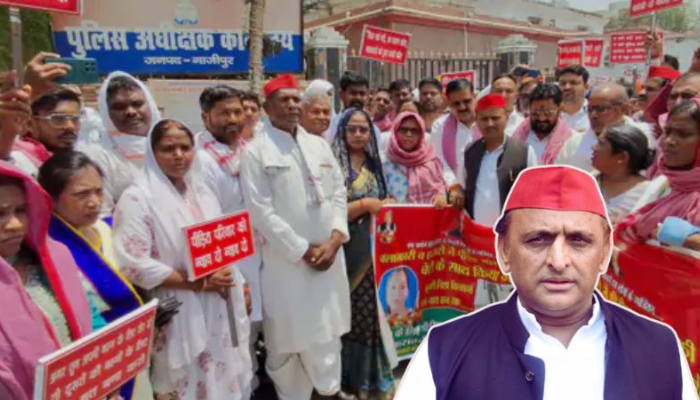
The events that happened in Uttar Pradesh’s Ghazipur on 22nd April (Wednesday) should not be dismissed as a simple incident. The manner in which leaders of the Samajwadi Party (SP) became active in the charged environment following the tragic death of a minor girl and the subsequent developments serves as a notable political indicator.
An SP delegation attempted to visit the grieving family, but they were met by villagers at the outskirts of the area. A confrontation broke out, which escalated into stone-throwing. During this conflict, former Minister Ram Asre Vishwakarma suffered a serious head injury and the villagers eventually succeeded in preventing the leaders from entering the hamlet.
It was not just an eruption of collective anger but rather represented a response to a political approach that has been consistently shaped by caste considerations. The significant distinction this time was that the populace not only acknowledged this political maneuvering but also delivered a retaliation, specifically tailored for such a circumstance, and completely unforeseen by anyone.
The attempt to politicise the tragedy backfire
The 16-year-old girl who passed away in Ghazipur was a member of the Vishwakarma community, whereas the accused identified as Pandey belongs to the Brahmin community. The rapid political reaction that followed the revelation of the details has prompted numerous inquiries. Offering condolences and seeking justice are expected but the inclination to interpret these instances immediately through a caste perspective inevitably raises doubts about the underlying motives.
The approach taken by SP officials upon their arrival in the village strengthened the doubt that their intention was not solely to convey condolences, but also to concoct a particular narrative. Consequently, the fury of the residents escalated and in the subsequent outburst, Vishwakarma who is also from the victim’s community found himself subjected to their ire.
The continuous plot of constructing caste-centric propaganda
Socialist political movements have historically been criticised for trying to gain political advantage by interpreting occurrences via a caste-oriented lens. This pattern was evident in the Ghazipur incident as well. The circulation of false information on social media, the promotion of unverified accusations like allegations of gang rape and efforts to provoke discord between two communities seemed to be components of a conspiracy that has been observed repeatedly in history.
The administration clarified that multiple claims were factually inaccurate, however, in spite of this, they continued to be disseminated. This communicated that more significance is being given to a special narrative, one that has the potential to generate political benefits than to the truth itself.
From Fatehpur to Badaun: A pattern of infusing a casteist and communal colour into every incident
Even if the incident in Ghazipur is regarded as an isolated matter, the recent developments in Fatehpur and Badaun help to further elucidate this narrative. Take, for example, the recent issue involving Aryan Yadav in Fatehpur, where a mundane situation was initially given a political interpretation, depicted as “punishment for serving tea” and later, attempts were made to turn it into a massive controversy.
A routine food safety enforcement action was characterised as an act of political retribution. Thereafter, a local disagreement was also transformed into a skewed narrative. As the matter progressed, visible resentment arose within the Muslim community with individuals asserting that the issue had been politicised without their submission being thoroughly acknowledged. In other words, the political tactic that the SP was using to maintain balance inadvertently placed the party in a difficult situation concerning its supposed vote bank.
A similar event surfaced last month, referred to as the Badaun double murder case. What was fundamentally a personal vendetta was tried to be showcased through the lens of caste supremacy and a “Thakur versus Others” narrative. The reality, however, was that immediate action was taken in this case and police encounters were conducted, bulldozers were deployed and a Special Investigation Team (SIT) was formed. However, a narrative was shaped to suggest that the incident was an act of hooliganism by a specific caste.
Now, the question is that if every incident is consistently portrayed as a caste-based conflict in this manner, will it promote trust within society, or will it simply deepen the existing divisions? These two instances from Fatehpur and Badaun demonstrate that the political strategies of the SP and its leadership continue to portray events as caste conflicts, instead of analysing them in an objective and just way.
When the public saw through the intentions
If these two incidents are concerned in relation to the case in Ghazipur, the reaction of the villagers stands out as the most critical aspect of the entire sequence of events. They prevented the SP delegation from entering the village, leading to an argument. This reaction was not spontaneous. It was the outcome of a lived experience in which people have often witnessed how incidents are politically twisted.
It was unmistakably evident to the populace that the politicians who had reached there were not present to contribute to a resolution, but instead to exacerbate the dispute. This is exactly the reason they declined to welcome them. This was not just a simple act of dissent, but a definitive statement that such political ventures would no longer be accepted. This change indicates that society is growing more conscious and it is no longer offering support merely based on identity but is also examining the genuine intentions of those who pretedn to be the sympathisers or well-wishers.
The public has also disclosed whom it trusts
The Ghazipur incident demonstrated who has earned the public’s trust. People are confident that the authorities will operate in accordance with due process and that the offender will face consequences, irrespective of their caste or religion. This trust is evident throughout the entire series of events. The public has recognised that political intervention is unnecessary for obtaining justice. In fact, they have firmly dismissed any attempts that seemed to seek to sway the same. Such trust represents the most imoprtant asset for any government.
A warning for the SP
For the Samajwadi Party (SP), this occurrence should be regarded as a significant warning. This is not simply a localised response, but a part of a larger sentiment that has been developing over time. When a political party cultivates a reputation for perceiving every event solely as a political opportunity, it is only to be expected that public trust will collapse. Akhilesh Yadav must pay attention to this indication. The circumstances will not improve through mere rhetoric or a cycle of attacks or counter attacks. Similar events will persist in this manner in the future without a change in political approach.
Outdated political paradigms are ineffective in a transforming society
The Ghazipur incident illustrates that society is not only evolving, but its political expectations are also shifting. Relying exclusively on caste dynamics for political maneuvering is becoming less effective with time. Individuals are now more alert, they pose more inquiries and most crucially, they are unafraid to express their opinions. This incident conveys a strong message that the people are no longer just an observer. They watch, they review and when required they take to the streets in protest. As a result, for those political parties that do not recognise the importance of this change, the future will be challenging.
Read the original report in Hindi here.