Illogical to assume that freedom struggle was led by a single leader or organisation: How Madras HC opened a can of worms in one judgement allowing erection of Stupa
On 26th December (Friday), the Madurai Bench of the Madras High Court delivered a significant judgment that has paved the way for the establishment of a memorial stupa to commemorate the 1755 “Natham Kanavai War,” which was fought against the British Empire. The verdict was pronounced by Justice GR Swaminathan in response to a petition by lawyer Siva Kalaimani Ambalam. He is also the managing trustee of Thannarasu Kallar Nadu Charitable Trust. He approached the court when the Tahsildar of Natham denied his request to erect a stupa monument in honour of the triumph of native forces over the colonisers. The writ suit requested permission to build a memorial symbol for the war on the petitioner’s patta land in Puthur Village of Natham Taluk in Dindigul district of Tamil Nadu. 18th-century warfare to chess championships: Success begets more success The court established a fascinating comparison with India’s staggering achievements in Chess, designating Chennai as the capital of the game within the nation. It highlighted the exceptional chess players emerging from the state who are bringing pride to the country on a global scale. The court stated that Tamil Nadu “is now home to a host of superstars in that sport. Gukesh Dommaraju, the current world champion, is a Chennaivasi. Grandmasters with very high Elo ratings, such as R Praggnanandhaa, Vaishali Rameshbabu, Pranesh, Ilamparthi, Aravindh Chithambaram, etc., are its residents.” It also invoked the name of chess grandmaster RB Ramesh, who started a Chess Gurukul (academy) in Chennai and produced many international chess champions from India, including R Praggnanandhaa and Bharath Subramaniyam. “How did all this become possible? Because of the victories scored by one individual. None other than the legendary Vishwanathan Anand,” the court highlighted. The judge evoked the proverb “success has many fathers but failure is an orphan.” He mentioned, “Success will beget many more successes. It can be a huge motivation. It can instil inspiration and trigger transformation. That is why it is necessary to celebrate success. It is not without reason that the Government of India commemorates Vijay Diwas Day on 16th December every year. It marks the victory of the Indian Armed Forces over Pakistan in the 1971 India-Pakistan War.” The instances served as a reminder from the court that celebrating success is essential, as it can inspire, motivate and initiate transformation. The history of India and its freedom movement is replete with examples where victories, or even attempts to confront adversaries, have motivated numerous others to this day. This phenomenon persists today across multiple fields, including defence, sports, medicine and entertainment. The success stories of individuals encourage many to follow a similar trajectory. A soldier’s sacrifice The court provided further insight into the importance of acknowledging such achievements. It emphasised, “India, that is Bharath, is a single nation. It has a civilizational unity. It is also a collection of communities that speak different languages and belong to different regions. Each community has its own sub-communities. They were originally identified by the classes and castes to which they belonged. We have been fused into a common citizenship.” The judge expressed that India is referred to as a “salad bowl” metaphorically, in contrast to the United States, which is described as a melting pot. He added that the various strands continue to retain their individuality in India and stressed that higher goals can be achieved by utilising the historical memories connected to these identities, pointing to the current matter. The court referenced a book by the wife of General K Sundarji, the former Army Chief, who was also known as a “thinking man’s general.” It brought attention to the general’s question concerning why a soldier on the battlefield chooses to give up his life and underscored, “The soldier under no circumstances would conduct himself in a way that may bring dishonour to his group. To uphold the regiment’s heroic name, any amount of sacrifice is worth it.” Duty of citizens and the truth of India’s freedom struggle The court cited Article 51A of the Indian Constitution and conveyed that it is the responsibility of every Indian citizen to uphold and adhere to the noble principles which inspired our country’s struggle for independence, to protect the nation and to perform national service when required. It also noted that a large portion of this generation is ignorant of the wars and efforts Indian society had to free itself from the clutches of the foreign powers, which disregarded the biblical phrase “ask and it shall be given.” “The British occupied us and ruled us for close to two hundred years. But right from the beginning, there was resistance and struggle. A false historical narrative has been built as if we got freedom without paying any price. It is again in

On 26th December (Friday), the Madurai Bench of the Madras High Court delivered a significant judgment that has paved the way for the establishment of a memorial stupa to commemorate the 1755 “Natham Kanavai War,” which was fought against the British Empire. The verdict was pronounced by Justice GR Swaminathan in response to a petition by lawyer Siva Kalaimani Ambalam. He is also the managing trustee of Thannarasu Kallar Nadu Charitable Trust.
He approached the court when the Tahsildar of Natham denied his request to erect a stupa monument in honour of the triumph of native forces over the colonisers. The writ suit requested permission to build a memorial symbol for the war on the petitioner’s patta land in Puthur Village of Natham Taluk in Dindigul district of Tamil Nadu.
18th-century warfare to chess championships: Success begets more success
The court established a fascinating comparison with India’s staggering achievements in Chess, designating Chennai as the capital of the game within the nation. It highlighted the exceptional chess players emerging from the state who are bringing pride to the country on a global scale.
The court stated that Tamil Nadu “is now home to a host of superstars in that sport. Gukesh Dommaraju, the current world champion, is a Chennaivasi. Grandmasters with very high Elo ratings, such as R Praggnanandhaa, Vaishali Rameshbabu, Pranesh, Ilamparthi, Aravindh Chithambaram, etc., are its residents.”
It also invoked the name of chess grandmaster RB Ramesh, who started a Chess Gurukul (academy) in Chennai and produced many international chess champions from India, including R Praggnanandhaa and Bharath Subramaniyam. “How did all this become possible? Because of the victories scored by one individual. None other than the legendary Vishwanathan Anand,” the court highlighted.
The judge evoked the proverb “success has many fathers but failure is an orphan.” He mentioned, “Success will beget many more successes. It can be a huge motivation. It can instil inspiration and trigger transformation. That is why it is necessary to celebrate success. It is not without reason that the Government of India commemorates Vijay Diwas Day on 16th December every year. It marks the victory of the Indian Armed Forces over Pakistan in the 1971 India-Pakistan War.”
The instances served as a reminder from the court that celebrating success is essential, as it can inspire, motivate and initiate transformation. The history of India and its freedom movement is replete with examples where victories, or even attempts to confront adversaries, have motivated numerous others to this day. This phenomenon persists today across multiple fields, including defence, sports, medicine and entertainment. The success stories of individuals encourage many to follow a similar trajectory.
A soldier’s sacrifice
The court provided further insight into the importance of acknowledging such achievements. It emphasised, “India, that is Bharath, is a single nation. It has a civilizational unity. It is also a collection of communities that speak different languages and belong to different regions. Each community has its own sub-communities. They were originally identified by the classes and castes to which they belonged. We have been fused into a common citizenship.”
The judge expressed that India is referred to as a “salad bowl” metaphorically, in contrast to the United States, which is described as a melting pot. He added that the various strands continue to retain their individuality in India and stressed that higher goals can be achieved by utilising the historical memories connected to these identities, pointing to the current matter.
The court referenced a book by the wife of General K Sundarji, the former Army Chief, who was also known as a “thinking man’s general.” It brought attention to the general’s question concerning why a soldier on the battlefield chooses to give up his life and underscored, “The soldier under no circumstances would conduct himself in a way that may bring dishonour to his group. To uphold the regiment’s heroic name, any amount of sacrifice is worth it.”
Duty of citizens and the truth of India’s freedom struggle
The court cited Article 51A of the Indian Constitution and conveyed that it is the responsibility of every Indian citizen to uphold and adhere to the noble principles which inspired our country’s struggle for independence, to protect the nation and to perform national service when required. It also noted that a large portion of this generation is ignorant of the wars and efforts Indian society had to free itself from the clutches of the foreign powers, which disregarded the biblical phrase “ask and it shall be given.”
“The British occupied us and ruled us for close to two hundred years. But right from the beginning, there was resistance and struggle. A false historical narrative has been built as if we got freedom without paying any price. It is again incorrect to assume that the freedom struggle commenced only after 1905 and that it was a movement led by a single organisation or a single leader,” the judge observed.
He indicated the immense sacrifices made by countless Indians to eradicate the tyrannical British Raj from the land. Many of these not only suffered through rigorous punishments, torture, assaults, and other forms of maltreatment but also ultimately gave up their lives for their homeland.
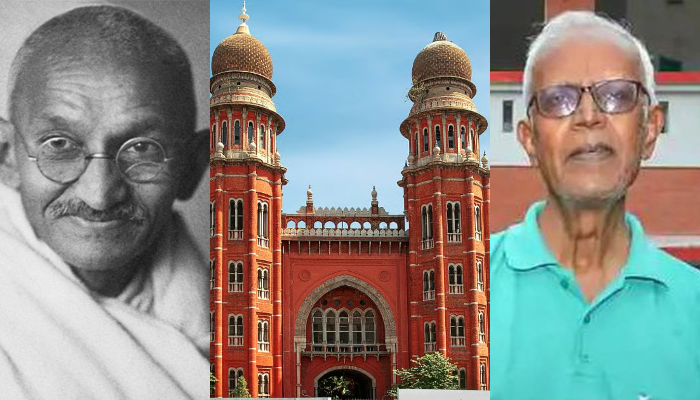
Unfortunately, this reality is not as much admitted in the nation where it has been perpetuated that Mohandas Karamchand Gandhi and his Swadeshi movement, or Jawaharlal Nehru, or their Congress party were the architects of independence, as rightful recognition is withheld from several who rose up against the Britishers.
However, the fact is that no single person, party or movement can be credited for independence, which was achieved through the efforts of millions of Indians. India’s freedom movement is etched in their blood, sweat and tears as they devoted everything, including their lives, to liberate their country from the bonds of oppression.
Tamil Nadu’s role in independence
The court then pointed out the crucial role of Tamil Nadu in India’s struggle for independence and noted that the first revolt against the British originated from the state long before 1857.
It expressed, “Tamil Nadu has contributed singularly to the freedom movement. There are scholars who hold the view that the first war of Indian independence was not waged in 1857 but much before from the Tamil soil. Several instances are cited. This court is not competent to go into these historical questions. But it can take judicial notice of the fact that the British met their match in the region of Madurai. Several names come to mind. Marudu brothers, Velunachiyar, Puli Thevar, Kattabomman, Oomaithurai, Valukkuveli Ambalam, the list can go on.
The judge insisted that celebrating the wars in which the indigenous people defeated the colonial army was just as important as remembering the names of those courageous soldiers. He conveyed that every such triumph attained at tremendous expense and against overwhelming odds should be cherished, and the memory of the martyrs should be respected.
“The petitioner, who is a practising lawyer, has gathered materials to show that in Natham Pass (Natham Kanavai), there was a bloody confrontation between the Melur Kallars and the English forces in the year 1755 in which the Kallars emerged winners,” the court mentioned.
Natham Kanavai War and the Kallar community
The court subsequently illuminated the history of the “Natham Kanavai War” and voiced that the brass idols from the Thirumogur (Koilkudi) Temple were stolen by the English soldiers. The group carrying the idols, under the command of Colonel Alexander Heron, was to cross the Natham Kanavai when the members of the Kallar community came together in large numbers.
They attacked Heron and his army to recover the sacred objects. The incident claimed thousands of lives. However, the Kallar community was able to recover every idol. Only thirty sepoys are reported to have survived along with Heron as they returned to Trichirappalli.
The judge also revealed the marital heritage of the Kallar community and equated them with Rajputs and Gurkhas. He further clarified the British intent to categorise them as criminals and unleash atrocities upon them.
He highlighted, “The Kallar community has a martial background. They can be compared to Gurkhas and Rajputs. Probably that was why the British branded them as criminal tribes. They languished for decades and faced untold hardships till the legendary leader Pasumpon Muthuramalinga Thevar redeemed the community.”
No permission is required to commemorate historical events
The court informed that the writ petition was undoubtedly submitted late, but the notion of laches (legal principle that prohibits from pursuing a claim or entitlement if unjustly postponed) cannot be applied. It emphasised, “So long as the impugned memo is holding good, the petitioner cannot install the stupa in the petition-mentioned site. Therefore, the writ petitioner cannot be non-suited on this ground.”
The officials alleged that there was no other explanation for the denial of authorisation other than the impending parliamentary elections. “Now the respondents submit that the report has been obtained from the jurisdictional police and based on the same, further action can be taken,” the judge added and discussed that he was unable to fully support the position.
He remarked, “The petitioner, after all, wants to erect a stupa to commemorate the victory of native forces over the colonial forces. Such events must be celebrated and preserved for historical memory. I had already taken the view that for the installation of the statue of a freedom fighter, that too only in a patta land, no permission is required,” alluding to a previous issue.
He had then declared, “Just as one’s home is his castle, one’s land is his fiefdom. The state can step in only by due process of law. A statutory or common law right cannot be restricted or taken away through an executive instruction or government orders. Only a statute that is not ultra vires the Constitution can impinge on such rights.”
The court at the time ruled that prior authorisation from the District Collector would be needed to erect a religious building for public worship, but the right of an individual to erect a statue in honour of a person he reveres cannot be restricted or tampered with because there is no such statutory law or rule addressing the installation of statues.
UAPA-accused Catholic Jesuit priest Stan Swamy’s memorial
The judge addressed the case pertaining to the placement of a statue of the Unlawful Activities Prevention Act (UAPA) accused Catholic Jesuit priest, late Stanislaus Lourduswamy alias Stan Swamy. The former recounted that the Tahsildar had declined permission, which was later granted by the same court. He also presented the controversial life of Swamy, which was stained by anti-national activities.
The court also presented the controversial life of Swamy, which was stained by anti-national activities, to maintain that if no approval is needed to set up a statue of such a notorious figure, then there should certainly be no necessity to seek permission to honour a crucial part of the nation’s freedom struggle.
“It is true that Stan Swamy is seen as a fighter for tribal rights by sections of society. But the fact remains that he was an accused in a case arising under UAPA. He died in prison. If for erecting a stone pillar in memory of Stan Swamy, permission is not required, certainly, no permission is required for erecting a stupa in memory of the Natham Kanavai battle,” it affirmed.
Swamy was booked as the principal conspirator in the Bhima Koregaon Elgar Parishad case of 2018, collaborated with the Maoists to overthrow democracy and dedicated his life to damaging the country. Furthermore, the Islamist outfit, Popular Front of India (PFI), which was later banned by the centre, was allowed to arrange programs at the Jesuit-run Indian Social Institute (ISI) when he was the director.
Ironically, such a vile man is commemorated with a statue in the very same land he worked to destroy, while those who died for the country either continue to remain anonymous, are denied their due or have to persistently fight for the acknowledgement of their great sacrifices, even posthumously.
The decision is announced
The judge quoted an earlier ruling regarding a government order, which specified that the instruction was exclusively related to public locations and not to patta lands.
“It is, of course, open to the government to bring in a law regulating the erection of statues even in private places. But then, so long as such a law has not been enacted, by issuing circulars and government orders, the right of an individual to put up a statue in one’s patta land cannot be taken away,” he elaborated on the verdict to provide more clarification.
The court stated that the order “pertains only to the erection of statues. The case at hand pertains to installing only a stupa. There is also no controversy, and there is not going to be any law and order implication. Therefore, the government may not have any objection.”
The court determined that the aforementioned judgment would equally be relevant to the present case despite the government order and finally concluded, “In this view of the matter, the impugned memo is quashed. The petitioner is at liberty to erect the memorial stupa forthe Natham Kanawai War in the petition-mentioned land. This writ petition stands allowed. No costs.”