
Inside IIT Delhi’s caste conference: Divya Dwivedi, Equality Labs, and the Dalit-Palestinian parallel – A push to frame caste as global oppression
On 25th January, the Indian Institute of Technology Delhi acknowledged “serious concerns” raised over the “Critical Philosophy of Caste and Race” conference held on its campus between 16th and 18th January. In an official statement, IIT Delhi said it has sought an explanation from the concerned faculty members and constituted a fact-finding committee with independent members to examine objections related to the choice of speakers and the nature of the content presented. "Critical Philosophy of Caste and Race" conference (Jan 16-18): Serious concerns have been raised over the choice of speakers and content of the conference. The Institute has sought an explanation from the concerned faculty, and a fact-finding committee with independent…— IIT Delhi (@iitdelhi) January 25, 2026 The institute further stated that appropriate action would be taken in accordance with institutional protocols once the committee submits its findings. The institute reiterated its commitment to national goals, academic integrity, and established institutional guidelines. What the conference was about The three-day event, titled “Critical Philosophy of Caste and Race” or CPCR3, was organised at the Senate Hall of IIT Delhi’s main building. It was positioned as an academic conference marking 25 years of the 2001 World Conference Against Racism held in Durban, South Africa. According to the organisers, the conference aimed to examine caste as a form of descent-based discrimination and to frame it alongside race within global human rights discourse. The programme brought together academics, activists, writers, and international speakers for keynote lectures, panel discussions, round tables, book launches, and film screenings centred on caste, race, gender, religion, and global advocacy. While it all sounds good from the outside, the conference provided a biased platform to a one-sided narrative of caste politics. The whole structure was designed to show that there are high levels of discrimination everywhere against minorities and marginalised communities in India. The conference was organised by Divya Dwivedi of IIT Delhi and Sowjanya Tamalapakula, with support from the Department of Humanities and Social Sciences. Divya Dwivedi is the same professor who once claimed that Hinduism was invented in the 20th century during a debate on a news channel. She also called Hinduism a “hoax” in an article she wrote for The Caravan. Among the speakers, there were international “activists” and “scholars”, including Thenmozhi Soundararajan, founder of Equality Labs, whose work has been controversial for its framing of caste within race-based and international advocacy narratives. Equality Labs has been pushing a caste narrative in the United States, claiming that upper-caste Indians who have migrated to the US often indulge in caste-based discrimination against Indian-origin colleagues and employees from the SC/ST community. Several sessions explicitly linked caste with race, global governance, religion, and contemporary political movements, including discussions comparing Dalit issues with other international conflicts. These sessions called for transnational alliances to address “caste-based discrimination”. The ideological orientation of these sessions and the speakers in the sessions, as well as the activist-driven framing of caste within an elite technical institution, have now come under scrutiny. Who is Divya Dwivedi and what she represents Divya Dwivedi is a professor in the Department of Humanities and Social Sciences at IIT Delhi who is behind the CPCR conferences. She teaches philosophy and literature. Over the past decade, she has emerged as an ideologue who consistently frames Hindu identity, caste, and Indian society through a confrontational political lens that is rooted in race discourse and global activist frameworks. Her academic career includes publications with international publishers, fellowships in European institutions, and advisory roles linked to UNESCO affiliated platforms. This global positioning is central to her work, as it means she is not confined to classroom debate. She actively seeks to shape how India’s social structure is interpreted, critiqued, and judged in international intellectual and political spaces. Her public record on Hinduism and the Hindu identity The ideological positioning of Dwivedi is in itself highly problematic. During a television debate in 2019, she declared, “The Hindu religion was invented in the early twentieth century in order to hide the fact that the lower caste people are the real majority of India.” She went on to claim that Mahatma Gandhi “helped construct a false Hindu majority and a new Hindu identity”, adding that this political construct must be “discarded”. These views were elaborated further in the essay she co-authored for the controversial magazine, The Caravan. The essay, titled “The Hindu Hoax”, presented Hindu identity as a d
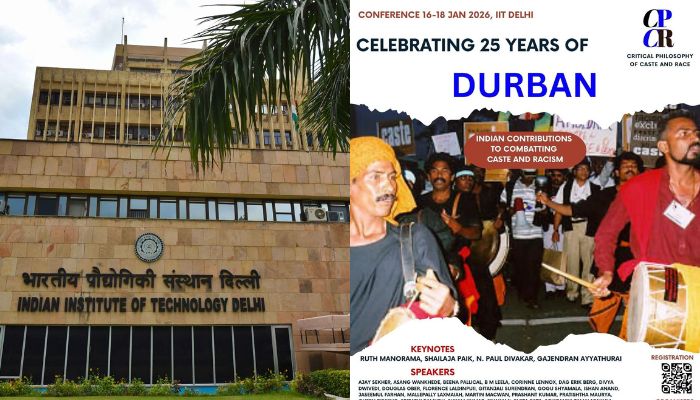

On 25th January, the Indian Institute of Technology Delhi acknowledged “serious concerns” raised over the “Critical Philosophy of Caste and Race” conference held on its campus between 16th and 18th January. In an official statement, IIT Delhi said it has sought an explanation from the concerned faculty members and constituted a fact-finding committee with independent members to examine objections related to the choice of speakers and the nature of the content presented.
"Critical Philosophy of Caste and Race" conference (Jan 16-18):
— IIT Delhi (@iitdelhi) January 25, 2026
Serious concerns have been raised over the choice of speakers and content of the conference.
The Institute has sought an explanation from the concerned faculty, and a fact-finding committee with independent…
The institute further stated that appropriate action would be taken in accordance with institutional protocols once the committee submits its findings. The institute reiterated its commitment to national goals, academic integrity, and established institutional guidelines.
What the conference was about
The three-day event, titled “Critical Philosophy of Caste and Race” or CPCR3, was organised at the Senate Hall of IIT Delhi’s main building. It was positioned as an academic conference marking 25 years of the 2001 World Conference Against Racism held in Durban, South Africa.
According to the organisers, the conference aimed to examine caste as a form of descent-based discrimination and to frame it alongside race within global human rights discourse. The programme brought together academics, activists, writers, and international speakers for keynote lectures, panel discussions, round tables, book launches, and film screenings centred on caste, race, gender, religion, and global advocacy.
While it all sounds good from the outside, the conference provided a biased platform to a one-sided narrative of caste politics. The whole structure was designed to show that there are high levels of discrimination everywhere against minorities and marginalised communities in India.
The conference was organised by Divya Dwivedi of IIT Delhi and Sowjanya Tamalapakula, with support from the Department of Humanities and Social Sciences. Divya Dwivedi is the same professor who once claimed that Hinduism was invented in the 20th century during a debate on a news channel. She also called Hinduism a “hoax” in an article she wrote for The Caravan.
Among the speakers, there were international “activists” and “scholars”, including Thenmozhi Soundararajan, founder of Equality Labs, whose work has been controversial for its framing of caste within race-based and international advocacy narratives. Equality Labs has been pushing a caste narrative in the United States, claiming that upper-caste Indians who have migrated to the US often indulge in caste-based discrimination against Indian-origin colleagues and employees from the SC/ST community.
Several sessions explicitly linked caste with race, global governance, religion, and contemporary political movements, including discussions comparing Dalit issues with other international conflicts. These sessions called for transnational alliances to address “caste-based discrimination”. The ideological orientation of these sessions and the speakers in the sessions, as well as the activist-driven framing of caste within an elite technical institution, have now come under scrutiny.
Who is Divya Dwivedi and what she represents
Divya Dwivedi is a professor in the Department of Humanities and Social Sciences at IIT Delhi who is behind the CPCR conferences. She teaches philosophy and literature. Over the past decade, she has emerged as an ideologue who consistently frames Hindu identity, caste, and Indian society through a confrontational political lens that is rooted in race discourse and global activist frameworks.
Her academic career includes publications with international publishers, fellowships in European institutions, and advisory roles linked to UNESCO affiliated platforms. This global positioning is central to her work, as it means she is not confined to classroom debate. She actively seeks to shape how India’s social structure is interpreted, critiqued, and judged in international intellectual and political spaces.
Her public record on Hinduism and the Hindu identity
The ideological positioning of Dwivedi is in itself highly problematic. During a television debate in 2019, she declared, “The Hindu religion was invented in the early twentieth century in order to hide the fact that the lower caste people are the real majority of India.” She went on to claim that Mahatma Gandhi “helped construct a false Hindu majority and a new Hindu identity”, adding that this political construct must be “discarded”.
These views were elaborated further in the essay she co-authored for the controversial magazine, The Caravan. The essay, titled “The Hindu Hoax”, presented Hindu identity as a deliberate political fiction created by upper caste elites. In the essay, she argued that there is “no innocent use of ‘Hindu’” and portrayed the term itself as inseparable from caste oppression and political domination.
Such claims are not framed as one strand of interpretation among many. They are presented as definitive conclusions, leaving little room for historical continuity, internal reform traditions, or the lived religious experience of millions of Hindus across caste. By presenting Hinduism as a “hoax”, she effectively denies the followers of Sanatan Dharma their legitimate place in India’s religious and civilisational space, reducing a living faith to a political construct and disregarding how millions of people understand and practise their own religion.
G20 intervention and internationalisation of the narrative
Dwivedi’s ideological posture became even more explicit during the G20 meeting in India in 2023. During that time, she used an interview with the French broadcaster France 24 to argue that India’s future must move beyond Hinduism itself.

Related Posts









Two-child norm and maternity leave: Big win for working...
The court set aside the decision of the division bench of Madras High Court, which...
Congress to hold dialogue on MGNREGA issue; workers from...
The Congress is organizing a national conference on Thursday to protest the alleged...
Tejashwi Named RJD Working President
Yadav's elevation comes after the RJD's drubbing in the recent assembly polls, which...
When Ranbir Kapoor calmed down Boney Kapoor after giving...
Producer Boney Kapoor lauded Ranbir Kapoor's exceptional professionalism on the...
150 Years of 'Vande Mataram' at Republic Day Parade today
Republic Day celebrations at Kartavya Path will highlight the 150th anniversary...

Finland wants top talent from the US and beyond: 2 week...
Finland is courting global tech talent with two-week fast-track visas, predictable...

If these Samsung settings are off, you're not using your...
Samsung phones have plenty of smart features - here are a few you shouldn't miss.

2016 nostalgia: 10 movies and shows you didn’t realise...
2016, a year before global shifts, is remembered fondly, though it wasn't perfect....

The best email newsletter software of 2026: Expert tested
I tested the top email newsletter platforms to help you choose the right tool for...

How to grow and care for a bunny ear cactus at home
How to grow and care for a bunny ear cactus at home
