Language, art, food and more: The Economist glorifies Mughals for bringing culture to India, as if nothing existed before Babur, netizens mock the bizarre article
Amitabh Bachchan’s character in a scene of the 1992 Bollywood flick “Bemisal” declared, “The British discovered all the hill stations in India, except for Kashmir, which was found by the Mughals,” to a highly impressed Kavita, portrayed by Rakhee Gulzar, who commended the Islamic imperialists for their “magnificent music, paintings and architecture,” insisting that they had no equal. He then playfully retorted that their greatest offering was “Mughlai food.” The clip resurfaced and went viral in 2022, with people calling out how the film industry, notorious for its anti-Hindu propaganda, consistently distorts the truth to glamorise the invaders. Fast forward to 2026, and “The Economist” has produced a print version of that movie sequence, crediting the dynasty for “language, food, architecture, music, art and syncretism” while sarcastically adding that it even brought the Bharatiya Janata Party to power in 2014. The Mughals brought language, food, architecture, music, art and syncretism to India. And they brought Narendra Modi’s party to power https://t.co/XX1e6m40ve— The Economist (@TheEconomist) April 20, 2026 The article titled “What have the Mughals ever done for us?” was published on 19th April (Sunday) accompanied by the tagline “How India’s greatest Muslim empire built its most powerful Hindu party.” It is a eulogy extolling the Muslim rulers for enriching India, a civilisation that already existed for millenia, as one of the oldest civilisations in the world with a flourishing economy, historical significance, artistic and scientific achievements, literary contributions and a socio-cultural heritage, without the influence of Mughals. Babur, who laid the groundwork for his empire, was drawn to the immense wealth and resources of the nation after being uprooted from his ancestral home in Ferghana (currently in Uzbekistan) due to regular conflicts with his family members and repeated losses in battles. All these invaders, from the Islamists to the White colonisers, chose India for its vast, famed treasures. They aimed to pillage and exploit the land, which they successfully did, and sought to convert the natives by any means necessary. The Mughals had a similar objective. Mughals enriched Indian civilisation: The formulation of a bizarre argument “The Mughals were the longest lasting of those. April 21st marks exactly 500 years since the Battle of Panipat, when Babur, a Central Asian descendant of Tamerlane and Genghis Khan (hence Mughal, from Mongol), defeated the last sultan of Delhi. The empire he established was, at its height, one of the world’s richest and most powerful. Its rulers adopted customs of Indian kingship, married locally and in effect became Indian (unlike the Britishers). Their achievements are Indian,” The Economist states. The Mughal empire’s wealth and authority were sourced from the Indian territory it had ravaged for centuries. They capitalised on the country’s thriving ancient customs and traditions to erect new structures, constructed by local workers with indigenous resources only to be promoted as “monuments of synchronisation.” They could not transport their looted fortune to their homeland as they were driven out of there by their own kith and kin and were never allowed to return. Babur made several efforts but faced continuous failures. As a result, they remained in India out of compulsion, not affection. Their love for India is further demonstrated by the reinterment of Babur’s remains in Kabul, in accordance with his wishes, because he regarded that place as his actual home. The left-liberal brigade usually applauds the condemnation of invaders, but not when the atrocities are perpetrated against India or Hindus. Such actions are then ignored, justified and celebrated as seen in this column. Thus, The Economist also ridiculed Prime Minister Narendra Modi for referencing India’s history of subjugation at the hands of foreign Economist admitted that the Mughals destroyed temples but claimed that this cannot be construed as an insult to them. The imposition of “jizya,” the massacre of Hindus and the forced conversions highlighted by the Islamic rulers in their own writings were conveniently disregarded by it. However, the cabal that labels trivial incidents as “provocation” against the Muslim community does not regard the attacks on the most sacred places of Hinduism as humiliation, insinuating that these should not be viewed as an assault on the faith, effectively normalising the profoundly anti-Hindu conduct. Afterwards, the author expressed, “They took everything India had. And what, the ideology asks, did they ever give us in return,” and initiated lauding the Mughals in the field of language. ‘India was exposed to Persia via the Mughals who contributed to Indian language’ The piece stressed, “Of the 28 words that made up the original of his quote above, a quarter entered India via Persian, points out Richard Eaton, a historian
Amitabh Bachchan’s character in a scene of the 1992 Bollywood flick “Bemisal” declared, “The British discovered all the hill stations in India, except for Kashmir, which was found by the Mughals,” to a highly impressed Kavita, portrayed by Rakhee Gulzar, who commended the Islamic imperialists for their “magnificent music, paintings and architecture,” insisting that they had no equal. He then playfully retorted that their greatest offering was “Mughlai food.”
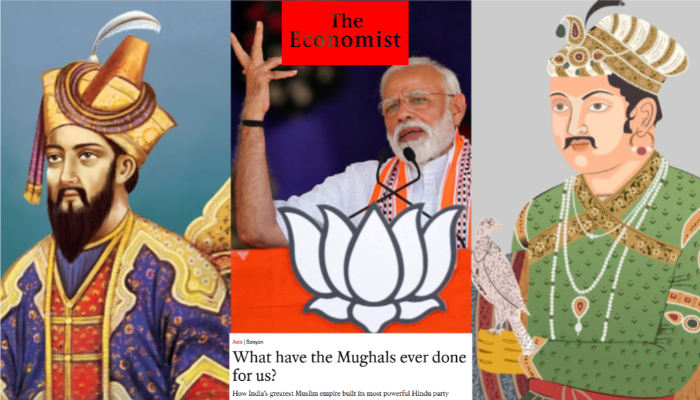
The clip resurfaced and went viral in 2022, with people calling out how the film industry, notorious for its anti-Hindu propaganda, consistently distorts the truth to glamorise the invaders. Fast forward to 2026, and “The Economist” has produced a print version of that movie sequence, crediting the dynasty for “language, food, architecture, music, art and syncretism” while sarcastically adding that it even brought the Bharatiya Janata Party to power in 2014.
The Mughals brought language, food, architecture, music, art and syncretism to India. And they brought Narendra Modi’s party to power https://t.co/XX1e6m40ve— The Economist (@TheEconomist) April 20, 2026
The article titled “What have the Mughals ever done for us?” was published on 19th April (Sunday) accompanied by the tagline “How India’s greatest Muslim empire built its most powerful Hindu party.” It is a eulogy extolling the Muslim rulers for enriching India, a civilisation that already existed for millenia, as one of the oldest civilisations in the world with a flourishing economy, historical significance, artistic and scientific achievements, literary contributions and a socio-cultural heritage, without the influence of Mughals.
Babur, who laid the groundwork for his empire, was drawn to the immense wealth and resources of the nation after being uprooted from his ancestral home in Ferghana (currently in Uzbekistan) due to regular conflicts with his family members and repeated losses in battles. All these invaders, from the Islamists to the White colonisers, chose India for its vast, famed treasures. They aimed to pillage and exploit the land, which they successfully did, and sought to convert the natives by any means necessary. The Mughals had a similar objective.
Mughals enriched Indian civilisation: The formulation of a bizarre argument
“The Mughals were the longest lasting of those. April 21st marks exactly 500 years since the Battle of Panipat, when Babur, a Central Asian descendant of Tamerlane and Genghis Khan (hence Mughal, from Mongol), defeated the last sultan of Delhi. The empire he established was, at its height, one of the world’s richest and most powerful. Its rulers adopted customs of Indian kingship, married locally and in effect became Indian (unlike the Britishers). Their achievements are Indian,” The Economist states.
The Mughal empire’s wealth and authority were sourced from the Indian territory it had ravaged for centuries. They capitalised on the country’s thriving ancient customs and traditions to erect new structures, constructed by local workers with indigenous resources only to be promoted as “monuments of synchronisation.”
They could not transport their looted fortune to their homeland as they were driven out of there by their own kith and kin and were never allowed to return. Babur made several efforts but faced continuous failures. As a result, they remained in India out of compulsion, not affection. Their love for India is further demonstrated by the reinterment of Babur’s remains in Kabul, in accordance with his wishes, because he regarded that place as his actual home.
The left-liberal brigade usually applauds the condemnation of invaders, but not when the atrocities are perpetrated against India or Hindus. Such actions are then ignored, justified and celebrated as seen in this column. Thus, The Economist also ridiculed Prime Minister Narendra Modi for referencing India’s history of subjugation at the hands of foreign
Economist admitted that the Mughals destroyed temples but claimed that this cannot be construed as an insult to them. The imposition of “jizya,” the massacre of Hindus and the forced conversions highlighted by the Islamic rulers in their own writings were conveniently disregarded by it.
However, the cabal that labels trivial incidents as “provocation” against the Muslim community does not regard the attacks on the most sacred places of Hinduism as humiliation, insinuating that these should not be viewed as an assault on the faith, effectively normalising the profoundly anti-Hindu conduct. Afterwards, the author expressed, “They took everything India had. And what, the ideology asks, did they ever give us in return,” and initiated lauding the Mughals in the field of language.
‘India was exposed to Persia via the Mughals who contributed to Indian language’
The piece stressed, “Of the 28 words that made up the original of his quote above, a quarter entered India via Persian, points out Richard Eaton, a historian of Muslim India. The language of the Mughal court infuses the vocabulary of most northern Indian languages. Indeed, Hindi and Hindu both come from Hind, the Persian name for the river known in English as the Indus (thus India). But what, apart from putting the Hindu in Hindu nationalism, have the Mughals ever done for us?”
India houses one of the most diverse collections of languages which has continued to evolve with time, and a similar episode unfolded with the Persianised Mughals. Languages impact each other and progress over time. Likewise, Hindi, which is rooted in Sanskrit, shares a common ancestor with Persian in the Indo-European language family. Therefore, the addition was more related to these origins than to the influence of the Mughals.
Moreover, if this reasoning is to be applied, then the English language should be attributed to the English people, but it would be incorrect, misleading and historically inaccurate, akin to the present argument. More importantly, language, art and literature do not require oppression as a means of dissemination. Many countries can communicate in foreign languages without being subjected to enslavement.
‘Mughals added refined taste to Indian cuisine and architecture’, claims the Economist
The Economist shifted to venerating the Mughals for culinary delights, often termed as “Mughalai,” including tandoori food items and biryani.
“The tandoor, a clay oven from which emerge flaky naans and charred kebabs, came from the Persianate world, as did samosas, sherbets, various desserts and biryani, India’s most-ordered dish on delivery apps for ten years straight. The party-pooper wing of the BJP frowns on meat and eggs, but even vegetarians enjoy a good tandoori paneer (from the Persian panir, a kind of cottage cheese that probably came via Afghans),” it contended.
The tandoor was invented in the Indus Valley, and Harappan civilisations, and Babur’s kingdom in Central Asia did not engage in rice cultivation, which is a key component in biryani. Spices, for which the Indian peninsula was famous, were also present. But for the idea that rice cooked with spices and meat may become a great dish, apparently, the Mughals have to be thanked. Indians might have been struggling or relying on rudimentary meals, as they purportedly lacked knowledge and expertise in creating delectable dishes until the Mughals entered the picture, according to the article.
Afterwards, it revered them for the lavish projects produced by Indian labourers and resources. The piece pointed out, “Four of India’s ten most popular ticketed historical sites for local tourists, and six among foreigners, were built by Mughals. The Taj Mahal tops both lists. Every year the prime minister delivers an Independence Day speech from the Red Fort, a Mughal monument in Delhi so central to India’s self-image it features on the back of the most common banknote.”
Ironically, these were built while common Indians, predominantly Hindus, continued to endure the brutality of the dictatorial policies and behaviour. They are symbols of the indulgently luxurious lifestyle of the Mughals and were designed to represent their affluent empire. Furthermore, they did not have the option to take this wealth to Central Asia as mentioned earlier and consequently took advantage of it for their own interests as they pleased.
However, these complexes are entirely Indian property, and the elected government is fully entitled to utilise them for currency or for other applications. Nevertheless, this does not erase the history tied to them or the decayed legacy of the Mughals. Urdu, interestingly, has its foundations in the Sanskrit and Prakrit languages, yet this cannot be outlined as it would contradict the agenda of exalting Muslim monarchs.
‘Mughals are responsible for Sherwani, Sitar and BJP juggernaut’
The Economist raved about the Mughals over Sherwani and Sitar, which were developed between the 16th and 18th centuries. It quoted “historian” Jadunath Sarkar and stated, “The popular religions of medieval India, Sufism, the Urdu language, and Indo-Saracen art were the common property of the conquerors and the conquered and tended to blend them together.”
Thereafter, it peddled the nauseating trope of “secularism” practised by Akbar, who commissioned the translation of Hindu epics, completely ignoring his violent campaigns against the community. As if this glorification were not enough, the article, in a derisive bashing of Hindu beliefs, proclaimed that the saffron party would not have risen to power in the absence of the “Babri mosque” at the Ram Janmbhoomi.
It stated, “In 1990, when the party held just 16% of seats in parliament, it launched a national campaign demanding a temple on the ground said to be the birthplace of Lord Ram, the protagonist of the Ramayana. At that site stood a mosque built during the reign of Babur, the first Mughal emperor. In 1992, a mob demolished the mosque under the gaze of BJP officials, sparking a nationwide conflagration that forged the party’s base, eventually propelling it to office. By early 2024, when Modi consecrated the promised temple, his party held 56% of seats. It has spent the past decade renaming Mughal cities, rejecting Mughal cuisine, and writing Mughals out of history books.”
The Ram Mandir, which is at the heart of the Hindu religion, was diminished to an election ploy because the BJP stood for the cause. Babar is painted as a protagonist by the media house despite demolishing temples, whereas the party is demonised for championing the rights of Hindus.
“It is one thing to raze an edifice of brick and mortar. It is harder to eradicate a culture that has, for over five centuries, permeated India’s blood and soil. That, then, is the best answer to their question of what the Mughals have ever done for them. They gave political Hinduism its eternal, indispensable villain,” it concluded.
The netizens react with astonishment
“Stating that Mughals brought Narendra Modi’s party to power is a bit like saying Hitler and Nazis created the state of Israel,” a user remarked, emphasising the absurdity of the statement.
“While the traumatic experiences of these regimes(Mughals in the case of Hindus and Nazis in the case of Jews) catalysed a defensive response that led to taking steps aimed at self-preservation by the two aggrieved groups, attributing the success of these movements to the tyrannical regimes as though it was some gift from them would be absolutely atrocious,” the person conveyed in a pointed denunciation of the effort to inappropriately edify them.
Stating that "Mughals brought Narendra Modi’s party to power" is a bit like saying "Hitler and Nazis created the state of Israel." While the traumatic experiences of these regimes(Mughals in the case of Hindus and Nazis in the case of Jews) catalysed a defensive response that…— Openminded Fanatic (@Openatic) April 20, 2026
Another netizen noted that the Fergana Valley lacked in agricultural produce and such products, but the dishes prepared from Indian resources have been acknowledged as “Mughlai” food.
they came from land where there was no food , water and where everything is haram and yet they brought culture to India.— manish82 (@manish_rws) April 22, 2026
Varun asked the media platform to expand their scope beyond just art or music and also commemorate the Mughals for creating the sun, moon and the Himalayas.
Why stop there? You might as well credit them with bringing the sun, the moon, and the Himalayas while you're at it — Varun Kumar Rana (@VarunKrRana) April 20, 2026
The Economist, similar to other mainstream media outlets, tends to create narratives that credit foreigners for Indian achievement, whether related to the past or the present, thereby detaching it from its core, which is in Hindu Indian society.