Lucknow-Kanpur Expressway in UP to be inaugurated: All you need to know about the country’s first barrier-free expressway
In a fresh addition to the state’s infrastructural achievements, the Yogi Adityanath government in Uttar Pradesh is set to inaugurate the Lucknow-Kanpur Expressway on 13th July. The 63-kilometre-long landmark infrastructural project built with an expenditure of ₹4,700 crore will be inaugurated by Union Defence Minister Rajnath Singh, Union Road Transport and Highways Minister Nitin Gadkari, and Uttar Pradesh Chief Minister Yogi Adityanath. The expressway will significantly improve connectivity between the two major cities of the state and considerably reduce the distance as the travel time. At present, the travel time between Lucknow and Kanpur is between 2.5 and 3 hours. After the expressway becomes operational, the journey between the two cities will take 35 to 45 minutes, which will save people a considerable amount of time. The expressway has been designated as National Expressway-6. Image via Bhaskar Advanced technology used in its construction The advanced 3D AMG technology was used in the construction of the expressway, about 30% of whose total length is elevated. An Advanced Traffic Management System (ATMS) has been installed on the expressway to issue challans (fines) to those exceeding the speed limit; the system will instantly transmit details for enforcement action. It has 63 high-resolution CCTV cameras and 16 Video Incident Detection Systems (VIDS). The entire stretch of the expressway will be under CCTV surveillance. In case an accident takes place on the expressway, assistance will arrive within 15 minutes. The expressway is fitted with Intelligent Traffic Management Systems (ITMS), including PTZ (pan-tilt-zoom) cameras, speed radars, emergency call boxes, variable message signs and incident detection systems. Two control rooms have been set up on the expressway at the 27th km and the 35th km for round-the-clock surveillance. Barrier-free journey Vehicles running on the expressway will have to follow a speed limit of 120 km per hour. The expressway, which will be the country’s first barrier-free expressway, will link Shaheed Path in Lucknow to Chakeri in Kanpur. Vehicles will be able to pass without conventional toll barriers, which will contribute to reducing delays and improving traffic movement. The project uses a technology called Multi-Lane Free Flow (MLFF) tolling system, which allows vehicles to pass through toll points without physical barriers, helping ensure smoother and faster travel. This tolling system combines Automatic Number Plate Recognition (ANPR) cameras and FASTag-based Electronic Toll Collection technology. High-speed cameras installed above the road automatically scan a vehicle’s number plate as it passes through the toll point. At the same time, sensors detect the FASTag fixed on the vehicle’s windshield. The toll amount is then automatically deducted from the linked FASTag account without requiring the vehicle to stop. If there is not sufficient balance in the FASTag account, the user will receive an Electronic Notice (E-Notice) for payment of the toll fee. The system requires very little human involvement. By allowing uninterrupted movement of vehicles, the system is expected to reduce travel time, improve fuel efficiency, cut vehicle emissions near toll plazas, reduce congestion, and improve overall highway operations. Two-wheelers will not be allowed on the expressway. To maintain ecological balance, the state forest department has proposed planting around 46,000 trees along the expressway. Lucknow-Kanpur expressway (Image via Bhaskar) Improved connectivity and smooth travel The route of the expressway is such that it will connect three different expressways, hugely benefiting residents of several other districts in Uttar Pradesh. It has been linked to the Lucknow Outer Ring Road, which will enable vehicles coming from Kanpur to head directly towards Rae Bareli, Sitapur, Hardoi, and Sultanpur without entering the city. Service lanes have also been built for smooth entry and exit to the Ring Road. The project includes four major bridges, 25 minor bridges, four flyovers, 11 pedestrian underpasses, and 13 underpasses for light vehicles. Currently, there are six lanes on the expressway, which will soon be expanded to eight lanes. This is an effective alternative to the 94-km-long old NH-27, which experiences heavy congestion. It has a total of five toll plazas, but the toll connecting to the Outer Ring Road will not be taxed. Currently, only four toll plazas will charge a fixed fee based on vehicle types. Higher fares but improved travel experience There will be two fare structures for state transport (roadways) buses travelling to Kanpur. While the fare for buses using the existing National Highway is ₹137, passengers on buses using the expressway may have to pay up to ₹150. The difference in fares is due to higher toll charges. The toll for a single bus journey on the expressway is ₹935 (with a return trip on
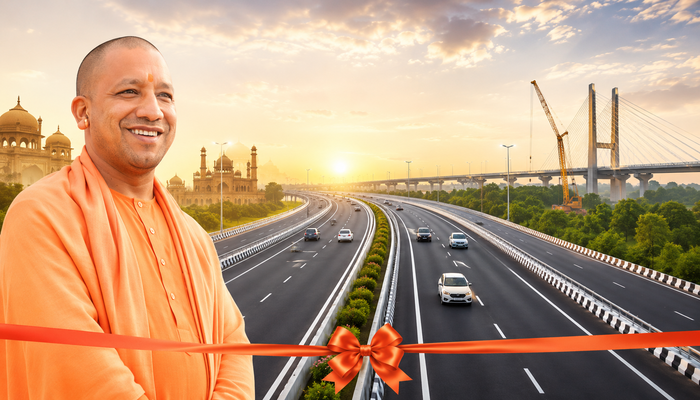
In a fresh addition to the state’s infrastructural achievements, the Yogi Adityanath government in Uttar Pradesh is set to inaugurate the Lucknow-Kanpur Expressway on 13th July. The 63-kilometre-long landmark infrastructural project built with an expenditure of ₹4,700 crore will be inaugurated by Union Defence Minister Rajnath Singh, Union Road Transport and Highways Minister Nitin Gadkari, and Uttar Pradesh Chief Minister Yogi Adityanath.
The expressway will significantly improve connectivity between the two major cities of the state and considerably reduce the distance as the travel time. At present, the travel time between Lucknow and Kanpur is between 2.5 and 3 hours. After the expressway becomes operational, the journey between the two cities will take 35 to 45 minutes, which will save people a considerable amount of time. The expressway has been designated as National Expressway-6.
Image via Bhaskar
Advanced technology used in its construction
The advanced 3D AMG technology was used in the construction of the expressway, about 30% of whose total length is elevated. An Advanced Traffic Management System (ATMS) has been installed on the expressway to issue challans (fines) to those exceeding the speed limit; the system will instantly transmit details for enforcement action. It has 63 high-resolution CCTV cameras and 16 Video Incident Detection Systems (VIDS). The entire stretch of the expressway will be under CCTV surveillance. In case an accident takes place on the expressway, assistance will arrive within 15 minutes.
The expressway is fitted with Intelligent Traffic Management Systems (ITMS), including PTZ (pan-tilt-zoom) cameras, speed radars, emergency call boxes, variable message signs and incident detection systems. Two control rooms have been set up on the expressway at the 27th km and the 35th km for round-the-clock surveillance.
Barrier-free journey
Vehicles running on the expressway will have to follow a speed limit of 120 km per hour. The expressway, which will be the country’s first barrier-free expressway, will link Shaheed Path in Lucknow to Chakeri in Kanpur. Vehicles will be able to pass without conventional toll barriers, which will contribute to reducing delays and improving traffic movement.
The project uses a technology called Multi-Lane Free Flow (MLFF) tolling system, which allows vehicles to pass through toll points without physical barriers, helping ensure smoother and faster travel. This tolling system combines Automatic Number Plate Recognition (ANPR) cameras and FASTag-based Electronic Toll Collection technology.
High-speed cameras installed above the road automatically scan a vehicle’s number plate as it passes through the toll point. At the same time, sensors detect the FASTag fixed on the vehicle’s windshield. The toll amount is then automatically deducted from the linked FASTag account without requiring the vehicle to stop. If there is not sufficient balance in the FASTag account, the user will receive an Electronic Notice (E-Notice) for payment of the toll fee.
The system requires very little human involvement. By allowing uninterrupted movement of vehicles, the system is expected to reduce travel time, improve fuel efficiency, cut vehicle emissions near toll plazas, reduce congestion, and improve overall highway operations.
Two-wheelers will not be allowed on the expressway. To maintain ecological balance, the state forest department has proposed planting around 46,000 trees along the expressway.
Lucknow-Kanpur expressway (Image via Bhaskar)
Improved connectivity and smooth travel
The route of the expressway is such that it will connect three different expressways, hugely benefiting residents of several other districts in Uttar Pradesh. It has been linked to the Lucknow Outer Ring Road, which will enable vehicles coming from Kanpur to head directly towards Rae Bareli, Sitapur, Hardoi, and Sultanpur without entering the city. Service lanes have also been built for smooth entry and exit to the Ring Road.
The project includes four major bridges, 25 minor bridges, four flyovers, 11 pedestrian underpasses, and 13 underpasses for light vehicles. Currently, there are six lanes on the expressway, which will soon be expanded to eight lanes. This is an effective alternative to the 94-km-long old NH-27, which experiences heavy congestion. It has a total of five toll plazas, but the toll connecting to the Outer Ring Road will not be taxed. Currently, only four toll plazas will charge a fixed fee based on vehicle types.
Higher fares but improved travel experience
There will be two fare structures for state transport (roadways) buses travelling to Kanpur. While the fare for buses using the existing National Highway is ₹137, passengers on buses using the expressway may have to pay up to ₹150. The difference in fares is due to higher toll charges. The toll for a single bus journey on the expressway is ₹935 (with a return trip on the same day costing ₹1,405), whereas the toll for buses using the National Highway is ₹95. To ensure passenger convenience, fuel stations, restaurants, parking areas and trauma centres are being developed along the expressway.