Major Buddhist complex found in Baramulla: Read about the breakthrough and how Modi govt is working to revive the cultural and historical heritage of Kashmir
A prominent archaeological discovery that holds the potential to redefine the cultural and historical contexts has transpired in Jammu & Kashmir. Large architectural remnants of a pivotal Buddhist complex from the Kushan era have been unearthed by archaeologists in Zehanpora in the Baramulla area of north Kashmir. The project is a joint effort between the Jammu & Kashmir Department of Archives, Archaeology and Museums (DAAM), Centre of Central Asian Studies (CCAS) and the University of Kashmir. Their goal is to enhance knowledge of the cultural and religious backdrop of ancient Kashmir. The digging started in early November and is halted due to winter but is anticipated to continue for years. The results are set to add important narratives to the region’s archaeological map, according to project director Dr Mohammad Ajmal Shah. It is the first massive collaborative exercise to receive formal sanction under the Archaeological Survey of India standards in the union territory. So far, the excavations have revealed a stupa, structural walls, pottery and copper objects. The items have endured for centuries despite severe weather and topographical difficulties. They stood as a testament to sophisticated architectural expertise as well as construction quality and comprehensive urban planning. Moreover, layers of stone foundations, carved pieces, ceramic pieces and structural alignments started to show up as excavation proceeded. It suggested a once-active monastery centre that might have been a key spot along earlier routes connecting Kashmir with Central Asia. High-resolution mapping, ground-penetrating radar research, drone documentation, digital archiving and similar methods have been employed in the process to ensure a methodical and scientific recovery of the site. Modern machinery uncover ancient origins The mission commenced after a number of sizable mounds that were long considered to be the remains of ancient stupas were identified during intensive preliminary surveys, which lasted several months and included drone imagery, mapping and ground verification. According to first observations, these mounds were not natural formations but rather the remains of old man-made structures, most likely stupas, monastic cells and other elements of a mighty Buddhist establishment. Meanwhile, Dr Shah made a vital progress in 2023 when he located an old photograph in a French museum collection depicting three stupas in Baramulla. It suggested a historical link between the place and Kashmir’s Buddhist tradition. The mounds matched substantial remnants of a stupa complex and related construction. It was also determined by later fieldwork, which indicated a booming early-historic Buddhist town. Image via thebizreporter.com Director of DAAM, KK Sidha expressed, “This joint excavation marks a landmark initiative in archaeological research in Jammu & Kashmir. The discoveries at Zehanpora will enrich local as well as wider understanding of our cultural heritage.” Deeper excavation, scientific analysis and the creation of a conservation strategy that could aid museum exhibits, scholarly research alongside heritage-tourism projects are the main priorities. To foster archaeological site protection, officials even plan to involve the local community through outreach and awareness campaigns. The initiative took place after DAAM and CCAS signed a crucial Memorandum of Understanding (MoU) on 31st October to improve archaeological research, documentation and heritage management in Jammu and Kashmir. Joint excavations, artefact preservation, 3D documentation and promotion of tourism were covered by the document. Baramulla Deputy Commissioner Minga Sherpa stated that the team has taken a “meticulous and scientific approach,” and further highlighted, “Baramulla has historically been a key corridor for trade and cultural exchange. The findings here will offer valuable insights into Kashmir’s past.” The site is also close to the historical towns of Kanispur (ancient Kanishkapura) and Ushkur (Huvishkapura). They are conceived to be found by Kushan emperors Kanishka and Huvishka. During the Kushan period (1st-3rd century CE), Kanispur, Ushkur and Zehanpora constituted a trinity of political, religious and cultural activity, according to Kalhana’s Rajatarangini. Significance of the findings The excavation would eventually provide greater insights into how societies lived, traded, worshipped and interacted throughout that time. Interestingly, a similar discovery was made on the right bank of the Chenab River in Akhnoor’s Ambaran hamlet. Now, the latest finding pointed to a large and interconnected Buddhist civilisation that covered Jammu and Kashmir. These excavations shed light on the extraordinary sociocultural sophistication of ancient Kashmir. The region was recorded to be situated at the intersection of trade routes connecting the Himalayan realm, Central Asia and the plains of the c
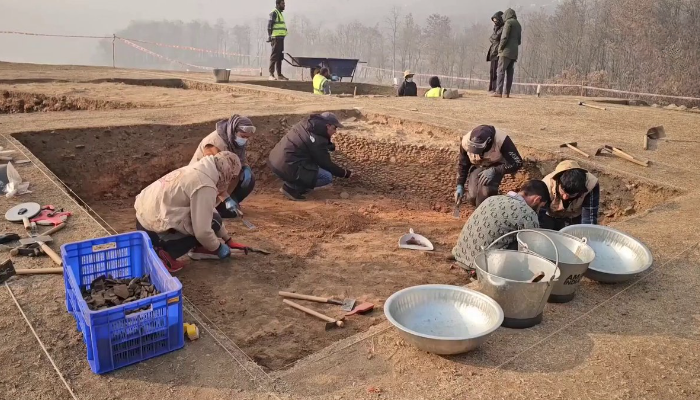

A prominent archaeological discovery that holds the potential to redefine the cultural and historical contexts has transpired in Jammu & Kashmir. Large architectural remnants of a pivotal Buddhist complex from the Kushan era have been unearthed by archaeologists in Zehanpora in the Baramulla area of north Kashmir.
The project is a joint effort between the Jammu & Kashmir Department of Archives, Archaeology and Museums (DAAM), Centre of Central Asian Studies (CCAS) and the University of Kashmir. Their goal is to enhance knowledge of the cultural and religious backdrop of ancient Kashmir. The digging started in early November and is halted due to winter but is anticipated to continue for years.
The results are set to add important narratives to the region’s archaeological map, according to project director Dr Mohammad Ajmal Shah. It is the first massive collaborative exercise to receive formal sanction under the Archaeological Survey of India standards in the union territory.
So far, the excavations have revealed a stupa, structural walls, pottery and copper objects. The items have endured for centuries despite severe weather and topographical difficulties. They stood as a testament to sophisticated architectural expertise as well as construction quality and comprehensive urban planning.
Moreover, layers of stone foundations, carved pieces, ceramic pieces and structural alignments started to show up as excavation proceeded. It suggested a once-active monastery centre that might have been a key spot along earlier routes connecting Kashmir with Central Asia.
High-resolution mapping, ground-penetrating radar research, drone documentation, digital archiving and similar methods have been employed in the process to ensure a methodical and scientific recovery of the site.
Modern machinery uncover ancient origins
The mission commenced after a number of sizable mounds that were long considered to be the remains of ancient stupas were identified during intensive preliminary surveys, which lasted several months and included drone imagery, mapping and ground verification. According to first observations, these mounds were not natural formations but rather the remains of old man-made structures, most likely stupas, monastic cells and other elements of a mighty Buddhist establishment.
Meanwhile, Dr Shah made a vital progress in 2023 when he located an old photograph in a French museum collection depicting three stupas in Baramulla. It suggested a historical link between the place and Kashmir’s Buddhist tradition. The mounds matched substantial remnants of a stupa complex and related construction. It was also determined by later fieldwork, which indicated a booming early-historic Buddhist town.

Director of DAAM, KK Sidha expressed, “This joint excavation marks a landmark initiative in archaeological research in Jammu & Kashmir. The discoveries at Zehanpora will enrich local as well as wider understanding of our cultural heritage.”
Deeper excavation, scientific analysis and the creation of a conservation strategy that could aid museum exhibits, scholarly research alongside heritage-tourism projects are the main priorities. To foster archaeological site protection, officials even plan to involve the local community through outreach and awareness campaigns.
The initiative took place after DAAM and CCAS signed a crucial Memorandum of Understanding (MoU) on 31st October to improve archaeological research, documentation and heritage management in Jammu and Kashmir. Joint excavations, artefact preservation, 3D documentation and promotion of tourism were covered by the document.
Baramulla Deputy Commissioner Minga Sherpa stated that the team has taken a “meticulous and scientific approach,” and further highlighted, “Baramulla has historically been a key corridor for trade and cultural exchange. The findings here will offer valuable insights into Kashmir’s past.”
The site is also close to the historical towns of Kanispur (ancient Kanishkapura) and Ushkur (Huvishkapura). They are conceived to be found by Kushan emperors Kanishka and Huvishka. During the Kushan period (1st-3rd century CE), Kanispur, Ushkur and Zehanpora constituted a trinity of political, religious and cultural activity, according to Kalhana’s Rajatarangini.
Significance of the findings
The excavation would eventually provide greater insights into how societies lived, traded, worshipped and interacted throughout that time. Interestingly, a similar discovery was made on the right bank of the Chenab River in Akhnoor’s Ambaran hamlet. Now, the latest finding pointed to a large and interconnected Buddhist civilisation that covered Jammu and Kashmir.
These excavations shed light on the extraordinary sociocultural sophistication of ancient Kashmir. The region was recorded to be situated at the intersection of trade routes connecting the Himalayan realm, Central Asia and the plains of the country.

The material culture that has been found thus far points to a prosperous community with robust creative traditions and potential ties to the wider Gandhara and Central Asian Buddhist domains, as per reports. The size of the community and its cultural makeup are likely to alter the perception of the valley’s place in the religious and economic networks of the former state, once archaeologists go into the second stage of their research. It would also grant information about the socio-religious life, architectural styles and settlement structure of ancient Kashmir.
Cultural and heritage revival in Kashmir under the Modi government
Earlier this year, Union Home Minister Amit Shah had announced that the government of Prime Minister Narendra Modi is dedicated to revitalising Kashmir’s historical and cultural legacy and “reclaim what has been lost.” He was speaking at the launch of a book named “Jammu Kashmir and Ladakh Through the Ages: A Visual Narrative of Continuities and Linkages,” in January.
Shah noted that Kashmir has always been and will always be an integral part of India. “There were attempts to separate Kashmir from India in the past but time itself has nullified those efforts,” he added, emphasising that no legal provision could ever break the connection.
The minister underlined that while most nations have defined their borders through geopolitics, India’s borders reflect its combination of cultural unity and geo-cultural expansiveness. He highlighted how the book beautifully depicted the relationship between Buddhism, Shaivism, Kashmir and Ladakh. The validity of the statement has been affirmed by the excavations at the heritage sites in Kashmir.
The centre has honoured its promise and facilitated the revival of several ancient religious sites in the valley, which are historically relevant to the true identity and culture of Kashmir.
Resurrection of the sacred legacy
On the first day of Chaitra Navratri in 2023, Amit Shah virtually inaugurated Mata Sharda Devi temple, which is situated in Teetwal village in the Kupwara district of North Kashmir, in the presence of other dignitaries. It was built by Seva Sharda Samiti Kashmir and Sri Sringeri Math. Pakistan-Occupied Kashmir (PoK) is only 500 meters away from the location.
Shah mentioned, “Ravinder Pandita (head of Save Sharda committee) has asked for a Kartarpur-style corridor for Sharda yatra and the government of India will surely make attempts in this direction, there is no doubt in that.” The original Sharada Peeth was constructed many centuries ago and lies inside PoK’s Neelum valley.
On 28th May, a Shivling was reinstalled in the ancient Jogeshwari Shiva temple in Rainawari of Srinagar, following a 35 year-gap. This Shivling was desecrated and thrown into the river by terrorists in Kashmir in 1990. It had been found by authorities at that point, but could not be kept in the temple for very long and was stored at the police station.
The Rainawari Kashmir Pandit Committee reclaimed the Shivling from the cops on the Special Magistrate of Srinagar’s order but the original one remained missing. Yet, the developments represented the renewal of the valley’s age-old culture and history under the Modi rule.
Iconic temples restored
The renowned Hindu temple of Goddess Uma Bhagwati reopened on 14th July 2024, after 34 years. It is situated in the Shangus neighbourhood of the Anantnag district in Brari Aangan. Nityanand Rai, the Union Minister of State for Home Affairs, attended the event. The temple was vandalised following the terrorist epidemic in the valley in the late 1980s.
Its restoration work was concluded before the inauguration took place. An idol of Goddess Uma Bhagwati was put in the sanctum sanctorum during the ritual while religious hymns were sang. The idol arrived from Rajasthan.
The government of Jammu and Kashmir likewise made the decision to restore the iconic Martand Sun Temple in Anantnag, a prominent Hindu holy site, on 27th March of that year. It also directed to install a statue of King Lalitaditya, who oversaw the temple’s construction.
Additionally, a “kalash” from Ayodhya was erected at the Ram Temple, which is on the precinct of the Sun Temple, in front of pilgrims from Tamil Nadu and Uttar Pradesh, alongside locals. The “kalash” was one of many delivered to certain Ram temples in the country. Additionally, Manoj Sinha, the Lieutenant Governor of Jammu and Kashmir, visited the Martand Sun Temple to partake in Mahayagya and offer prayers.
The temple is believed to have been constructed in the eighth century AD but between 1389 and 1413, there were multiple efforts to demolish it. It was demolished at the behest of Muslim king Sikandar Shah Miri, also known as Sikandar Butshikan (Idol-breaker). The moniker was given to him by mediaeval Islamists due to his tendency to attack and destroy Hindu temples.
Conclusion
The recent discovery of the Buddhist complex further highlights the genuine history of the valley long before foreign religions and tyrannical rulers invaded the land of Kashmir. Hence, the government has been leading efforts to re-introduce the true past of the valley and dispel the forced obscurity left by radical elements that have worked hard to wipe out Kashmir’s civilisational roots in Indic faiths and cultures.