Nobody killed Vishal Kumar: Read what reasons the court gave to acquit all 20 accused in ABVP activist murder case in 2012
On 30th December, the Additional Sessions Court in Mavelikkara acquitted all 20 adult accused in the 2012 murder of ABVP activist Vishal Kumar. The court stated that the prosecution failed to prove its case beyond reasonable doubt. The verdict was delivered by Judge P P Pooja. OpIndia accessed the copy of the judgment in the matter. While the verdict did not dispute that Vishal was murdered, it concluded that the State could not legally establish who did it, or how a large group could be fastened with collective liability for the crime. The prosecution said that it would challenge the verdict in the High Court. A Kerala court on Tuesday (December 30) acquitted all 20 accused individuals, reportedly workers of the Campus Front, in the 2012 murder case of ABVP activist Vishal Kumar in Alappuzha.Tune in for more LIVE Updates: https://t.co/ujdirIFJgv#RepublicWorld #RepublicTV… pic.twitter.com/uc2O80rH7H— Republic (@republic) December 30, 2025 The judgment came as a second injury for the victim’s family, not because courts are expected to convict without proof, but because the reasons cited for the acquittal exposed a deeper institutional failure. The judgment pointed out that the investigation that began the day Vishal was killed could not preserve the basics, a reliable first version, prompt procedure, credible identification, clean recoveries, and consistent witness testimony. The system allowed gaps and contradictions to grow so large that a murder in a busy campus setting ended in a legal conclusion that no one could be punished. It left behind an uncomfortable headline that almost wrote itself, a young ABVP activist was stabbed to death, and 13 years later, nobody killed him. The campus murder of July 2012 Vishal was only 19 years old when the incident happened. He was a first year BSc student at NSS College, Konni, and an ABVP activist from Chengannur. On the morning of 16th July, he was at Christian College to welcome freshers as part of ABVP activities. The prosecution’s case was that Campus Front members arrived at the college, abused the ABVP group, got into an altercation, and it spiralled into a violent attack with a knife and other objects. Vishal, who tried to alleviate the situation, was stabbed. Two other ABVP members, Vishnuprasad and Sreejith, were also injured. Vishal was rushed to the government hospital in Chengannur and was then shifted to Kottayam Medical College Hospital. He succumbed to his injuries in the early hours of the next day. This was not a crime that happened in a private space or in isolation. It took place in a politically charged campus atmosphere, outside the college gate, where hundreds of students were present. This detail mattered because the judgment repeatedly returned to the central theme that in a situation like this, the prosecution must either produce strong independent corroboration, or it must present an unimpeachable, consistent account from its key witnesses. The court stated that nothing of this sort was present in the prosecution’s arguments. Who were the accused, and why this case carried a wider political shadow The 20 individuals who were acquitted by the court were described as members of Campus Front of India (CFI), which was the student wing of the Popular Front of India (PFI). PFI was banned by the Government of India in September 2022. One more accused was a juvenile at the time of the offence. His case was separated for proceedings before the Juvenile Justice Board in Alappuzha. The list of acquitted accused, as reported at the time of the verdict, included Ashiq, Shafeeq, Ansar Faisal, Shafeeq, Asif Muhammad, Nasim, Sanuj, Althaj, Shameer Rawther, Safeer, Afsal, Abdul Wahab, Shibin Habeeb, Shahjahan Maulavi, Nawaz Sherif, Shameer, Sajeev, and Saleem. They faced serious charges including murder, unlawful assembly armed with deadly weapons, rioting, wrongful confinement, and allied provisions, along with conspiracy. Some of them were also booked for harbouring the accused. The defence position was that the case had been inflated to rope in many, and that only one person stabbed the victim while the others were made to stand trial on a broad political narrative. In substance, the court’s verdict leaned towards a similar conclusion, not necessarily by accepting every defence claim, but by finding that the prosecution could not meet the strict threshold required for conviction. This is where the victim centric lens matters. Even if courts must acquit when evidence does not cross the legal threshold, the question that remains is why the evidence did not cross it. The judgment pointed to avoidable gaps, and those gaps, in turn, pointed to avoidable failures by the police and prosecution. A thirteen year journey, and the cost of delay The case was first investigated by the local police, later handed to the Crime Branch, and a chargesheet was filed against 20 individuals including the juvenile. During the t
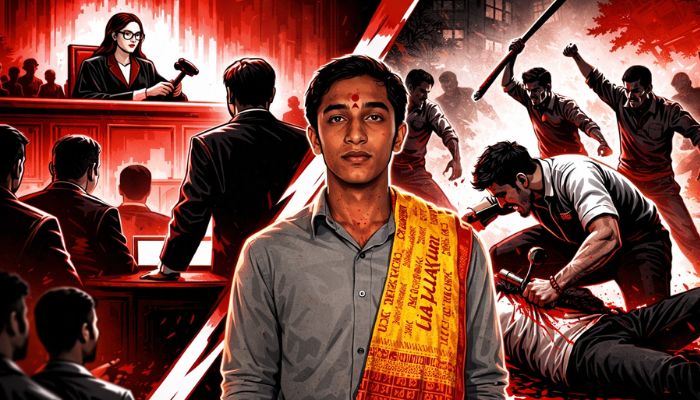

On 30th December, the Additional Sessions Court in Mavelikkara acquitted all 20 adult accused in the 2012 murder of ABVP activist Vishal Kumar. The court stated that the prosecution failed to prove its case beyond reasonable doubt. The verdict was delivered by Judge P P Pooja. OpIndia accessed the copy of the judgment in the matter.
While the verdict did not dispute that Vishal was murdered, it concluded that the State could not legally establish who did it, or how a large group could be fastened with collective liability for the crime. The prosecution said that it would challenge the verdict in the High Court.
A Kerala court on Tuesday (December 30) acquitted all 20 accused individuals, reportedly workers of the Campus Front, in the 2012 murder case of ABVP activist Vishal Kumar in Alappuzha.
— Republic (@republic) December 30, 2025
Tune in for more LIVE Updates: https://t.co/ujdirIFJgv#RepublicWorld #RepublicTV… pic.twitter.com/uc2O80rH7H
The judgment came as a second injury for the victim’s family, not because courts are expected to convict without proof, but because the reasons cited for the acquittal exposed a deeper institutional failure. The judgment pointed out that the investigation that began the day Vishal was killed could not preserve the basics, a reliable first version, prompt procedure, credible identification, clean recoveries, and consistent witness testimony.
The system allowed gaps and contradictions to grow so large that a murder in a busy campus setting ended in a legal conclusion that no one could be punished. It left behind an uncomfortable headline that almost wrote itself, a young ABVP activist was stabbed to death, and 13 years later, nobody killed him.
The campus murder of July 2012
Vishal was only 19 years old when the incident happened. He was a first year BSc student at NSS College, Konni, and an ABVP activist from Chengannur. On the morning of 16th July, he was at Christian College to welcome freshers as part of ABVP activities. The prosecution’s case was that Campus Front members arrived at the college, abused the ABVP group, got into an altercation, and it spiralled into a violent attack with a knife and other objects. Vishal, who tried to alleviate the situation, was stabbed. Two other ABVP members, Vishnuprasad and Sreejith, were also injured.
Vishal was rushed to the government hospital in Chengannur and was then shifted to Kottayam Medical College Hospital. He succumbed to his injuries in the early hours of the next day. This was not a crime that happened in a private space or in isolation. It took place in a politically charged campus atmosphere, outside the college gate, where hundreds of students were present.
This detail mattered because the judgment repeatedly returned to the central theme that in a situation like this, the prosecution must either produce strong independent corroboration, or it must present an unimpeachable, consistent account from its key witnesses. The court stated that nothing of this sort was present in the prosecution’s arguments.
Who were the accused, and why this case carried a wider political shadow
The 20 individuals who were acquitted by the court were described as members of Campus Front of India (CFI), which was the student wing of the Popular Front of India (PFI). PFI was banned by the Government of India in September 2022. One more accused was a juvenile at the time of the offence. His case was separated for proceedings before the Juvenile Justice Board in Alappuzha.
The list of acquitted accused, as reported at the time of the verdict, included Ashiq, Shafeeq, Ansar Faisal, Shafeeq, Asif Muhammad, Nasim, Sanuj, Althaj, Shameer Rawther, Safeer, Afsal, Abdul Wahab, Shibin Habeeb, Shahjahan Maulavi, Nawaz Sherif, Shameer, Sajeev, and Saleem.
They faced serious charges including murder, unlawful assembly armed with deadly weapons, rioting, wrongful confinement, and allied provisions, along with conspiracy. Some of them were also booked for harbouring the accused. The defence position was that the case had been inflated to rope in many, and that only one person stabbed the victim while the others were made to stand trial on a broad political narrative.
In substance, the court’s verdict leaned towards a similar conclusion, not necessarily by accepting every defence claim, but by finding that the prosecution could not meet the strict threshold required for conviction.
This is where the victim centric lens matters. Even if courts must acquit when evidence does not cross the legal threshold, the question that remains is why the evidence did not cross it. The judgment pointed to avoidable gaps, and those gaps, in turn, pointed to avoidable failures by the police and prosecution.
A thirteen year journey, and the cost of delay
The case was first investigated by the local police, later handed to the Crime Branch, and a chargesheet was filed against 20 individuals including the juvenile. During the trial, the prosecution examined 55 witnesses and produced 205 documents, and the case was handled over time by multiple officers.
Long timelines corrode cases in predictable ways. Memories fade, witnesses turn hostile, and early investigative omissions become impossible to cure later. But the troubling part in this matter was that key weaknesses were not merely the product of time. Some were present from the first hours and days, the handling of the first information, the lack of proper identification procedures, and the way search and seizure material was documented and presented.
The judgment must be studied as a manual on how reasonable doubt grows, not because the crime is unclear, but because the case construction was not disciplined enough to survive cross examination.
The court’s first major finding, the first version itself was suspect
One of the most damaging parts of the judgment for the prosecution was the court’s conclusion that the first information and related documents appeared to have been antitimed, and possibly even antedated.
In its judgment, the court noted that the prosecution’s claim that recording of the first information began at 11.45 am could not be relied on. Furthermore, the court said that there was merit in the defence contention that the first information and the connected document were antitimed. The court also noted that the endorsement showed the documents reached the court office only at 10.45 am on 17th July 2012, the day after the incident, and recorded that there was merit in the defence contention that the documents were antitimed and may have been antedated as well.
This was not a minor technicality. In criminal trials, a prompt and reliable first version anchors the narrative. When the first version becomes doubtful, the entire prosecution story begins to look like a product of later stitching, particularly when later testimonies add names, roles, and motive details that were missing at the start.
The court went further and pointed out that even claims about when information was received at the police station, and how that was recorded, did not inspire confidence. When a court places the first version under suspicion, every later improvement becomes easier to dismiss as embellishment.
The court’s second major finding, the prosecution ‘suppressed the genesis’ and presented a ‘one sided story’
A key portion of the judgment addressed the context of the clash and the presence of other student groups at the spot. The court stated that the prosecution suppressed the genesis of the crime and projected a one sided version of the ABVP members, creating doubt regarding the entire prosecution story.
This line was particularly significant because it was not merely about a witness contradicting himself. It was a judicial finding that the prosecution narrative was incomplete in its portrayal of what led to the incident, who all were present, and how the confrontation unfolded.
In a politically charged campus environment, courts look for neutrality and corroboration. If multiple groups were present, the court expects either independent witnesses, or at least a credible attempt to capture and present the wider scene. The court’s criticism suggested that the investigation and prosecution did not sufficiently grapple with this basic expectation.
Eyewitness testimony, when ‘injured witness’ was not enough
The prosecution relied heavily on the injured eyewitnesses, Vishal’s companions who were themselves wounded in the incident. Ordinarily, injured witnesses carry weight because they are presumed to have been present and to have little reason to falsely implicate random people while sparing real attackers.
But courts still test credibility, consistency, and procedure. Here, the judgment repeatedly noted omissions in early statements, later improvements, and contradictions, especially on whether several accused were already known to the witnesses.
The court observed that if certain accused were known to the primary witness as later claimed, he should have stated that fact in the first information itself, and the absence of those details created doubt about their identity, their presence, and their complicity. The court also noted that claims about several accused being known previously did not find place in the first version, and the later expansion created doubt.
This was where the tragedy of delay and poor documentation merged. If a witness truly knew several accused, the case needed to capture that clarity immediately. If he did not know them, then the investigation needed a proper identification procedure.
The prosecution appeared to have ended up in the worst of both worlds, claiming familiarity later without recording it early, and failing to properly identify unknown accused through robust legal procedure.
The fatal procedural gap, no reliable test identification parade
One of the most repeated themes in the judgment was the weakness of identification evidence. The court noted that identification not preceded by a Test Identification Parade could not be safely relied on in the facts and circumstances of the case, especially when improvements from prior statements made a witness unreliable.
For at least one accused, the judgment noted that he was not identified by any witness through a test identification parade. The court also noted that the prosecution had no case that several accused were identified by the witness through a test identification parade or otherwise.
This was not a small lapse. When accused persons are not previously known, test identification is a basic step, not a luxury. It preserves the evidentiary value of recognition before memories fade and before witnesses are exposed to photographs, media reports, or informal police cues. When that step is skipped, dock identification years later becomes vulnerable to the argument that the witness was merely pointing to the person he knew was the accused, not the person he genuinely remembered.
In a mass assault case where the prosecution wants the court to apply unlawful assembly and common object principles, identification becomes even more critical. If individuals cannot be firmly placed at the scene with credible identification, the entire architecture of group liability collapses.
Motive and later improvements, the ‘love jihad’ claim that did not exist at the beginning
The prosecution side suggested that Vishal faced hostility because he had opposed “love jihad” activity and that this contributed to motive. The judgment, however, highlighted that such a claim did not appear in the earliest statements, and it recorded admissions by witnesses that they had not given statements to that effect at the initial stage.
When motive is introduced late, courts treat it with caution. Motive is not always necessary when there is direct evidence, but when direct evidence becomes shaky, motive becomes the glue that holds the narrative. If the glue itself looks like a late addition, it weakens the structure further.
The larger point was not about whether that motive was true or false in the real world. It was about case building. If the State wanted motive to matter, it needed to record it early, corroborate it, and present it consistently. The court found that did not happen.
Search and seizure, when a missing witness and late documentation became reasonable doubt
The judgment also flagged significant issues in the way searches and seizures were handled, particularly around a search in the house of the accused described as the alleged stabber. The court noted that the officer who conducted the search in the house of that accused was neither cited nor examined before the court. It also noted that while the search memo showed the search proceedings, the search memo reached the court only on 25 July 2012, even though the search was stated to have occurred on 17 July 2012.
A search memo reaching the court late, coupled with failure to examine the searching officer, is a gift to the defence in any serious trial. It invites the argument that the recovery is tainted, that documentation was created later, or that the chain of custody is uncertain. Courts do not need to declare evidence fabricated to still find that the manner of proof is unreliable.
Forensics did not rescue the case, and the judgment said so
Where eyewitness testimony becomes contested, forensic corroboration can often rescue the prosecution. Here, the judgment indicated that it did not.
The court noted, for instance, that a material object contained blood insufficient to ascertain origin and group. It also noted that certain clothing items contained human blood but the group could not be ascertained, and it added that these circumstances alone were insufficient to prove guilt beyond reasonable doubt.
This is again a familiar pattern in failed prosecutions. Forensic results that do not conclusively link the weapon or clothing to the victim, or do not establish blood group match, do not provide the kind of hard corroboration that courts prefer when other parts of the narrative are under doubt.
This does not mean forensics disproved the prosecution. It means it could not strengthen it enough to cross the criminal standard of proof.
Conspiracy and harbouring, the add on charges that could not stand without a strong core
Once the court found the core murder case unproven beyond reasonable doubt, the add on charges, conspiracy and harbouring, had little chance of surviving unless independently established. The judgment indicated that the prosecution could not convincingly prove that particular accused sheltered offenders as claimed, or that a conspiracy was established in a manner the law requires.
This was not merely a technical outcome. It revealed how the prosecution appeared to have built a wide net, but without reinforcing the foundation that would allow the net to hold.
In politically sensitive cases, the temptation is often to charge broadly, to show seriousness, to bring in common object and conspiracy, and to present the incident as an organised attack. The risk is that if identification and procedural proof are not airtight, the breadth becomes a weakness. Every additional accused becomes another point of doubt, another gap to exploit, and another reason for the court to hesitate.
What comes next
The prosecution has said it intends to appeal. The High Court will examine whether the trial court’s view was a plausible view of the evidence, whether key evidence was misread, whether legal principles were wrongly applied, and whether an acquittal can be overturned. Appeals against acquittals are possible, but they are not easy, because appellate courts are cautious about reversing a finding of reasonable doubt unless there is a clear error.
Meanwhile, the human truth remains unchanged. Vishal Kumar was 19. He died from a stab injury after an attack outside a college gate. He did not return home. His family has lived with a thirteen year wait that ended in a verdict that offers no closure.
If the system wants to avoid more such verdicts, it must learn from what this judgment flags, not by attacking the court for applying the law, but by forcing accountability on investigation and prosecution for failing to do what the law requires from the beginning.
Because when the first information is doubted, identification is not secured, witnesses improve, key officers are not examined, and forensics do not corroborate, the courtroom outcome becomes almost prewritten. The accused walk free, the victim is buried again, and the public is left with a brutal line that should never become normal in a civilised society.
Nobody killed Vishal Kumar, not because the crime did not happen, but because the State could not prove who did it.
You can read the judgment here.