Over 300 crores spent, 33,723 ponds built: Read exclusive details about how CM Yogi Adityanath is transforming Uttar Pradesh with this targeted scheme
The Khet Talaab Yojana is a key water conservation and irrigation support scheme of the Uttar Pradesh Government under Chief Minister Yogi Adityanath. The scheme, that was launched in 2017, is designed to help farmers store rainwater in small ponds built within their fields and use that water for irrigation during dry spells. The scheme has been implemented in the state under the Rashtriya Krishi Vikas Yojana (RKVY) with funding support from the Government of India. Both the state and the Centre share the funding in a 50 per cent ratio. The aim of the scheme is to reduce dependence on falling groundwater, improve irrigation reliability, and strengthen farm resilience. Under the leadership of Chief Minister Yogi Adityanath, the scheme has shown remarkable changes in drought prone regions. The scheme has expanded from seven districts of Bundelkhand to multiple districts across the state. Official data accessed through RTI by OpIndia suggests that the scale has grown steadily over time. Why the scheme was launched For decades, farmers in Bundelkhand faced drought, dry wells, and crop failures. With the arrival of summers, hand pumps used to dry out, and farming was entirely dependent on rainfall. The Khet Talaab Yojana was designed as a decentralised fix for this problem. The ponds created under the scheme help in storing rainwater at the farm level, which farmers can use to irrigate crops when needed. It also improves groundwater recharge over the long term. In a report by UP Tak on Bundelkhand’s revival, the change in the region has been described as a silent shift, where small farm ponds were built in fields to store rainwater, which now supports irrigation throughout the year. The scheme has directly affected agriculture in the region by improving water availability. It has also provided additional income to farmers through fish farming. Launch, phases, and Bundelkhand as the starting point According to the information available on the UP Government’s website, the scheme began with an initial phase in seven districts of Bundelkhand. A total of 2,000 ponds were constructed at an outlay of Rs 12.20 crore, covering all development blocks in these districts. The seven districts where the scheme started included Jhansi, Jalaun, Lalitpur, Banda, Chitrakoot, Hamirpur, and Mahoba. In the next phase, the coverage was expanded to a total of 43 districts. It targeted 167 over exploited and critical development blocks, with an additional outlay of Rs 27.88 crore and a target of 3,384 ponds. The target was achieved in a little over a year, and after that, the state government, with the help of the Centre, has funded the scheme consistently. Over the years, 33,723 ponds have been created across state. In 2017-18, 2,000 ponds were created. The schemed peaked in 2022-23 when 5,851 ponds were created. Year-wise total ponds created across state. (Source: Soil Conservation Wing of Department of Agriculture, Government of Uttar Pradesh.) RTI numbers show Bundelkhand remained the top beneficiary According to the data provided by the Soil Conservation Wing of Department of Agriculture, Government of Uttar Pradesh, in response to the RTI filed by OpIndia, a total of 33,723 ponds have been created so far under the scheme since its launch. The UP government has allocated Rs 311.43 crore in grants. The data showed that the original seven Bundelkhand districts remained the most consistent top beneficiaries year after year. Cumulative grant figures for 2016–17 to 2024–25 highlight sustained focus on the region. 6,213 ponds were created in Jhansi since the launch of the scheme, followed by Banda where 4,743 ponds were created. In Jalaun 4,504 ponds were created, Mahoba witnessed creation of 4,321 ponds, Chitrakoot 4,228 ponds, Hamirpur 3,922 ponds, and Lalitpur saw creation of 3,200 ponds. Top districts (Bundelkhand) where maximum ponds have been created since the launch of ‘Khet Talaab Yojana’. (Source: Soil Conservation Wing of Department of Agriculture, Government of Uttar Pradesh.) The consistency matters because it signals that Bundelkhand was not treated as a one time pilot. The region continued to receive substantial support even as the scheme expanded statewide. What people on the ground say, and why it supports the policy intent Beyond the numbers, statements from beneficiaries provide on ground accounts that fit neatly with the scheme’s stated objectives. In Banda’s Luktara village, locals described water becoming available for daily needs and livestock, and agriculture becoming less monsoon dependent. A farmer in Jhansi described the shift away from rainfall only farming by saying, “We are no longer dependent on rains.” Speaking to UP Tak, a government agriculture officer in Jhansi also described the scheme’s mechanics and scale. He stated that the grant is paid directly through Direct Benefit Transfer. He pointed out that Jhansi has crossed around six thousand po
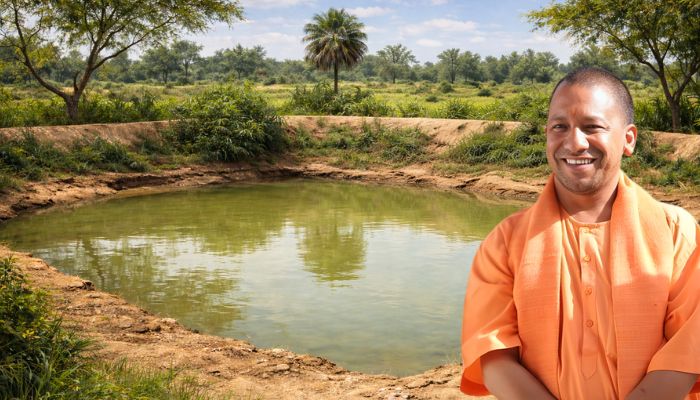

The Khet Talaab Yojana is a key water conservation and irrigation support scheme of the Uttar Pradesh Government under Chief Minister Yogi Adityanath. The scheme, that was launched in 2017, is designed to help farmers store rainwater in small ponds built within their fields and use that water for irrigation during dry spells.
The scheme has been implemented in the state under the Rashtriya Krishi Vikas Yojana (RKVY) with funding support from the Government of India. Both the state and the Centre share the funding in a 50 per cent ratio. The aim of the scheme is to reduce dependence on falling groundwater, improve irrigation reliability, and strengthen farm resilience.
Under the leadership of Chief Minister Yogi Adityanath, the scheme has shown remarkable changes in drought prone regions. The scheme has expanded from seven districts of Bundelkhand to multiple districts across the state. Official data accessed through RTI by OpIndia suggests that the scale has grown steadily over time.
Why the scheme was launched
For decades, farmers in Bundelkhand faced drought, dry wells, and crop failures. With the arrival of summers, hand pumps used to dry out, and farming was entirely dependent on rainfall. The Khet Talaab Yojana was designed as a decentralised fix for this problem. The ponds created under the scheme help in storing rainwater at the farm level, which farmers can use to irrigate crops when needed. It also improves groundwater recharge over the long term.
In a report by UP Tak on Bundelkhand’s revival, the change in the region has been described as a silent shift, where small farm ponds were built in fields to store rainwater, which now supports irrigation throughout the year. The scheme has directly affected agriculture in the region by improving water availability. It has also provided additional income to farmers through fish farming.
Launch, phases, and Bundelkhand as the starting point
According to the information available on the UP Government’s website, the scheme began with an initial phase in seven districts of Bundelkhand. A total of 2,000 ponds were constructed at an outlay of Rs 12.20 crore, covering all development blocks in these districts. The seven districts where the scheme started included Jhansi, Jalaun, Lalitpur, Banda, Chitrakoot, Hamirpur, and Mahoba.
In the next phase, the coverage was expanded to a total of 43 districts. It targeted 167 over exploited and critical development blocks, with an additional outlay of Rs 27.88 crore and a target of 3,384 ponds. The target was achieved in a little over a year, and after that, the state government, with the help of the Centre, has funded the scheme consistently.
Over the years, 33,723 ponds have been created across state. In 2017-18, 2,000 ponds were created. The schemed peaked in 2022-23 when 5,851 ponds were created.

RTI numbers show Bundelkhand remained the top beneficiary
According to the data provided by the Soil Conservation Wing of Department of Agriculture, Government of Uttar Pradesh, in response to the RTI filed by OpIndia, a total of 33,723 ponds have been created so far under the scheme since its launch. The UP government has allocated Rs 311.43 crore in grants.
The data showed that the original seven Bundelkhand districts remained the most consistent top beneficiaries year after year. Cumulative grant figures for 2016–17 to 2024–25 highlight sustained focus on the region.
6,213 ponds were created in Jhansi since the launch of the scheme, followed by Banda where 4,743 ponds were created. In Jalaun 4,504 ponds were created, Mahoba witnessed creation of 4,321 ponds, Chitrakoot 4,228 ponds, Hamirpur 3,922 ponds, and Lalitpur saw creation of 3,200 ponds.

The consistency matters because it signals that Bundelkhand was not treated as a one time pilot. The region continued to receive substantial support even as the scheme expanded statewide.
What people on the ground say, and why it supports the policy intent
Beyond the numbers, statements from beneficiaries provide on ground accounts that fit neatly with the scheme’s stated objectives. In Banda’s Luktara village, locals described water becoming available for daily needs and livestock, and agriculture becoming less monsoon dependent. A farmer in Jhansi described the shift away from rainfall only farming by saying, “We are no longer dependent on rains.”
Speaking to UP Tak, a government agriculture officer in Jhansi also described the scheme’s mechanics and scale. He stated that the grant is paid directly through Direct Benefit Transfer. He pointed out that Jhansi has crossed around six thousand ponds. As a matter of fact, data from RTI replies showed that Jhansi is the top beneficiary of the scheme. He also said that the scheme contributed significantly to improvements in the local water table.
Expansion beyond Bundelkhand
After Bundelkhand, the scheme expanded to multiple other districts. These include Meerut, Ghaziabad, Shamli, Muzaffarnagar, Saharanpur, Baghpat, Gautam Buddh Nagar, Aligarh, Hathras, Kasganj, Hapur, Bulandshahr, Amroha, Mathura, Agra, Firozabad, Etah, Farrukhabad, Kannauj, Kanpur Dehat, Kanpur Nagar, Unnao, Mainpuri, Etawah, Auraiya, Bareilly, Bijnor, Badaun, Pilibhit, Rampur, Moradabad, Sambhal, Ayodhya, Ambedkar Nagar, Gonda, and Bahraich.
The broadening of the scheme indicated that the state moved strategically from a Bundelkhand first intervention to wider water stressed blocks across Uttar Pradesh.
How funds have been allocated over the years
Funds under the Khet Talab Yojana were allocated progressively over the years, reflecting the scheme’s phased expansion and increased focus on water conservation. Beginning with Rs 12.20 crore in 2016–17, allocations rose to Rs 24.50 crore in 2017–18 and Rs 43.22 crore in 2018–19. Spending remained substantial in subsequent years, peaking at Rs 63.51 crore in 2022–23, before moderating to Rs 35.81 crore in 2023–24 and Rs 10.77 crore in 2024–25. In total, the Uttar Pradesh government has spent Rs 311.43 crore on the scheme so far.

Pond sizes, costs, and how the grant works
The scheme supports two standard pond sizes, each with a depth of 3 metres. A small pond measures 22x20x3 metres. The estimated cost of such a pond is Rs 1,05,000. A medium pond measures 35x30x3 metres, and the estimated cost of such a pond is Rs 2,28,400.
Farmers receive a 50 per cent grant amount, which is paid via Direct Benefit Transfer. Typically, the grant is paid in instalments linked to work progress and completion. This structure is intended to ensure that farmers have skin in the game, while still making the construction affordable for small and marginal landholders.
Eligibility, priority groups, and key conditions
While the scheme gives priority to Scheduled Caste and Scheduled Tribe farmers, minority farmers, and small and marginal farmers, the government categorically stated in its RTI reply that such data is not maintained by the state agriculture department. Farmers have to apply for the scheme, and approval comes from the district level administration. Notably, one farmer can receive support for only one pond.
Online registration is mandatory, and selecting the Khet Talaab option during registration is required.
A crucial condition is that the beneficiary must have a functional micro irrigation system, such as drip or sprinkler irrigation, installed through the agriculture or horticulture department within the previous seven years and currently operational.
How to apply, where to apply, and documents required
Applications are submitted online on the UP Agriculture Department portal at agridarshan.up.gov.in.
Applicants fill in personal and land details, upload the required documents, and deposit a token amount as required during application windows. Selection follows a first come, first served processing approach, subject to eligibility and verification.
Documents typically required include Aadhaar, bank details, land records such as Khasra Khatauni, a recent photograph, a declaration, and micro irrigation related documentation, including the tripartite agreement where applicable.
The Yogi Adityanath led BJP government in Uttar Pradesh has focused on long term solutions with the Khet Talaab Yojana rather than short term relief. The scheme combines rainwater harvesting and decentralised irrigation. Grants allocated via Direct Benefit Transfer ensure that the money reaches farmers directly. With these features, the scheme has delivered measurable outcomes on the ground, especially in drought prone Bundelkhand.