Wikipedia bans its co-founder from editing articles after his outspoken views on leftist censorship and admission of anti-Hindu bias
On 22nd June (local time), Wikipedia imposed a community ban on its co-founder, Larry Sanger, preventing him from editing the heavily biased encyclopaedia after a group of editors accused him of off-wiki canvassing, treating the platform as an ideological battleground and attempting to organise users against its existing content establishment. Well, that’s that—I’ve been blocked by Wikipedia “indefinitely” for unstated reasons, by the “consensus” of a mob. There was no due process, no prosecutor, no dispassionate judge, no jury, no interpretation of law. All my judges were self-selected and hated me. pic.twitter.com/N57BRWTG4K— Larry Sanger (@lsanger) June 22, 2026 The “final decision” came after a long discussion among administrators concluded that there was a “clear consensus” to ban Sanger. The closing administrator claimed that Sanger had engaged in off-wiki canvassing, was not present to “constructively build the encyclopedia” and had raised concerns about the outing of anonymous editors. Proposals for a narrower topic ban or partial block received support but were rejected in favour of a complete community ban. An administrator had initially blocked Sanger before the mandatory 72-hour discussion period ended. The action was reversed on procedural grounds, only for another administrator to close the discussion later and impose the same punishment as a formal community ban. The action came days after Sanger appeared on CNN-News18 and spoke openly about Wikipedia’s pronounced Left bias, its anti-Hindu slant and the manner in which its source-control system excludes conservative and non-Left publications. The same interview was later reproduced in Wikipedia’s internal proceedings and used by editors demanding his removal. Notably, Sanger has been a vocal critic of Wikipedia and has accused it of being overtaken by leftist ideology many times, including during a conversation with OpIndia in 2020. The project that triggered the proceedings The immediate dispute began with Sanger’s proposal for WikiProject Intellectual Diversity, or WPID. He described it as a group that would bring together editors interested in fair decision-making, genuine neutrality, broader sourcing, administrative accountability and the representation of viewpoints that have been pushed out of Wikipedia. The project also included a PolicyScanner that monitored more than 90 policy pages, noticeboards and internal discussions. Sanger said it would merely alert users to relevant debates and would not instruct anyone on what to write or how to vote. Wikipedia editors, however, claimed that the project was not meant to improve articles but to operate as a lobbying group. They claimed that the scanner could direct like-minded editors towards live policy disputes, thereby influencing what Wikipedia calls “consensus”. They also objected to WPID’s stated interest in reconsidering the rules on “reliable sources”, due weight and fringe views. The proposal was separately rejected after attracting 396 comments from 113 editors in approximately five days. The closing note declared that WPID would primarily function as an advocacy and policy-lobbying group and that its scanner and recruitment efforts posed a risk of “organised canvassing or vote-stacking”. The way Wikipedia editors erected barriers against WPID was expected. Sanger, one of the co-founders of Wikipedia, wanted to bring more clarity and accountability to the platform, which has become a breeding ground for leftist propaganda. Wikipedia routinely presents its decisions as the product of open consensus, but when an organised group sought to question the ideological assumptions behind that consensus, the proposed participation itself was treated as a threat. CNN-News18 interview became evidence against Sanger On 20th June, Sanger appeared for an interview on CNN-News18’s Plain Speak podcast. During the interview, Sanger said Wikipedia’s central problem was its control over what it labels a reliable source. He explained that the platform selected predominantly Left-wing and establishment sources while excluding publications that were conservative or significantly right of centre. Articles could then be declared neutral only because they accurately reflected an already skewed pool of approved sources. Speaking about India, Sanger said he believed that Wikipedia’s anti-Hindu bias was a fact, although he acknowledged that he could not conclusively establish its exact origin. He suggested that Western Left-wing journalists were often more inclined to adopt a Muslim viewpoint and that the same ideological preference entered Wikipedia through its approved sources. Sanger also said that the Left had “marched through” Wikipedia, just as it had captured other cultural institutions. According to him, Wikipedia’s bias had begun resembling that of the BBC and The New York Times by 2010 and became more pronounced after Brexit and Donald Trump’s first elec
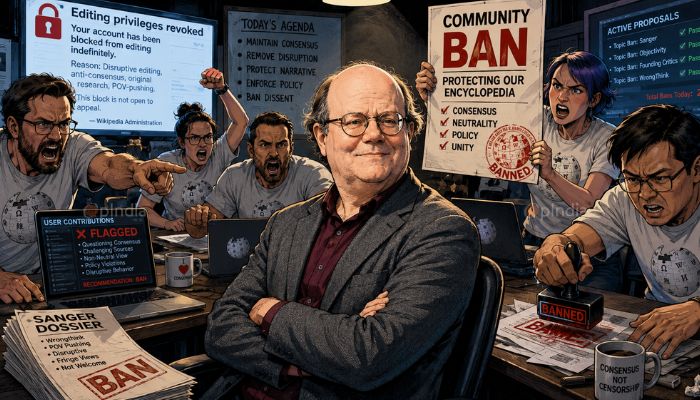
On 22nd June (local time), Wikipedia imposed a community ban on its co-founder, Larry Sanger, preventing him from editing the heavily biased encyclopaedia after a group of editors accused him of off-wiki canvassing, treating the platform as an ideological battleground and attempting to organise users against its existing content establishment.
Well, that’s that—I’ve been blocked by Wikipedia “indefinitely” for unstated reasons, by the “consensus” of a mob. There was no due process, no prosecutor, no dispassionate judge, no jury, no interpretation of law. All my judges were self-selected and hated me. pic.twitter.com/N57BRWTG4K— Larry Sanger (@lsanger) June 22, 2026
The “final decision” came after a long discussion among administrators concluded that there was a “clear consensus” to ban Sanger. The closing administrator claimed that Sanger had engaged in off-wiki canvassing, was not present to “constructively build the encyclopedia” and had raised concerns about the outing of anonymous editors. Proposals for a narrower topic ban or partial block received support but were rejected in favour of a complete community ban.
An administrator had initially blocked Sanger before the mandatory 72-hour discussion period ended. The action was reversed on procedural grounds, only for another administrator to close the discussion later and impose the same punishment as a formal community ban.
The action came days after Sanger appeared on CNN-News18 and spoke openly about Wikipedia’s pronounced Left bias, its anti-Hindu slant and the manner in which its source-control system excludes conservative and non-Left publications. The same interview was later reproduced in Wikipedia’s internal proceedings and used by editors demanding his removal. Notably, Sanger has been a vocal critic of Wikipedia and has accused it of being overtaken by leftist ideology many times, including during a conversation with OpIndia in 2020.
The project that triggered the proceedings
The immediate dispute began with Sanger’s proposal for WikiProject Intellectual Diversity, or WPID. He described it as a group that would bring together editors interested in fair decision-making, genuine neutrality, broader sourcing, administrative accountability and the representation of viewpoints that have been pushed out of Wikipedia.
The project also included a PolicyScanner that monitored more than 90 policy pages, noticeboards and internal discussions. Sanger said it would merely alert users to relevant debates and would not instruct anyone on what to write or how to vote.
Wikipedia editors, however, claimed that the project was not meant to improve articles but to operate as a lobbying group. They claimed that the scanner could direct like-minded editors towards live policy disputes, thereby influencing what Wikipedia calls “consensus”. They also objected to WPID’s stated interest in reconsidering the rules on “reliable sources”, due weight and fringe views.
The proposal was separately rejected after attracting 396 comments from 113 editors in approximately five days. The closing note declared that WPID would primarily function as an advocacy and policy-lobbying group and that its scanner and recruitment efforts posed a risk of “organised canvassing or vote-stacking”.
The way Wikipedia editors erected barriers against WPID was expected. Sanger, one of the co-founders of Wikipedia, wanted to bring more clarity and accountability to the platform, which has become a breeding ground for leftist propaganda. Wikipedia routinely presents its decisions as the product of open consensus, but when an organised group sought to question the ideological assumptions behind that consensus, the proposed participation itself was treated as a threat.
CNN-News18 interview became evidence against Sanger
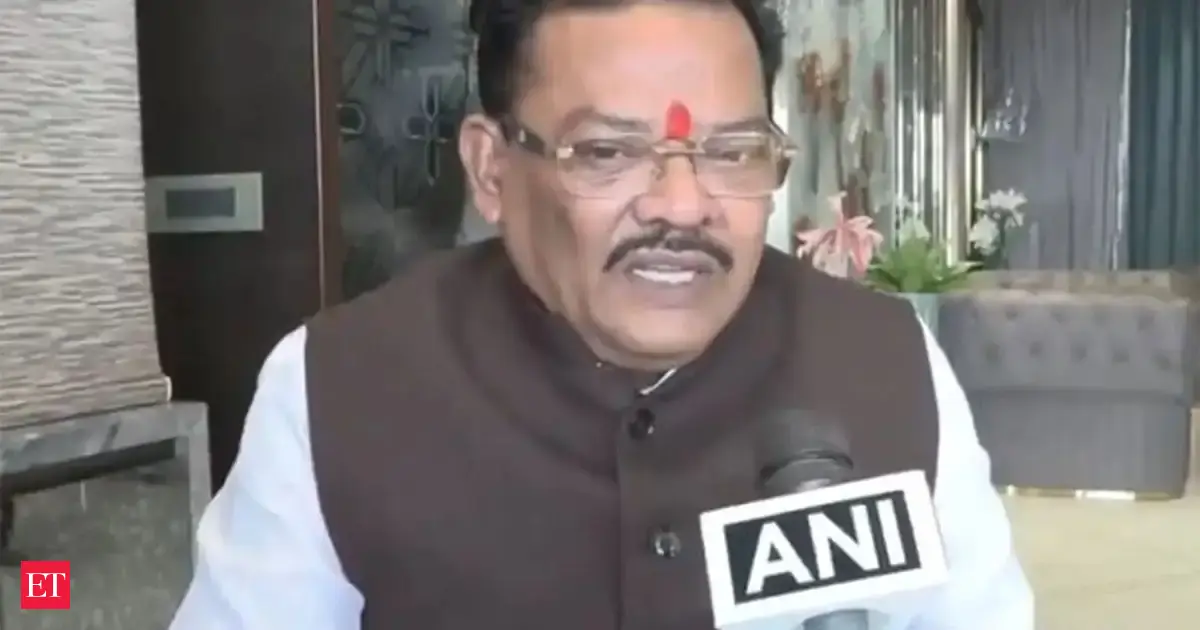
On 20th June, Sanger appeared for an interview on CNN-News18’s Plain Speak podcast. During the interview, Sanger said Wikipedia’s central problem was its control over what it labels a reliable source. He explained that the platform selected predominantly Left-wing and establishment sources while excluding publications that were conservative or significantly right of centre. Articles could then be declared neutral only because they accurately reflected an already skewed pool of approved sources.
Speaking about India, Sanger said he believed that Wikipedia’s anti-Hindu bias was a fact, although he acknowledged that he could not conclusively establish its exact origin. He suggested that Western Left-wing journalists were often more inclined to adopt a Muslim viewpoint and that the same ideological preference entered Wikipedia through its approved sources.
Sanger also said that the Left had “marched through” Wikipedia, just as it had captured other cultural institutions. According to him, Wikipedia’s bias had begun resembling that of the BBC and The New York Times by 2010 and became more pronounced after Brexit and Donald Trump’s first election.
When asked what Indians and Hindus who believed Wikipedia was biased could do, Sanger advised them to join Wikipedia and WPID. He pointed out that the active editing community was far smaller than most readers imagined and said India had enough educated people to field many capable writers who could learn how the platform operated.
This is what irked the Wikipedia editors. They presented these remarks as decisive evidence of canvassing. They interpreted the invitation as an attempt to recruit an army of Indian or Hindu editors to alter internal outcomes. The possibility that Indians and Hindus might join to correct what they consider persistent misrepresentation was recast as an existential danger to Wikipedia.
Why Wikipedia said it banned him
OpIndia went through the discussion, the link to which was shared by Sanger on the social media platform X. The administrators’ discussion went far beyond one social-media post or one television interview.
Sanger said that Wikipedians were debating whether WPID should be permitted and that many opposed it while others supported it. Editors argued that directing his more than 90,000 followers towards an active discussion amounted to biased off-wiki notification.
They also cited an earlier post in which Sanger wrote that the Left had marched through Wikipedia and there was no reason others could not “march right back”. Sanger later conceded that the phrase contained indefensible rhetoric and expressed regret, but continued to maintain that Wikipedia had been ideologically captured.
Other accusations included claims that he had made very few recent article edits, devoted most of his activity to reforming Wikipedia and wanted to weaken rules involving reliable sources, fringe theories and due weight. His criticism of anonymous administrators and his argument that powerful functionaries should be publicly identifiable were presented by opponents as support for “doxxing”.
Sanger rejected that allegation. He distinguished between maliciously exposing private information and creating a prospective policy requiring people who exercise exceptional power to disclose their identities. He argued that anonymous users can determine the content read by millions, block contributors and influence reputations without real-world accountability.
Sanger called the proceedings a mob trial
In his formal defence, which was published during the discussion on Wikipedia, Sanger said the administrators’ process resembled a trial without a prosecutor, a clear indictment, a neutral judge or ordinary due process. He described the participants accusing him as self-selected prosecutors and said people who might have defended him had been intimidated.
If you want to see the circus that decided my fate in such a bizarre and irregular way, go here: https://t.co/1LAGbNAKToBe sure to look at my defense:https://t.co/rv83A11Vyg— Larry Sanger (@lsanger) June 22, 2026
On canvassing, he argued that WikiProject applicants were expected to recruit participants and that he had not found a rule expressly prohibiting off-wiki recruitment. He denied asking anyone to vote in a particular manner and said the CNN-News18 appeal was an invitation to join Wikipedia, not to manipulate a specific decision.
He also defended his right to seek policy reform. Sanger was centrally involved in creating Wikipedia’s original neutrality policy and argued that questioning later interpretations of that policy could not reasonably be treated as an attack on the encyclopaedia.
However, his defence did not satisfy the dominant group of editors. They said Wikipedia was not a court, warnings did not need to come from administrators and his lengthy replies were themselves further evidence of disruptive conduct.
Jimmy Wales called the indefinite ban ‘ludicrous’
Wikipedia co-founder Jimmy Wales intervened publicly and strongly opposed the proposed indefinite ban. His support for Sanger came despite the two appearing not to be on speaking terms and having blocked each other on social media at one point. In his statement, Sanger said that he had already unblocked Wales and expected the same from him.
This situation just gets more and more interesting.Jimmy Wales, despite blocking me here on X (I unblocked him some time ago, he could return the favor), actually defended me on Wikipedia. This might make him look good to you all, but not so much to a lot of the Wikipedia blob. pic.twitter.com/qp0xuGU9Wj— Larry Sanger (@lsanger) June 22, 2026
Wales said intellectual diversity was important to Wikipedia and warned that failure in this area could undermine civility and neutrality. He called the idea that Sanger’s conduct deserved an indefinite ban “ludicrous” and urged editors to sit back and examine what they were demanding.
He said he was willing to defend Sanger’s right to express views on intellectual diversity and sourcing policies without necessarily agreeing with every one of those views. According to Wales, editors should listen, disagree respectfully, debate the proposals and reject WPID if they considered it flawed.
Banning someone for raising an unpopular argument, he said, was a mistake. Interestingly, Wales has long supported banning people or sources on Wikipedia. OpIndia is one of the casualties, as Wikipedia does not consider the media house a “reliable” source but keeps fake-news peddlers and propaganda platforms such as The Wire on its reliable list.
Wales also defended general outreach to ideological groups that felt excluded from Wikipedia. He noted that if conservatives were persuaded that Wikipedia was merely Leftist propaganda, they would stay away, leaving internal discussions without conservative voices and increasing the risk of further bias.
He nevertheless drew a distinction between inviting dissatisfied users to participate and recruiting people to disrupt a vote or misbehave. Wales also said Sanger could have conducted himself more graciously and should apologise for some exchanges.
Crucially, he declined to use any founder-level authority to intervene directly, which he should have done if he truly believed that Sanger had every right to demand accountability. He said he did not intend to take a functionary action and was present only to remind editors of Wikipedia’s values. His objection was ultimately disregarded and the ban went ahead.
Wikipedia editors target OpIndia while building the case against Sanger
Wikipedia editors repeatedly targeted OpIndia during the proceedings and used Larry Sanger’s support for the publication as another argument for banning him.
While reproducing Sanger’s CNN-News18 interview, Wikipedia editor Newslinger described OpIndia as “a far-right anti-Muslim website that was blacklisted in 2020 for doxing a Wikipedia editor”. The editor further highlighted that Sanger had described OpIndia and Swarajya as among the “Important religious sources” for understanding Hindu religious doctrines.
Source: Wikipedia
In another comment supporting action against Sanger, the same editor accused him of having “advocated for the reintegration of websites that were blacklisted for doxing editors, including Breitbart News and OpIndia”.
Source: Wikipedia
The focus on OpIndia was not incidental. Wikipedia editors presented Sanger’s defence of the publication as proof that he wanted supposedly “unreliable sources” restored to the platform. In effect, an Indian publication that has extensively documented Wikipedia’s anti-Hindu and anti-India bias was itself cited as evidence against a person who questioned that very ideological gatekeeping.
OpIndia has faced Wikipedia’s hostility for years. The publication was blacklisted after it investigated the people controlling contentious Wikipedia pages, documented the role of influential editors and administrators and exposed how attempts to add inconvenient facts were routinely blocked.
During OpIndia’s earlier interview with Sanger in 2020, Editor-in-Chief Nupur J Sharma explained that Wikipedia had blacklisted the entire website after she wrote about the editors and administrators who were locking biased pages and ensuring that attempts to correct them were reversed.
Sanger responded, “They have no class. What can I say? I’ve been talking about this sort of thing for a long time, but it’s gotten worse.”
He added that Wikipedia had undergone a “steep decline” since around 2015, both in the extent of its bias and in how closed its editing community had become.
The latest proceedings demonstrated precisely how this system works. OpIndia’s designation by Wikipedia editors was treated as settled truth. Sanger’s willingness to question that designation was then converted into evidence of misconduct. No serious consideration was given to whether OpIndia had been blacklisted because its investigations challenged the authority and anonymity of Wikipedia’s entrenched editors.
The platform’s editors thus targeted both the critic and the publication that had independently documented the same problem. Sanger was accused of wrongdoing for defending OpIndia, while OpIndia’s previous exposure of Wikipedia’s editorial cartel was used to discredit him further.
OpIndia dossier exposed how Wikipedia’s anti-Hindu bias is institutionalised
Sanger’s criticism of Wikipedia is consistent with the findings of an extensive 187-page dossier published by OpIndia in 2024. The research examined Wikipedia’s internal discussions, editing histories, source-classification system, administrator hierarchy, financial disclosures and the Wikimedia Foundation’s funding relationships, with a specific focus on India and Hindu-related subjects.
The dossier challenged Wikipedia’s claim that it is an open encyclopaedia written freely by unpaid volunteers without central editorial intervention. It documented how a relatively small group of administrators and influential editors exercise control over which sources may be cited, which facts remain in articles, who may participate in contentious subjects and which contributors are blocked from the platform.
At the time of the research, Wikipedia had only 435 active administrators across the world. These administrators could block users, restrict editing, protect contentious pages, delete articles, close disputes and enforce sanctions. Above them was the even smaller Arbitration Committee, which effectively functions as Wikipedia’s highest internal adjudicatory body.
Most of these powerful users operated through pseudonyms. Their identities, affiliations, employers and potential conflicts of interest were not known to the public, even though their decisions influenced articles read by millions of people. This structure was not a free-for-all system governed by the wisdom of crowds. It was an editorial hierarchy in which anonymous individuals possessed powers comparable to those exercised by editors in conventional publishing organisations.
How the ‘reliable sources’ system creates the bias
The principal mechanism through which Wikipedia controls content is its classification of publications as reliable, unreliable or deprecated.
Once a publication is deprecated or blacklisted, its reports generally cannot be used to support information in Wikipedia articles. This means that even a factually correct report, an exclusive statement or a direct quotation may be rejected merely because Wikipedia’s editors have prohibited the publication carrying it.
The dossier documented that OpIndia and Swarajya were blacklisted while Left-leaning publications such as The Wire, Scroll, Newslaundry and The Print remained acceptable. International outlets including Al Jazeera, the BBC, The Guardian, CNN and The New York Times were also treated far more favourably despite their own documented controversies, ideological positions and instances of misinformation.
This allows Wikipedia to claim that an article neutrally reflects its sources after its editors have already removed sources representing the other side.
One example involved The Wire’s reporting on India’s naval capabilities. Retired Commodore Jaideep Maolankar accused the publication of misrepresenting his remarks to downplay the Indian Navy’s achievements. OpIndia covered his statement, but Wikipedia editors refused to include the controversy in The Wire’s article. They argued that Maolankar’s own clarification was a self-published source, while OpIndia could not be cited because it had already been blacklisted.
The information was therefore excluded, not because it had been disproved, but because Wikipedia’s source-control system had eliminated the publication that documented it.
The dossier found similar resistance while examining Wikipedia’s treatment of The Wire’s other misinformation controversies. Attempts to add uncomfortable facts were delayed, diluted or rejected, while negative descriptions of non-Left publications were presented prominently using sources approved by the same ideological establishment.
Anti-Hindu and anti-India framing in articles
The dossier examined several India-related articles, including those concerning the 2020 Delhi riots, the Godhra train burning, the expression “Jai Shri Ram”, “Hindu terrorism”, Narendra Modi, press freedom and Indian democracy.
It documented how Hindu victims, Islamist violence and evidence inconvenient to the Leftist account were frequently diminished or buried, while claims made by activist organisations and hostile foreign publications were elevated into Wikipedia’s authoritative narrative.
In the article on the Godhra train burning, OpIndia found that the organised killing of Hindu passengers was diluted through language and framing that foregrounded disputed theories. In articles involving “Hindu terrorism”, allegations and political terminology received greater prominence than acquittals, evidentiary failures and the collapse of several prosecution claims.
OpIndia also examined the treatment of “Jai Shri Ram”, arguing that Wikipedia relied heavily on hostile reports associating the Hindu religious expression with violence and intimidation. The resulting article did not merely describe controversies involving the chant but contributed to portraying the expression itself through a negative political and communal lens.
These narratives matter because Wikipedia does not remain confined to its own website. Its articles are prominently displayed by Google, used in knowledge panels, cited by artificial-intelligence systems and treated as background material by journalists, students and researchers.
India received approximately 796 million page views across Wikimedia projects in June 2024, while Indians were among the largest groups of contributors to English Wikipedia. Articles about the Indian general election, Narendra Modi, the NDA, the Lok Sabha and India received millions of views. A skewed Wikipedia entry therefore has the power to shape how an Indian event, organisation or public figure is understood across the world.
Wikimedia funded the editor who targeted Sanger and OpIndia
The dossier also examined the Wikimedia Foundation’s financial support for Wikipedia editors and administrators. It highlighted the case of Newslinger, the same editor who later played a prominent role in targeting Sanger, his comments about anti-Hindu bias and his defence of OpIndia during the ban proceedings.
Newslinger had worked extensively on Wikipedia’s perennial sources list, which classifies publications according to the platform’s internal assessment of reliability. He subsequently received funding through the WikiCred programme for a project named Sourceror.
The proposal described Sourceror as a browser extension and application programming interface that would take Wikipedia’s source ratings beyond the encyclopaedia. It was designed to inform internet users about the supposed quality of publications they were reading and allow developers to incorporate Wikipedia’s reliability classifications into other technologies.
In his proposal, Newslinger stated that he had spent 20 months maintaining the perennial sources list and noted that thousands of editors used it to decide whether publications could support claims on Wikipedia. The dossier argued that Wikimedia was therefore funding the institutionalisation and wider dissemination of a source-classification system already shaped by ideologically motivated editors.
The same editor later called Sanger’s CNN-News18 interview one of the most unacceptable actions he had seen from a Wikipedia contributor. He accused Sanger of canvassing Indians, defended OpIndia’s blacklisting and demanded a complete community ban.
Why the dossier recommended treating Wikipedia as a publisher
In the dossier, OpIndia concluded that Wikipedia should no longer be permitted to present itself as a passive intermediary.
Its editors select sources, remove information, commission or promote specific forms of content, lock pages, impose an editorial line and exclude contributors who challenge that line. The Wikimedia Foundation also provides grants connected to editing, source assessment, community projects and technological tools that influence how information is presented.
OpIndia recommended that Wikipedia be legally treated as a publisher in India and made directly accountable for the content appearing on its platform. It also called for scrutiny of Wikimedia’s financial transactions, grants and activities in India, particularly because the Foundation collects donations from Indians and funds projects connected to the country without maintaining a direct official presence comparable to its influence.
OpIndia further recommended an Indian browser extension capable of identifying bias and misinformation in Wikipedia articles and an investigation into whether the Google-Wikimedia relationship creates anti-competitive consequences for Indian publications. When Wikipedia blacklists an Indian source and Google simultaneously elevates Wikipedia’s version of events, the affected publication loses not only representation but also visibility, credibility, traffic and revenue.
Sanger’s ban has now vindicated the central warning of the dossier. Wikipedia’s bias is not an occasional error created by an individual volunteer. It is protected through its source lists, anonymous administrators, internal sanctions, grants and the extraordinary amplification it receives from Big Tech.
The Leftist capture is now difficult to deny
This whole episode has offered a live demonstration of the problem Sanger has described for years. A platform that claims anyone can edit it has banned one of its creators after he invited people with underrepresented views to participate. A community that invokes diversity treated intellectual diversity as an organised threat. A system that claims to be neutral used an interview about anti-Hindu bias as evidence that the speaker was unfit to remain.
Wikipedia’s editors insist that Sanger was banned for his conduct and not for his opinions. Yet the proceedings repeatedly returned to the opinions themselves: his criticism of mainstream sources, his defence of OpIndia, his view that Hindus and conservatives should participate and his challenge to rules built by the current ideological establishment.
The result is that Wikipedia’s content machinery remains protected from precisely the voices most likely to expose its bias. Its co-founder has now been removed from the institution he helped create, not because he vandalised articles or inserted fabricated material, but after he openly challenged the Leftist gatekeeping that determines which facts, sources and perspectives are permitted to exist on the world’s “most influential online encyclopaedia”.