Protectors of Somnath: Know about Veer Hamirji Gohil, the brave Hindu warrior who overwhelmed the large army of Islamic invader Zafar Khan
Many brave men have nurtured India’s soil with their blood and contributed to its prosperity and glory. Millions of young Hindu warriors sacrificed their lives to protect the Sanatan Dharma and the Sanatan heritage. It is because of such young warriors that the Sanatan legacy lived on. One such young warrior was Veer Hamirji Gohil (Hamirsinhji Gohil), who made the supreme sacrifice in a religious battle, giving up his life to protect Somnath Mahadev. Leftist historians have always ignored Hindu warriors and attempted to erase them from history, and Veer Hamirji Gohil was no exception. The history of Veer Hamirji Gohil is sparsely documented in the history of 14th-century Gujarat. He finds mention in some independent Hindu texts. Veer Hamirji is still remembered in the Kathiawar region through folk tales. Hamirji Gohil and some of his companions fought against the Islamic invaders to protect the Somnath temple. Let’s take a look at his complete history. Who was Hamirji Gohil? Chapter 9 of the Kathiawar Sarvasangraha mentions that in 1391 AD, Zafar Khan bin-Wazir-ul-Mulk was the governor of Gujarat, and it was during this time that Somnath was attacked. Furthermore, the Gujarat Sarvasangraha also contains an account of Zafar Khan’s invasion of Somnath. Poet Kalapi’s work, ‘Hamirkavya’, also mentions this event. More recently, books such as ‘Gohil Veer Hamirji’ (Dhirsinh Gohil), published in 1921, and ‘Somnath and Hamirji Gohil’ (Jaymall Parmar) provide impartial historical accounts. Based on the references in all these books, we have attempted to understand the history of Hamirji Gohil. Hamirsinhji Gohil was the ruler of the Arthila state, located in the Amreli region of the Saurashtra (Kathiawar) district of Gujarat state. Bhimji Gohil of Arthila had three sons: Dudaji, Arjanji, and Hamirji. Dudaji ascended the thrones of Arthila and Lathi, Arjanji ruled over 11 villages of Gadhali, and the youngest son, Hamirji, ruled Samadhiyala. Notably, Hamirji Gohil was an ancestor of Sursinhji Takhtsinhji Gohil, who was famous as the poet ‘Kalapi’. In 1398 AD, Hamirji was on the throne of Samadhiyala, and it was during this time that Zafar Khan attacked Somnath. Arjanji and Hamirji Gohil shared a deep, affectionate bond. However, one day, a quarrel erupted between the two brothers over a rooster fight, and in a fit of rage, Arjanji banished his younger brother Hamir from their home. Following this incident, Hamirji left Gohilwad and went to Marwar, where he lived with his brave Rajput friends, who empathised with him. Zafar Khan’s Attack on the Somnath Temple The history of the attack on the Somnath Temple is also found in the 14th-century Islamic Persian historical accounts (Mirat-i-Sikandari). At that time, the Tughlaq dynasty ruled Delhi under Muhammad Tughlaq II. After the defeat of his governor, Shamsuddin, in Junagadh, Zafar Khan was appointed as the governor of Gujarat. Over time, he became the independent ruler of Gujarat. He established his centre in Somnath. He was a staunch opponent of idol worship, and his gaze fell upon Somnath, a place of immense religious significance for millions of Hindus. Zafar appointed a Muslim named Rasul Khan as the police chief of Junagadh. Shortly afterwards, Zafar ordered that ‘idolaters’ (Hindus) should not be allowed to gather in Somnath. At that time, the Shivaratri fair was being held in Somnath. Rasul and his men began a massacre and ordered the extermination of the Hindus. In response to this incident, the local Hindus killed Rasul Khan. When Zafar Khan came to know about this, he became enraged and marched to quell the unrest in Sorath. Zafar Khan issued a decree to attack Somnath and set out towards it. He departed with Muslim soldiers from the Kabuli, Makrani, Afghani, and Pathan communities to wreak havoc on Somnath. Meanwhile, Arjanji Gohil became very distressed and ordered a search for Hamirji at Mansura fort. Hamirji had gone to Garhvi in Marwar and was informed about Arjanji’s condition. Hamirji became concerned and returned to his brother in Arthila and started living there. “Have the Rajput women died? Will the Rajput army attack Mahadev in front of them?” One day, after strolling in the forest with friends like Chhatrapal Sarvaiya, Patalji Bhati, Sanghdevji Solanki, and Nanji Maharaj, a Brahmin from Sihor, Hamirji returned home and started eating hurriedly. Dudaji’s wife, Hamirji’s sister-in-law, said to him, “Why are you in such a hurry? Do you want to climb Somaiya Mountain (the local name for Somnath) immediately?” Hearing this, Hamirji asked, “Sister-in-law, is Somaiya in danger?” His sister-in-law replied, “The army has come to demolish the Somaiya temple, and the Governor of Gujarat’s army is advancing towards Somnath.” Upon hearing his sister-in-law’s words, Hamirji immediately stood up without finishing his food and said, “What are you uttering? Is there no Rajput who will go and die for Somnath? Will the army of
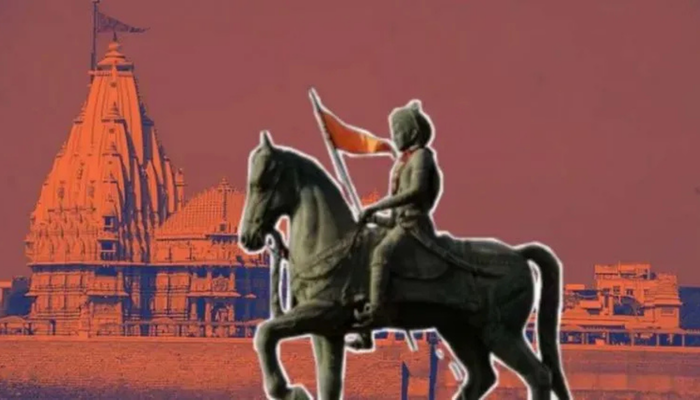

Many brave men have nurtured India’s soil with their blood and contributed to its prosperity and glory. Millions of young Hindu warriors sacrificed their lives to protect the Sanatan Dharma and the Sanatan heritage. It is because of such young warriors that the Sanatan legacy lived on. One such young warrior was Veer Hamirji Gohil (Hamirsinhji Gohil), who made the supreme sacrifice in a religious battle, giving up his life to protect Somnath Mahadev. Leftist historians have always ignored Hindu warriors and attempted to erase them from history, and Veer Hamirji Gohil was no exception.
The history of Veer Hamirji Gohil is sparsely documented in the history of 14th-century Gujarat. He finds mention in some independent Hindu texts. Veer Hamirji is still remembered in the Kathiawar region through folk tales. Hamirji Gohil and some of his companions fought against the Islamic invaders to protect the Somnath temple. Let’s take a look at his complete history.
Who was Hamirji Gohil?
Chapter 9 of the Kathiawar Sarvasangraha mentions that in 1391 AD, Zafar Khan bin-Wazir-ul-Mulk was the governor of Gujarat, and it was during this time that Somnath was attacked. Furthermore, the Gujarat Sarvasangraha also contains an account of Zafar Khan’s invasion of Somnath. Poet Kalapi’s work, ‘Hamirkavya’, also mentions this event. More recently, books such as ‘Gohil Veer Hamirji’ (Dhirsinh Gohil), published in 1921, and ‘Somnath and Hamirji Gohil’ (Jaymall Parmar) provide impartial historical accounts. Based on the references in all these books, we have attempted to understand the history of Hamirji Gohil.
Hamirsinhji Gohil was the ruler of the Arthila state, located in the Amreli region of the Saurashtra (Kathiawar) district of Gujarat state. Bhimji Gohil of Arthila had three sons: Dudaji, Arjanji, and Hamirji. Dudaji ascended the thrones of Arthila and Lathi, Arjanji ruled over 11 villages of Gadhali, and the youngest son, Hamirji, ruled Samadhiyala. Notably, Hamirji Gohil was an ancestor of Sursinhji Takhtsinhji Gohil, who was famous as the poet ‘Kalapi’. In 1398 AD, Hamirji was on the throne of Samadhiyala, and it was during this time that Zafar Khan attacked Somnath.
Arjanji and Hamirji Gohil shared a deep, affectionate bond. However, one day, a quarrel erupted between the two brothers over a rooster fight, and in a fit of rage, Arjanji banished his younger brother Hamir from their home. Following this incident, Hamirji left Gohilwad and went to Marwar, where he lived with his brave Rajput friends, who empathised with him.
Zafar Khan’s Attack on the Somnath Temple
The history of the attack on the Somnath Temple is also found in the 14th-century Islamic Persian historical accounts (Mirat-i-Sikandari). At that time, the Tughlaq dynasty ruled Delhi under Muhammad Tughlaq II. After the defeat of his governor, Shamsuddin, in Junagadh, Zafar Khan was appointed as the governor of Gujarat. Over time, he became the independent ruler of Gujarat. He established his centre in Somnath. He was a staunch opponent of idol worship, and his gaze fell upon Somnath, a place of immense religious significance for millions of Hindus.
Zafar appointed a Muslim named Rasul Khan as the police chief of Junagadh. Shortly afterwards, Zafar ordered that ‘idolaters’ (Hindus) should not be allowed to gather in Somnath. At that time, the Shivaratri fair was being held in Somnath. Rasul and his men began a massacre and ordered the extermination of the Hindus. In response to this incident, the local Hindus killed Rasul Khan. When Zafar Khan came to know about this, he became enraged and marched to quell the unrest in Sorath. Zafar Khan issued a decree to attack Somnath and set out towards it. He departed with Muslim soldiers from the Kabuli, Makrani, Afghani, and Pathan communities to wreak havoc on Somnath.
Meanwhile, Arjanji Gohil became very distressed and ordered a search for Hamirji at Mansura fort. Hamirji had gone to Garhvi in Marwar and was informed about Arjanji’s condition. Hamirji became concerned and returned to his brother in Arthila and started living there.
“Have the Rajput women died? Will the Rajput army attack Mahadev in front of them?”
One day, after strolling in the forest with friends like Chhatrapal Sarvaiya, Patalji Bhati, Sanghdevji Solanki, and Nanji Maharaj, a Brahmin from Sihor, Hamirji returned home and started eating hurriedly. Dudaji’s wife, Hamirji’s sister-in-law, said to him, “Why are you in such a hurry? Do you want to climb Somaiya Mountain (the local name for Somnath) immediately?” Hearing this, Hamirji asked, “Sister-in-law, is Somaiya in danger?” His sister-in-law replied, “The army has come to demolish the Somaiya temple, and the Governor of Gujarat’s army is advancing towards Somnath.”
Upon hearing his sister-in-law’s words, Hamirji immediately stood up without finishing his food and said, “What are you uttering? Is there no Rajput who will go and die for Somnath? Will the army of the Mlecchas (Muslims) attack Somaiya (the local name for Somnath) while there are still Kshatriyas around? Has Rajput valour died?” With these questions, Hamirji stood up in anguish. His sister-in-law said to him, “There is no shortage of Rajputs in Kathiawar; they are countless, but no true hero seems willing to come forward to defend Somnath. This is not some ordinary hunting game; this is about having the courage to face a powerful army in defence of Mahadev. And if you are so troubled, then you yourself should take up arms, brother-in-law. You are also a Rajput, aren’t you?”
Hamirji’s sister-in-law spoke her mind frankly, but Hamirji’s pride was deeply wounded. Hamirji said to his sister-in-law, “Please convey my Jajera Johar to both my brothers. Whether anyone accompanies me or not, I will go to the Somnath temple.” His sister-in-law tried to dissuade him, but Hamirji remained resolute. Hamirji set out for Somnath with around 200 warriors. At a time when the people were gripped by fear of Zafar Khan and the kingdom was plagued by internal strife, Hamirji embarked on his journey to the Somnath temple alone.
Phase A: Gifts on the way and a marriage at Dronagadha
Hamirji was travelling on the road to Somnath when he came across a Nesada, a settlement of Maldharis such as Bharwads and Ahirs. At midnight, he heard an elderly woman singing a Marsiya (a folk song sung at someone’s death). Hamirji went to her and asked, “Whose Marsiya are you singing?” The elderly woman replied that her son had recently died, so she was singing his Marsiya. Hamirji insisted, “Will you sing my Marsiya? I want to hear it.” The woman shockingly replied, “What did you say? How can I absolve myself of sin by singing your Marsiya while you are still alive?” Hamirji said, “We are on the path of death. We have set out for Somaiya to protect Somnath. We will not return from there.” The elderly woman blessed Hamirji and said, “Get married on the way, for a warrior should not step onto the battlefield unmarried. Saying this, the elderly woman started walking towards Somnath and told Hamirji, “I will go to Somnath and wait for you.”
From there onward lay the expanse of Dronagadhda, spread across the Gir region, where Vegdaji, a Bhil Chiefain, held great influence and authority. All the Bhils considered Somnath their revered deity. Vegda Bhil had a daughter named Rajbai. Once, a Jethwa Rajput was going on a pilgrimage to Tulsishyam, and a war broke out between the Bhils and the Jethwas. The Jethwa Rajput died, but before dying, he entrusted his young daughter to Vegdaji. The Jethwa Rajput took a promise from Vegdaji that he would raise his daughter and marry her to a Rajput warrior.
The elderly woman reached Vegda Bhil’s place and said, “Hamirji Gohil is on his way to the Somnath temple; arrange your daughter’s marriage with him. He is a brave Rajput from Gohilwad.” Some time later, Hamirji arrived in that area and, by chance, met Vegda Bhil. At Vegda’s insistence, Hamirji stayed in his hut for two days. Afterwards, Vegdaji arranged the marriage of Hamirji and his daughter. Thus, Hamirji’s marriage took place en route to the Somnath temple.
The Rajputs sacrificed their lives to defend Somnath
The very next day after his wedding, Hamirji set off for Somnath. Vegdaji and other Bhils were with him. He had also gathered young men from other castes, including Rajput, Kathi, Rabari, Bharwad, Ahir, and Mer. This small band of warriors finally reached Somnath. Hamirji, Vegdaji, the priests, and the residents of Prabhas Nagar, along with some Rajputs, were patiently waiting for Zafar Khan in the temple courtyard. Zafar Khan had heard that some Hindu warriors would confront him, but he was not worried. Zafar Khan reached the foothills of Prabhas Mountain. At that moment, Vegdaji’s Bhil soldiers greeted Zafar Khan with arrows, and the Muslim army cried out in distress.
On one side was the religious fanaticism to destroy the temple of Lord Shiva, and on the other lay the fierce desire to protect Somaiya. Zafar advanced his cannons, but the Bhil soldiers, employing guerrilla warfare tactics, broke the morale of the Muslim army. Soon, the number of Bhil soldiers started dwindling, and Vegdaji was also martyred. The battle lasted for nine days. By then, only a few warriors remained with Hamirji. As the battle was nearing its end, Hamirji performed the Somnath Aarti early in the morning. Red Gulal showered on the warriors who had come to bid farewell to death in the courtyard. The elderly woman (bard) was also in the temple. Hamirji requested her to sing a Marsiya. For an hour, the courtyard echoed with the sound of the Marsiya. Sitting on the shore, turning her prayer beads, the elderly woman said, “O brave one, you are blessed, for you have preserved the water of that heroic manhood of Kathiawar which was destined to die.” She sang the Marsiya–
The battle began with the Marsiya. On one side were Hamirji Gohil’s warriors, and on the other, Zafar Khan’s Islamic soldiers. The remaining Hindu warriors fought in the temple courtyard to protect the Shiva Lingam. Hamirji’s entire army was annihilated, but being a Rajput, he single-handedly charged into the Islamic army. His entire body was mutilated. As Zafar struck Hamirji Gohil with full force, his head was severed from his body and fell onto the Shiva Lingam of Somnath. It is said that despite a severed head, Hamirji’s body continued to fight till the destruction of the Islamic army. The Islamic army was annihilated on the battlefield, and in the end, victory belonged to Hindu pride. Hamirji himself had attained martyrdom, but his vow to protect Somnath had been fulfilled as the remaining Islamic army fled.
The incident shows how a lone Kathiawar Rajput, along with a few devoted warriors, offered his life at Somnath when the valour of Saurashtra faltered. Today, outside the Somnath temple stands the temple of Vegdaji, and within the temple complex, directly opposite the Shiva Lingam, is the statue of Hamirji Gohil. To express their gratitude, the devotees of Somnath established a tradition according to which the saffron flag of the Somnath temple is first taken to Hamirji’s statue before being hoisted to the temple’s pinnacle. This tradition continues to this day.
The story of valorous Hamirji Gohil, who sacrificed his life before the Shiva Lingam of Somnath, was not a figment of imagination or a fiction, but a historical truth. Hamirji was a man who dared to lay down his life for his faith. When kingdoms were engrossed in their own self-interest, when power had become inert, and when people silently endured everything out of fear, a young Rajput, along with a few warriors, stood up to defy death at the feet of Somnath. The sacrifice of Hamirji Gohil often conveys the message that history is not written by those in power, but by the blood of heroes who remain unwavering even in the face of death for the sake of their faith. The Somnath Temple, as it stands today, is not merely a pile of stones, but a witness to the sacrifices made by heroes like Hamirji before the Shiva Lingam.
(This article is a translation of the original article published on OpIndia Gujarati.)