RSF targets OpIndia: Their dubious Press Freedom Index and the global regime change orgs – How Western-funded fiction factories are targeting nationalist voices in India
The Reporters Without Borders (RSF) debate took a sudden turn in late 2025, when RSF included India’s Hindu nationalist news outlet OpIndia on its annual “Press Freedom Predators” list, alongside global corporate magnates such as Elon Musk and the Adani Group. Widespread discussion about RSF’s neutrality and political agendas was spurred by this controversial group. Many have seen the inclusion of OpIndia, a strong supporter of nationalist and sovereign narratives, as part of RSF’s larger plan to discredit Indian nationalist voices that oppose Western geopolitical objectives. This listing was the result of past RSF reports that portrayed nationalist elements as dangers to press freedom and critiqued India’s media environment under the current government. The UK’s Telegraph newspaper noted how RSF’s story influenced how the world saw India’s democratic climate and press landscape, highlighting the strange coalition of different Indian media and corporate figures with worldwide criticism. This short research critically investigates the origins of this dispute by tracking RSF’s financing sources, which are mostly from Western government organisations and foundations connected to regime change, such as the US Congress-funded National Endowment for Democracy (NED), as well as its opaque methods. It also examines RSF’s connections to investigative organisations such as Bellingcat, which has been exposed as a CIA front, demonstrating a coordinated information ecosystem that pushes Western goals under the guise of press freedom advocacy. The study shows that RSF is not an unbiased custodian of free journalism, but rather a contentious actor in the worldwide ideological fight over India’s sovereignty and democratic narrative. RSF: Image Vs ecosystem The World Press Freedom Index (WPFI), which is frequently cited by Western governments, multilateral organizations, and legacy media, is published by RSF, which positions itself as an international NGO that defends press freedom worldwide. However, the Index relies on opaque, perception-based surveys with undisclosed respondents and undisclosed category-wise scoring, posing significant concerns regarding reproducibility and openness, as even India’s official policy think tank NITI Aayog has pointed out. Such an index, according to critics in India and elsewhere, runs the risk of turning into a geopolitical instrument rather than a neutral assessment when it is based on subjective expert questionnaires dominated by a limited ecosystem that faces the West. In reality, RSF’s country narratives frequently reflect the talking points of Western human rights organisations and affiliated media, particularly when it comes to nations like India, Hungary, and others that are seen as “illiberal” or “nationalist.” While characterising Western structural problems like corporate consolidation, intelligence leaks, and surveillance scandals as minor anomalies in generally “free” contexts, RSF’s India country note consistently presents Hindu nationalism as the primary threat to journalism. Funding: Western governments, NED and Regime change philanthropy RSF receives substantial backing from Western governments and quasi-governmental democracy promotion organisations, according to its public statements and independent investigations. Research referenced in the OpIndia-CSDS document states that RSF has received funding from: French government agencies, including the French Development Agency (AFD), the foreign ministry, the defense ministry, the interior ministry, the culture ministry, and the city of Bayeux. The European Instrument for Democracy and Human Rights (EIDHR) of the European Commission. Similar European aid organizations, such as the Swedish International Development Agency (SIDA). The National Endowment for Democracy (NED), which is funded by the US Congress, clearly identifies itself as an organization that promotes democracy and is primarily supported by the US government. Large US foundations like the Ford Foundation, which has a lengthy and contentious history of supporting political action and lobbying in India, including organisations later charged with financial irregularities and anti-India campaigns, are also connected to RSF. According to investigative reporting cited in the OpIndia paper, RSF has consistently adopted tough positions against governments targeted by US-EU regime change initiatives, such as Venezuela, while showing support for US funded organisations and oligarch-owned opposition media in those nations. This donor profile clearly places RSF within the well-known “democracy promotion” network. NGOs, media initiatives, indices, and lobbying campaigns that selectively highlight “authoritarianism” in regimes at odds with Western geopolitical preferences of which India is increasingly one are funded by Western governments and affiliated institutions. Methodology and bias of the World Press Freedom Index Three
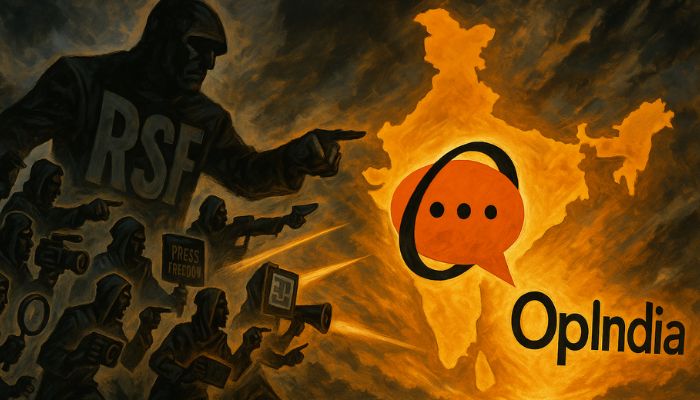

The Reporters Without Borders (RSF) debate took a sudden turn in late 2025, when RSF included India’s Hindu nationalist news outlet OpIndia on its annual “Press Freedom Predators” list, alongside global corporate magnates such as Elon Musk and the Adani Group. Widespread discussion about RSF’s neutrality and political agendas was spurred by this controversial group. Many have seen the inclusion of OpIndia, a strong supporter of nationalist and sovereign narratives, as part of RSF’s larger plan to discredit Indian nationalist voices that oppose Western geopolitical objectives. This listing was the result of past RSF reports that portrayed nationalist elements as dangers to press freedom and critiqued India’s media environment under the current government.
The UK’s Telegraph newspaper noted how RSF’s story influenced how the world saw India’s democratic climate and press landscape, highlighting the strange coalition of different Indian media and corporate figures with worldwide criticism. This short research critically investigates the origins of this dispute by tracking RSF’s financing sources, which are mostly from Western government organisations and foundations connected to regime change, such as the US Congress-funded National Endowment for Democracy (NED), as well as its opaque methods. It also examines RSF’s connections to investigative organisations such as Bellingcat, which has been exposed as a CIA front, demonstrating a coordinated information ecosystem that pushes Western goals under the guise of press freedom advocacy. The study shows that RSF is not an unbiased custodian of free journalism, but rather a contentious actor in the worldwide ideological fight over India’s sovereignty and democratic narrative.
RSF: Image Vs ecosystem
The World Press Freedom Index (WPFI), which is frequently cited by Western governments, multilateral organizations, and legacy media, is published by RSF, which positions itself as an international NGO that defends press freedom worldwide. However, the Index relies on opaque, perception-based surveys with undisclosed respondents and undisclosed category-wise scoring, posing significant concerns regarding reproducibility and openness, as even India’s official policy think tank NITI Aayog has pointed out. Such an index, according to critics in India and elsewhere, runs the risk of turning into a geopolitical instrument rather than a neutral assessment when it is based on subjective expert questionnaires dominated by a limited ecosystem that faces the West.
In reality, RSF’s country narratives frequently reflect the talking points of Western human rights organisations and affiliated media, particularly when it comes to nations like India, Hungary, and others that are seen as “illiberal” or “nationalist.” While characterising Western structural problems like corporate consolidation, intelligence leaks, and surveillance scandals as minor anomalies in generally “free” contexts, RSF’s India country note consistently presents Hindu nationalism as the primary threat to journalism.
Funding: Western governments, NED and Regime change philanthropy
RSF receives substantial backing from Western governments and quasi-governmental democracy promotion organisations, according to its public statements and independent investigations. Research referenced in the OpIndia-CSDS document states that RSF has received funding from:
- French government agencies, including the French Development Agency (AFD), the foreign ministry, the defense ministry, the interior ministry, the culture ministry, and the city of Bayeux.
- The European Instrument for Democracy and Human Rights (EIDHR) of the European Commission.
- Similar European aid organizations, such as the Swedish International Development Agency (SIDA).
- The National Endowment for Democracy (NED), which is funded by the US Congress, clearly identifies itself as an organization that promotes democracy and is primarily supported by the US government.
Large US foundations like the Ford Foundation, which has a lengthy and contentious history of supporting political action and lobbying in India, including organisations later charged with financial irregularities and anti-India campaigns, are also connected to RSF. According to investigative reporting cited in the OpIndia paper, RSF has consistently adopted tough positions against governments targeted by US-EU regime change initiatives, such as Venezuela, while showing support for US funded organisations and oligarch-owned opposition media in those nations.
This donor profile clearly places RSF within the well-known “democracy promotion” network. NGOs, media initiatives, indices, and lobbying campaigns that selectively highlight “authoritarianism” in regimes at odds with Western geopolitical preferences of which India is increasingly one are funded by Western governments and affiliated institutions.
Methodology and bias of the World Press Freedom Index
Three main problems with RSF’s Index opacity, subjectivity, and selective emphasis are the focus of several Indian and international criticisms.
Opacity: It is hard to audit how specific scores were created for India or compare them with similarly situated countries because RSF does not reveal question wise scores or the identities and institutional locations of its respondents.
Subjectivity: The Index is based on perception. ‘Experts’ complete surveys on subjects including “ownership pressure,” “hate campaigns,” and “self-censorship.” If this group of experts is overwhelmingly drawn from liberal-progressive, Western facing circles, their ideological preconceptions will inevitably influence the results, especially in opposition to conservative or nationalist regimes.
Selective Emphasis: Critics point out that while nations like India are severely penalized due to narrative-heavy accounts of “Hindu nationalist pressure” and social media trolling, Western democracies with severe structural issues concentrated media ownership, aggressive use of security laws, and intelligence collusion remain relatively high.
RSF’s methodology is inadequate as a policy benchmark due to “lack of a consensual definition of press freedom,” “very low sample size,” and “non-transparent weighting of parameters,” according to an Indian government discussion paper. As a result, OpIndia has referred to the Index as a “biased tool tailor-made to peddle the global Left’s narrative,” pointing out that while RSF’s own historical data indicates that India’s media environment declined throughout the Congress years, the discourse disproportionately attacks the Modi period.
RSF and India: Narrative Construction against nationalist politics
A predetermined template is frequently highlighted in RSF’s India fact sheets and press releases. “Hindu nationalist mobs,” “Modi supporters,” “Bhakts,” and the “right-wing ecosystem” are highlighted as the main dangers facing journalists. Violence against journalists from vernacular or nationalist backgrounds is mostly ignored in favour of occurrences and narratives that are reinforced by a particular clique of English-language liberal sites, many of whom are connected to Western foundations. Despite being irreconcilable with the image of nearly “captured media,” there is little recognition of structural variety in India’s media, thousands of journalists, hundreds of channels, and fiercely critical coverage of the Modi government on several major platforms.
The CSDS-Lokniti report on “Indian Media, Trends and Patterns,” which is featured in the OpIndia research, starts off by referencing RSF’s pessimistic depiction of Indian media freedom. It then uses this as a starting point to make the claim that the majority of journalists believe that media outlets support the ruling BJP. However, the survey’s findings, such as “85% of women journalists suffered mental health issues,” were drawn from a small sample of 206 journalists out of a nation of 1.4 billion. According to OpIndia’s critique, the global index denounces India, a domestic foreign funded think tank mentions the index, and the media then cites both as proof of democratic regression. This feedback loop is caused by the subjective narrative of RSF and the scant data of CSDS.
RSF describes OpIndia as a “Hindu nationalist website” that “smears journalists” critical of the government, portraying any objection to its technique or ideological leaning as part of an anti-press freedom effort. This is a classic rhetorical strategy in which those who challenge the index or its supporters are characterized as enemies of journalism, effectively closing the door on genuine methodological debate.
Bellingcat: OSINT, NED money and the intelligence shadow
Bellingcat, a Netherlands-based “open source investigations” collective lauded by Western media for its work on Russia, Syria, and other conflict theaters, is a crucial component of the network highlighted in the OpIndia-CSDS study.
According to public records, Bellingcat has received donations from the National Endowment for Democracy (NED), a US-Congress-funded organization specifically established to assist organizations that promote US interests overseas. Additionally, it gets funding from various Western government-affiliated institutions and benefactors, notably European and British sources. Even sympathetic sources acknowledge that such funding is frequently intended to promote studies that are in line with Western foreign policy interests, such as tracking army movements in Russia or charges of chemical weapons in Syria, which easily fit NATO narratives.
Therefore, critical observers characterize NED as a “front” for US foreign policy, established to do overtly what the CIA once did covertly, and Bellingcat as a component of this ecosystem, an NGO layer that amplifies and launders information flows favorable to Western strategic messaging rather than formal intelligence officers. Bellingcat has been directly accused by the Russian government and others of being a Western intelligence cutout, citing instances in which its “open source” conclusions coincidentally matched classified disclosures and biased attributions of culpability in disputed occurrences.
The Global Investigative Journalism Network (GIJN), OCCRP, Forbidden Stories, Internews, ICIJ, DRFLab, Freedom House, NED, and other organizations that receive funding from Western governments, Soros’s Open Society Foundations, Omidyar networks, Ford Foundation, and similar actors are all included in the OpIndia–CSDS paper. Foreign funded narratives can then be repackaged domestically under the guise of “independent investigative journalism” because many of them collaborate with Indian media outlets and activists who are steadfastly opposed to the Modi administration and Hindutva.
In this way, Bellingcat serves as a model for the larger ecosystem that RSF operates in. It is an officially recognized non-governmental organization, it is substantively in line with Western security and foreign policy agendas, and it is frequently referenced as an impartial source of information by the same Western media outlets who fund it.
RSF, Syrian media projects and narrative warfare
The Syria case study in the OpIndia report demonstrates how RSF type organisations work closely with Western states in active conflict areas. According to documentation, Canal France International (CFI), a French media-support organisation backed by the French foreign ministry, provides funding for Radio Rozana, a Syrian channel that RSF hailed as “independent.” The governments of Denmark, Sweden, and Norway provide funding for international media support. RSF itself funds alongside other Western donors.
Simultaneously, Radio Rozana collaborated with the “Syriaza” narrative project of Ara Pacis Initiative, which was specifically funded by the Italian foreign ministry and operated under the strong support of the Italian government and presidency. Building “narratives” and “storytelling” to influence public opinion in and about Syria is mentioned in the project’s own materials.
When taken as a whole, this demonstrates a model. Western governments finance media outlets via middlemen like RSF and CFI, then sponsor content and “capacity building” for journalists whose work supports a specific interpretation of the conflict, typically one in which the targeted government is an inhumane authoritarian and Western-backed opposition forces are democrats. When the same RSF then declares “press freedom” in those countries, it is basically evaluating an information battlefield that its own donors contributed to.
The India-focused network: CSDS, KAS, RSF, GIJN and beyond
The OpIndia research places RSF in the context of a dense network of India facing institutions that share funding, partners, and ideological lines.
- The paper states that CSDS and its Lokniti program, a Delhi think tank, systematically amplify narratives of “Hindu majoritarianism,” Dalit-Muslim hyphenation, and caste divisions, frequently in collaboration with Western organizations and donors connected to the government.
- Konrad Adenauer Stiftung (KAS) is a German foundation that is “politically affiliated” with the CDU. It is almost exclusively sponsored by German public funds and has contributed over ₹2.6 crore to CSDS since 2016. It also operates a special “Media Programme Asia” that focuses on youth and investigative journalism.
- Important sponsors of the “Uncovering Asia” investigative journalism conference were GIJN, OCCRP, Ford Foundation, Open Society Foundations, Oak Foundation, and others. Among the Indian attendees were individuals and media outlets who have constantly criticized the Modi government and Hindutva.
According to the study, RSF is a good fit for this web. International investigative networks cross-promote each other’s work while utilizing the same pool of international donors, CSDS references RSF on the fall of Indian media, and RSF depends on narratives from Western-funded Indian outlets. This creates a closed epistemic circuit wherein Western-funded organizations create the questionnaire, provide the tales, analyze the data, and then give each other rankings and rewards that are used as weapons in both domestic political discussions and international diplomacy.
Narrative impact: Delegitimising nationalist India
The issue is not that RSF criticises India, rather, it actively undermines a democratically elected government by reducing intricate media ecosystems to a morality play between “brave liberal journalists” and “authoritarian Hindu nationalists.”
It ignores or minimizes threats and acts of violence against journalists who are thought to be nationalist, pro-Hindutva, or critical of global liberal narratives.
Also is reinforced by the same Western media that promote unfavorable coverage of India on topics such as farm laws, CAA, Kashmir, and alleged “minority persecution,” frequently citing RSF, Freedom House, and comparable indices as objective indicators of “democratic backsliding.”
This is not merely a discussion, as the OpIndia–CSDS report highlights. When indices show India slipping into authoritarianism, it becomes simpler to justify:
- Increased foreign funding for activist networks and non-governmental organizations (NGOs) opposing Indian laws and policies.
- In international forums, diplomatic pressure and “naming and shaming”.
- Deliberate attempts to undermine India’s international image, particularly when New Delhi challenges Western stances on Russia, China, the climate, or trade or claims strategic autonomy in relation to the US EU alliance.
To put it another way, RSF’s coverage of India is de facto a geopolitical tool in the larger struggle over how India’s rise is portrayed as either an illiberal, majoritarian state in constant need of Western guidance and “civil society correction” or as a pluralist, civilizational democracy finding its own path.
Conclusion
When the strands are combined, a distinct pattern appears. Western state institutions and US-style democracy-promoting organizations like NED and sizable foundations connected to regime change provide the majority of RSF’s funding. Despite being advertised as an impartial worldwide standard, its flagship World Press Freedom Index is perception-based, opaque, and fundamentally susceptible to ideological prejudice. RSF largely relies on Western funded, left liberal media ecosystems to propagate a biased narrative in India that highlights Hindu nationalism as the main threat. The OpIndia–CSDS study places RSF in a broader network that encompasses CSDS, KAS, IDRC, Soros affiliated foundations, and Indian activist or journalist circles. All of these organizations are working toward the same goal, which is the consistent production of unfavorable narratives regarding Hindu identity, Indian democracy, and nationalist politics.
Therefore, from a nationalist Indian perspective, RSF is less of an unbiased guardian of press freedom and more of a crucial component of a transnational narrative apparatus whose resources, partnerships, and products continually work against India’s elected government and civilizational self-assertion. When India is ritualistically devalued in indices defined in far-off Western capitals, a truly sovereign response necessitates rigorous examination of who pays the scoreboard, who crafts the questions, and whose strategic interests are ultimately served.