Thiruparankundram Hill row: DMK govt consistently tramples on religious rights of Hindus as secularism takes its last breath at the alter of Muslim appeasement
The controversy surrounding the prominent “Thiruparankundram hill” in Tamil Nadu’s Madurai continues unabated, even after the Madras High Court’s decision supporting the Hindus. On 3rd November, a lamp was ignited at the customary Uchipillaiyar temple mandapam against Justice GR Swaminathan’s order to light it at the “Deepathoon,” an ancient stone pillar. Afterward, the action by the temple officials culminated in a brawl between police and Hindu activists. The ruling Dravida Munnetra Kazhagam (DMK), infamous for its animosity towards Hindus decided to challenge the court’s 1st December directive, in the name of concerns over law and order. The matter escalated as petitioner, Rama Ravikumar, attempted to mount the hill while accompanied by Central Industrial Security Force (CISF) troops, on court’s verdict. However, the state police headed by Madurai Commissioner J Loganathan intervened and halted them after prohibitory orders were issued by Madurai district collector, claiming public safety and the current law-and-order situation. Members of the Hindu Munnani organisation alongside other activists gathered in front of the temple and demanded that the lamp be lit in the court-mandated location. Some people tried to get past police barricades. It resulted in jostling and a scuffle, in which a police personnel was hurt. A senior Hindu Munnani leader asserted that temple administration had made “no arrangements whatsoever” to comply with the high court’s judgement. Notably, the temple’s management had contested the court’s earlier decision, arguing that the move would jeopardise communal harmony. However, Judge Swaminathan responded with a stern instruction that the lamp must be lit by 6 pm or contempt proceedings would commence at 6:05 pm. DMK flouts court’s order, belittles genuine Hindu beliefs in favour of unfounded Muslim assertions It is concerning, though not unexpected, for the government to behave in this manner considering the actions of the Hindu-hating Dravidian party. The ruling has already been appealed by the state government and the Hindu Religious and Charitable Endowments Department. Furthermore, the DMK and its allies even asked the district administration not to follow the court order. “Hindu outfits are attempting to disrupt public unity by instigating religious conflict in a place where people have lived harmoniously, transcending religious differences. There are also indications that these organisations plan to heavily mobilise their members in Tirupparankundram on Dec 3, the day Karthigai Deepam is traditionally lit, posing a risk to law and order,” the statement alleged. DMK is unreservedly willing to contravene court orders to display its contempt for Hinduism. The judiciary has sided with the Hindus based on facts and evidence, but the government is intended on continuing the distorted narrative of communal harmony because, in their perversed perspective, tolerance and secularism are only preserved at the expense of Hindus and by encroaching on their religious rights. These values were never compromised when the Democratic Party of India (SDPI), the political wing of the banned Popular Front of India (PFI), attempted to conduct animal slaughter at the revered location referred to as one of the six abodes of Lord Murugan. The same was not under threat when Indian Union Muslim League (IUML) leader and Ramanathapuram MP K. Nawas Kani (IMUL) along with another MLA and supporters ate non-vegetarian biryani at the sacred hill. Kani even announced that the place belonged to the Waqf Board. Efforts were also underway to rename it as Sikkandar Hills, after the representative of the Sultans of Delhi who governed Madurai, which led to protests from Hindus. The DMK did not perceive these collectively provocative actions as a danger to harmony and peace only because a significant part of Hinduism was being disparaged which the party implicitly endorses. However, all hell breaks loose when Hindus assertively fight for their rights through legal means. Likewise, the illegal occupation of the Muslims has persisted on the hill even after the high court pronounced it to be a Hindu temple and the DMK government has allowed these violations. The flag bearers of Dravidianism have invariably sided with fraudulent Muslim claims associated with Thiruparankundram hill and consistently opposed authentic Hindu concerns and legitimate rights. DMK’s repeated disrespect towards Sanatan Dharma While the DMK conceals itself behind communal harmony or law and order in the recent issue, it has never hesitated to openly express its disdain for Hinduism and its adherents. Chief Minister MK Stalin’s son and “proud Christian” Udhayanidhi Stalin, who serves as the deputy chief minister, has explicitly called for the annihilation of Sanatan Dharma, in 2023. He had remarked, “Just like dengue, mosquitoes, malaria, or coronavirus need to be eradicated, we have to eradicate Sanata
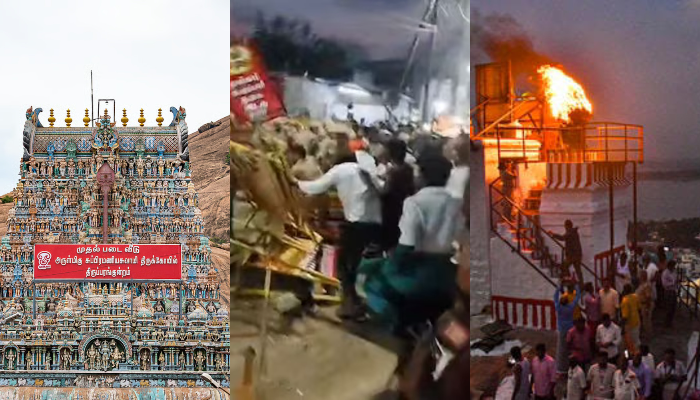

The controversy surrounding the prominent “Thiruparankundram hill” in Tamil Nadu’s Madurai continues unabated, even after the Madras High Court’s decision supporting the Hindus. On 3rd November, a lamp was ignited at the customary Uchipillaiyar temple mandapam against Justice GR Swaminathan’s order to light it at the “Deepathoon,” an ancient stone pillar. Afterward, the action by the temple officials culminated in a brawl between police and Hindu activists.
The ruling Dravida Munnetra Kazhagam (DMK), infamous for its animosity towards Hindus decided to challenge the court’s 1st December directive, in the name of concerns over law and order. The matter escalated as petitioner, Rama Ravikumar, attempted to mount the hill while accompanied by Central Industrial Security Force (CISF) troops, on court’s verdict.
However, the state police headed by Madurai Commissioner J Loganathan intervened and halted them after prohibitory orders were issued by Madurai district collector, claiming public safety and the current law-and-order situation.
Members of the Hindu Munnani organisation alongside other activists gathered in front of the temple and demanded that the lamp be lit in the court-mandated location. Some people tried to get past police barricades. It resulted in jostling and a scuffle, in which a police personnel was hurt. A senior Hindu Munnani leader asserted that temple administration had made “no arrangements whatsoever” to comply with the high court’s judgement.
Notably, the temple’s management had contested the court’s earlier decision, arguing that the move would jeopardise communal harmony. However, Judge Swaminathan responded with a stern instruction that the lamp must be lit by 6 pm or contempt proceedings would commence at 6:05 pm.
DMK flouts court’s order, belittles genuine Hindu beliefs in favour of unfounded Muslim assertions
It is concerning, though not unexpected, for the government to behave in this manner considering the actions of the Hindu-hating Dravidian party. The ruling has already been appealed by the state government and the Hindu Religious and Charitable Endowments Department. Furthermore, the DMK and its allies even asked the district administration not to follow the court order.
“Hindu outfits are attempting to disrupt public unity by instigating religious conflict in a place where people have lived harmoniously, transcending religious differences. There are also indications that these organisations plan to heavily mobilise their members in Tirupparankundram on Dec 3, the day Karthigai Deepam is traditionally lit, posing a risk to law and order,” the statement alleged.
DMK is unreservedly willing to contravene court orders to display its contempt for Hinduism. The judiciary has sided with the Hindus based on facts and evidence, but the government is intended on continuing the distorted narrative of communal harmony because, in their perversed perspective, tolerance and secularism are only preserved at the expense of Hindus and by encroaching on their religious rights.
These values were never compromised when the Democratic Party of India (SDPI), the political wing of the banned Popular Front of India (PFI), attempted to conduct animal slaughter at the revered location referred to as one of the six abodes of Lord Murugan. The same was not under threat when Indian Union Muslim League (IUML) leader and Ramanathapuram MP K. Nawas Kani (IMUL) along with another MLA and supporters ate non-vegetarian biryani at the sacred hill. Kani even announced that the place belonged to the Waqf Board.
Efforts were also underway to rename it as Sikkandar Hills, after the representative of the Sultans of Delhi who governed Madurai, which led to protests from Hindus. The DMK did not perceive these collectively provocative actions as a danger to harmony and peace only because a significant part of Hinduism was being disparaged which the party implicitly endorses. However, all hell breaks loose when Hindus assertively fight for their rights through legal means.
Likewise, the illegal occupation of the Muslims has persisted on the hill even after the high court pronounced it to be a Hindu temple and the DMK government has allowed these violations. The flag bearers of Dravidianism have invariably sided with fraudulent Muslim claims associated with Thiruparankundram hill and consistently opposed authentic Hindu concerns and legitimate rights.
DMK’s repeated disrespect towards Sanatan Dharma
While the DMK conceals itself behind communal harmony or law and order in the recent issue, it has never hesitated to openly express its disdain for Hinduism and its adherents. Chief Minister MK Stalin’s son and “proud Christian” Udhayanidhi Stalin, who serves as the deputy chief minister, has explicitly called for the annihilation of Sanatan Dharma, in 2023.
He had remarked, “Just like dengue, mosquitoes, malaria, or coronavirus need to be eradicated, we have to eradicate Sanatana.” The apex court had also lashed out at him and asked, “You abuse your rights under freedom of speech and expression and right to freedom of religion and then come to Supreme Court for protection under Article 32? Do you not know the consequences of what you said,” during a hearing.
DMK MP A Raja went even further to add that Udayanidhi’s derogatory commnets were mild and Sanatan Dharma should have been likened to HIV and leprosy. Hinduphobic actor and DMK-supported Rajya Sabha MP Kamal Haasan who professed to spread “the word of Christ” similarly articulated his wish to “break the chains” of Sanatan Dharma in August of this year.
“Don’t take anything else in your hands, only education. We cannot win without it, because the majority can make you lose. Majority Fools (Moodargal) will make u lose, knowledge alone will seem defeated. That’s why we must hold on to education firmly,” he insisted.
The DMK has not only targeted Hinduism but has also engaged in actions that demean the religion. The Tamil Nadu government in July formally renamed Waddells Road in Chennai’s Kilpauk to Archbishop Ezra Sargunam Road, in recognition of the late anti-Hindu Christian evangelist and Bishop Ezra Sargunam. The party has even opposed Vedic rituals in the name of upholding “secular credentials” as witnessed during the memorial for former Chief Minister J Jayalalithaa.
Conclusion
People who harbour hatred for Hinduism find a place within the DMK, as the entire party epitomises Hindumisia under the guise of their malicious secularism, venerating the vehement critic of the religion and idolising EV Periyar, while showing deference to Abrahamic faiths, particularly Islam and Christianity.
The repeated confrontations at Thiruparankundram hill are simply a continuation of the same. The DMK government is determined to trample on the rights of Hindus, even if it entails defying court orders ot challenging them. Like all its counterparts in India, the party glosses over its abject disdain for Hindus for the sake of “communal harmony and peace,” which is conveniently overlooked while dealing with even the most fabricated claims by members of minority religions.
The Hindu belief system, its holy places and practices, is sacrificed at this twisted altar without a second thought. This is evident in Tamil Nadu, as it is in every part of the country, time and again, with Hindus repeatedly bearing the burden of minority appeasement and vote bank politics perpetrated by these parties.
Nonetheless, DMK or “secular parties” would never have the audacity to behave in this manner towards Muslims or followers of other faiths, which reveals much about their true intentions and motivations.